• Produktbild: Circularity of Plastics
  • Produktbild: Circularity of Plastics
- 13%

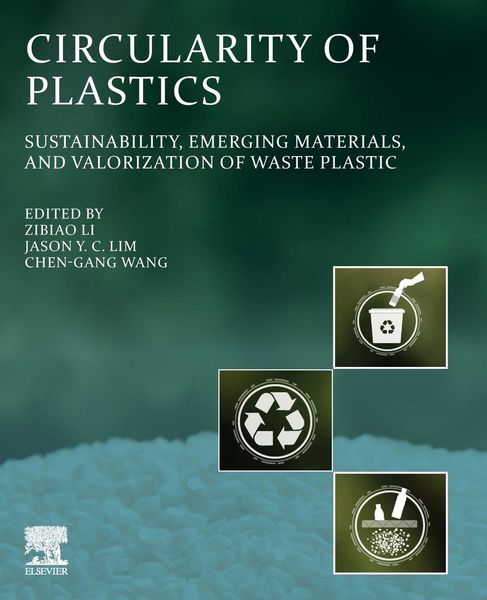
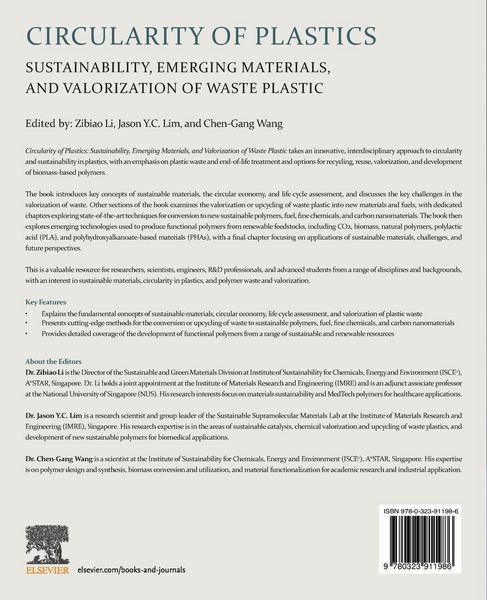
Circularity of Plastics Sustainability, Emerging Materials, and Valorization of Waste Plastic

13% sparen

186,99 € UVP 215,90 €

inkl. gesetzl. MwSt., Versandkostenfrei


Beschreibung

Produktdetails

Einband

Taschenbuch

Erscheinungsdatum

28.02.2023

Abbildungen

150 illustrations (30 in full color)

Herausgeber

Zibiao Li + weitere

Verlag

Elsevier Science & Technology

Seitenzahl

344

Maße (L/B/H)

23,5/19,1/1,8 cm

Gewicht

593 g

Sprache

Englisch

ISBN

978-0-323-91198-6

Beschreibung

Portrait

Dr. Zibiao Li obtained his PhD in Biomedical Engineering from National University of Singapore (NUS). Currently, he is working as a senior research scientist at the Institute of Materials Research and Engineering (IMRE), A*STAR, Singapore. He is currently the Head of Advanced Sustainable Materials Department in IMRE. His research interests are focused on biodegradable functional polymeric materials design, structural properties investigations and their hybrid fabrications for high performance applications in consumer care and healthcare. He has published over 120 journal papers, 2 books, 5 book chapters, 15 technological disclosures / Patents, mainly in the area of biodegradable and sustainable materials.
Dr Jason Y. C. Lim obtained his PhD in Inorganic Chemistry from the University of Oxford, U.K. Thereafter, he obtained a postdoctoral position at the same institute under the supervision of Professor Charlotte K. Williams, working on metal-free organocatalysis for the synthesis of polylactic acid, a leading biopolymer with vast commercial applications in today's world. His current research interests at IMRE, Singapore, include development of novel catalysts to replace toxic heavy-metal catalysts used for polymer synthesis, chemical valorisation and upcycling of waste plastics, development of new sustainable polymers for biomedical applications, as well as ion sensors for agritech nutrient monitoring to reduce over-application of fertilisers. At the time of writing, he has authored/ co-authored 25 peer-reviewed papers in top chemistry and materials science journals.
Dr Chen-Gang Wang obtained his Ph.D. in organic and polymeric materials under the supervision of Professor Toshikazu Takata from Tokyo Institute of Technology, Japan. After working in chemical industry for two years, he moved to Nanyang Technological University as a research fellow in Professor Atsushi Goto's group and promoted to senior research fellow at 2019. His current position is a research scientist in Advanced Sustainable Materials Department in IMRE/A*STAR, Singapore.

His research expertise focuses primarily on polymer science and materials. His current research interests include development of biomass-based polymers and the polymerization methods, design and synthesis of degradable/decomposable polymers, and creation of structurally complex polymer materials for advanced applications. He has (co)authored 23 peer-reviewed papers in top chemistry and materials science journals.

Produktdetails

Einband

Taschenbuch

Erscheinungsdatum

28.02.2023

Abbildungen

150 illustrations (30 in full color)

Herausgeber

Verlag

Elsevier Science & Technology

Seitenzahl

344

Maße (L/B/H)

23,5/19,1/1,8 cm

Gewicht

593 g

Sprache

Englisch

ISBN

978-0-323-91198-6

Herstelleradresse

Libri GmbH
Europaallee 1
36244 Bad Hersfeld
DE

Email: gpsr@libri.de

Noch keine Bewertungen vorhanden

Verfassen Sie die erste Bewertung zu diesem Artikel

Helfen Sie anderen Kundinnen und Kunden durch Ihre Meinung.

Kundinnen und Kunden meinen

Bewertungen (0)

Die Leseprobe wird geladen.
  • Produktbild: Circularity of Plastics
  • Produktbild: Circularity of Plastics
  • 1 Sustainable material management for a circular plastics economy

    SECTION 1 Valorization of waste plastics into new materials and fuels
    2 Sustainable chemical recycling of plastic waste into new polymers
    3 Converting plastic waste to fuel and fine chemicals
    4 Upcycling of waste plastics to carbon nanomaterials

    SECTION 2 Functional polymers from sustainable and renewable resources
    5 Functional polymers from CO2 as feedstock
    6 Functional polymers from biomass-based monomers
    7 New functional materials from lignocellulosic biomass
    8 Poly(lactic acid) (PLA) as a building block for a circular economy
    9 Poly(hydroxyalkanoates) (PHAs) based circular materials for a sustainable future
    10 Sustainable materials applications: Current challenges and future perspectives