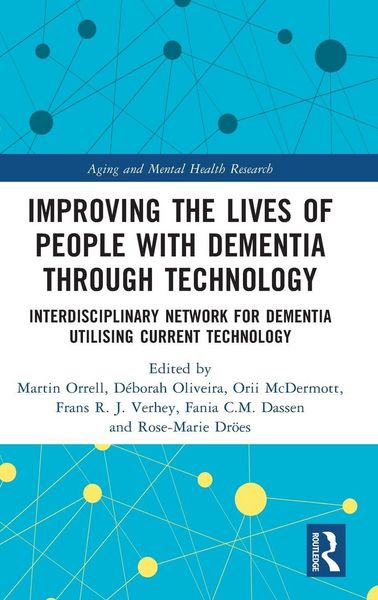

Improving the Lives of People with Dementia through Technology Interdisciplinary Network for Dementia Utilising Current Technology
-
- Hardcover ausgewählt
- Taschenbuch
- eBook
-
Sprache:Englisch
181,99 €
inkl. gesetzl. MwSt.,
Beschreibung
Produktdetails
Einband
Gebundene Ausgabe
Erscheinungsdatum
30.11.2022
Abbildungen
schwarz-weiss Illustrationen, farbige Illustrationen, Raster, farbig, Zeichnungen, schwarz-weiss, Zeichnungen, farbig, Tabellen, schwarz-weiss
Herausgeber
Orrell Martin + weitereVerlag
Taylor & FrancisSeitenzahl
264
Maße (L/B/H)
24/16,1/1,9 cm
Gewicht
500 g
Sprache
Englisch
ISBN
978-1-03-222667-5
This book explores the practical application of recent improvements in technology for people living with dementia and highlights the positive outcomes on care, quality of life, and services on patients through exploration of 15 research projects to redefine the future of dementia care.
Using research compiled in collaboration with leading universities and organisations across Europe, this book demonstrates how INDUCT's (Interdisciplinary Network for Dementia Utilising Current Technology's) findings resulted in implications for practical cognitive and social factors to improve the usability of technology, evaluating the effectiveness of specific contemporary technology, and tracing facilitators and barriers for implementation of technology in dementia care.
Featuring a unique training programme along with a wide range of patient-public involvement, this state-of-the-art volume will be essential reading for researchers, academics and scholars in the fields of dementia and mental health research, gerontology, psychology and nursing.
Noch keine Bewertungen vorhanden
Verfassen Sie die erste Bewertung zu diesem Artikel
Helfen Sie anderen Kundinnen und Kunden durch Ihre Meinung.
Kurze Frage zu unserer Seite
Vielen Dank für Ihr Feedback
Wir nutzen Ihr Feedback, um unsere Produktseiten zu verbessern. Bitte haben Sie Verständnis, dass wir Ihnen keine Rückmeldung geben können. Falls Sie Kontakt mit uns aufnehmen möchten, können Sie sich aber gerne an unseren Kund*innenservice wenden.
zum Kundenservice