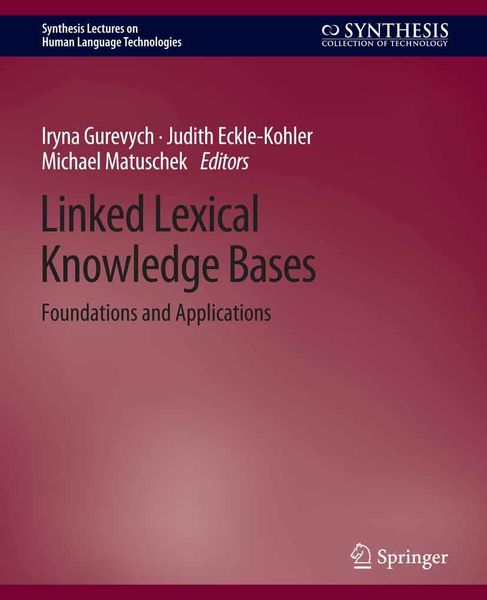
Linked Lexical Knowledge Bases Foundations and Applications
-
- Taschenbuch
- eBook ausgewählt
-
Form:Einzelkauf Download
-
Sprache:Englisch
43,99 €
inkl. gesetzl. MwSt.Beschreibung
Produktdetails
Format
Kopierschutz
Nein
Family Sharing
Nein
Text-to-Speech
Nein
Erscheinungsdatum
01.06.2022
Verlag
SpringerSeitenzahl
124 (Printausgabe)
Dateigröße
1755 KB
Sprache
Englisch
EAN
9783031021626
This book conveys the fundamentals of Linked Lexical Knowledge Bases (LLKB) and sheds light on their different aspects from various perspectives, focusing on their construction and use in natural language processing (NLP). It characterizes a wide range of both expert-based and collaboratively constructed lexical knowledge bases. Only basic familiarity with NLP is required and this book has been written for both students and researchers in NLP and related fields who are interested in knowledge-based approaches to language analysis and their applications.
Lexical Knowledge Bases (LKBs) are indispensable in many areas of natural language processing, as they encode human knowledge of language in machine readable form, and as such, they are required as a reference when machines attempt to interpret natural language in accordance with human perception. In recent years, numerous research efforts have led to the insight that to make the best use of available knowledge, the orchestrated exploitation of different LKBs is necessary. This allows us to not only extend the range of covered words and senses, but also gives us the opportunity to obtain a richer knowledge representation when a particular meaning of a word is covered in more than one resource. Examples where such an orchestrated usage of LKBs proved beneficial include word sense disambiguation, semantic role labeling, semantic parsing, and text classification.
This book presents different kinds of automatic, manual, and collaborative linkings between LKBs. A special chapter is devoted to the linking algorithms employing text-based, graph-based, and joint modeling methods. Following this, it presents a set of higher-level NLP tasks and algorithms, effectively utilizing the knowledge in LLKBs. Among them, you will find advanced methods, e.g., distant supervision, or continuous vector space models of knowledge bases (KB), that have become widely used at the time of this book's writing. Finally, multilingual applications of LLKB's, such as cross-lingual semantic relatedness and computer-aided translation are discussed, as well as tools and interfaces for exploring LLKBs, followed by conclusions and future research directions.
Noch keine Bewertungen vorhanden
Verfassen Sie die erste Bewertung zu diesem Artikel
Helfen Sie anderen Kundinnen und Kunden durch Ihre Meinung.
Kurze Frage zu unserer Seite
Vielen Dank für Ihr Feedback
Wir nutzen Ihr Feedback, um unsere Produktseiten zu verbessern. Bitte haben Sie Verständnis, dass wir Ihnen keine Rückmeldung geben können. Falls Sie Kontakt mit uns aufnehmen möchten, können Sie sich aber gerne an unseren Kund*innenservice wenden.
zum Kundenservice