Gutscheinbedingungen

**Gültig bis 06.07.2026 auf fremdsprachige Bücher online auf thalia.at, in der Thalia App ab einem Mindestbestellwert von 30€ und in allen Thalia Buchhandlungen in Österreich. In den Buchhandlungen nur gültig auf lagernde Ware. Einzelne Artikel können ausgeschlossen sein. Ausgenommen sind preisgebundene Artikel & eBooks. Pro Einkauf einmal einlösbar. Nur gültig gegen Vorlage oder im Onlineshop hinterlegter Bonuscard. Infos zur Einlösung in der Buchhandlung sind auf der Bonuscard-Vorteilspreisseite zu finden. Click & Collect nur bei Onlinevorabzahlung möglich. Keine Einlösung bei Scan & Go-Bezahlung. Keine Barauszahlung. Nicht kombinierbar mit anderen Aktionen und Gutscheinen. Gutschein wird auf max. 500€ Bestellwert angerechnet. Nicht gültig für Versandkosten und Services.

  • Produktbild: Policing the Global South
  • Produktbild: Policing the Global South

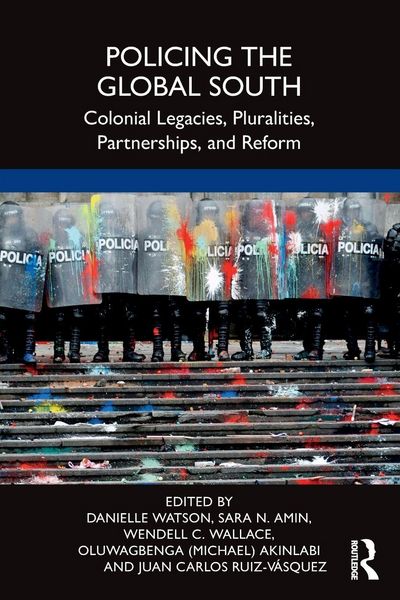
Policing the Global South Colonial Legacies, Pluralities, Partnerships, and Reform

54,99 €

inkl. gesetzl. MwSt., Versandkostenfrei


Beschreibung

Produktdetails

Einband

Taschenbuch

Erscheinungsdatum

11.11.2022

Abbildungen

schwarz-weiss Illustrationen, Raster, schwarz-weiss, Zeichnungen, schwarz-weiss, Tabellen, schwarz-weiss

Herausgeber

Danielle Watson + weitere

Verlag

Taylor & Francis

Seitenzahl

416

Maße (L/B/H)

23,4/15,6/2,2 cm

Gewicht

700 g

Sprache

Englisch

ISBN

978-0-367-64811-4

Beschreibung

Rezension

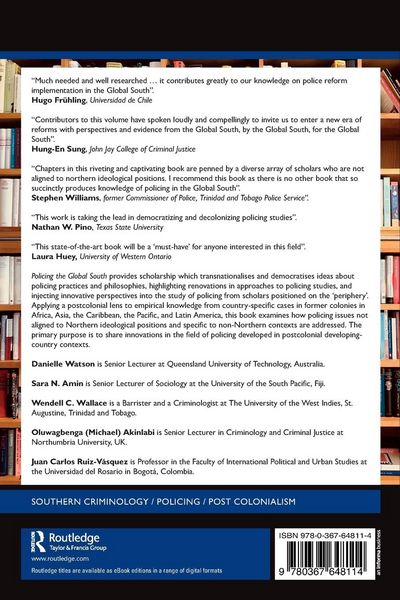
"This is a much needed and well researched addition to the literature on policing focused on how social and political context in the South create spaces and limitations for innovative police reforms. It contributes greatly to our knowledge on police reform implementation in the Global South."

-Hugo Frühling, Professor of Public Affairs, Institute of Public Affairs Universidad de Chile

"We have been exporting conceptual frameworks and operational models to address security and justice problems in Africa, Asia, Latin America, and Oceania. Good-hearted bilateral and multilateral donors have acted like international travelers unaware of the voltage differences across countries, leaving behind a trail of short-circuited reforms. This volume is an antidote to that benevolent naivete. Contributors of this volume have spoken loudly and compellingly to invite us to enter a new era of reforms with perspectives and evidence from the Global South, by the Global South, for the Global South. No serious comparative police scholars can afford missing their voices."

-Hung-En Sung, Professor of Criminal Justice, John Jay College of Criminal Justice

"If you desire knowledge about policing in the Global South, 'Policing the Global South' is the book for you as it provides a wealth of information on policing issues in non-northern contexts. Chapters in this riveting and captivating book are penned by a diverse array of scholars who are not aligned to northern ideological positions. I recommend this book as there is no other book that so succinctly produces knowledge of policing in the Global South as this book does."

-Stephen Williams, former Commissioner of Police, Trinidad and Tobago Police Service.

"With its wide range of research interests in the areas of police history, of colonial history, of gender, policing and security, Policing the Global South, offers scholars of this genre and of postcolonial and transitional societies an invaluable addition on policing. By decentering the Western's notion of itself, this book offers a unique collection of case-studies; ranging from policing in postcolonial South Asia and community policing in Sub -Saharan Africa, to gender and security in East Asia and to the more recent drug misuse and crime prevention in Latin America. In so doing, this book diverts attention away from the master narratives, its associated 'exceptionalism' and reductive reasoning to provide a more compelling argument on 'policing' as an interplay between agency, social order, and politics constituted by and within independent nation states. Focusing explicitly on its own identity and destiny, and reaching towards a new temporality, this collection provides a much needed resource on global policing which will guide and inspire many in the field and beyond."

-Dr Preeti Nijhar is an Independent Scholar, Scholar and author of Community Policing: National and International Models and Approaches (2000) and Law and Imperialism: Criminality and Constitution in Colonial India and Victorian England (Empires in Perspective) (2009).

"This work is an important and necessary reference for scholars interested in developing contextually appropriate responses to policing issues. It advances criminological knowledge on policing in the global South by compiling innovative post-colonial studies by Southern researchers that challenge Northern perspectives, ideologies, and assumptions that have failed to transform policing. The editors consciously included contributions of researchers rooted and situated in different parts of the global South that examine policing issues in their appropriate historical, ideological, and social contexts. As a result, this collection is taking the lead in democratizing and decolonizing policing studies."

-Nathan W. Pino, Professor of Sociology and Honorary Professor of International Studies, Texas State University

"The 21st century is an age of uncertainty and context specific evidence concerning policing in the Global South provides some of the most important theoretical insights. This collection brings together a wealth of data and thoughtful analysis and will be a vital resource for coming to terms with policing and the global system."

-James Sheptycki, Professor of Criminology, York University, Toronto, Canada

"Security represents a public good to which all citizens have - in theory - an inalienable right. However, when it comes to the provision of security 'on the ground', the reality often proves much more complex. In this comprehensive volume of new and emergent research, scholars from across the globe provide fresh opportunities to explore and engage with various aspects of the 'messy' realities of security provision in different contexts. This state-of-the-art book will be a 'must-have' for anyone interested in this field."

-Laura Huey, Professor of Sociology at the University of Western Ontario and Editor, Police Practice and Research.

Produktdetails

Einband

Taschenbuch

Erscheinungsdatum

11.11.2022

Abbildungen

schwarz-weiss Illustrationen, Raster, schwarz-weiss, Zeichnungen, schwarz-weiss, Tabellen, schwarz-weiss

Herausgeber

Verlag

Taylor & Francis

Seitenzahl

416

Maße (L/B/H)

23,4/15,6/2,2 cm

Gewicht

700 g

Sprache

Englisch

ISBN

978-0-367-64811-4

Herstelleradresse

Libri GmbH
Europaallee 1
36244 Bad Hersfeld
DE

Email: gpsr@libri.de

Noch keine Bewertungen vorhanden

Verfassen Sie die erste Bewertung zu diesem Artikel

Helfen Sie anderen Kundinnen und Kunden durch Ihre Meinung.

Kundinnen und Kunden meinen

Bewertungen (0)

Die Leseprobe wird geladen.
  • Produktbild: Policing the Global South
  • Produktbild: Policing the Global South
  • Introduction

    Chapter 1- Policing the Global South-- colonial legacies, pluralities, partnerships and reform

    Part 1 – Acknowledging colonial legacies and their impact on policing

    Chapter 2- Bringing empire back in: Unaccountable public violence, sovereignty and the rule of difference in Latin America

    Chapter 3- Post-coloniality as lenses that reveal day-to-day police practices in Brazil and Mexico

    Chapter 4- Modalities of policing in contemporary Brazil

    Chapter 5- ‘VIP Culture’ and the provision of policing and security in postcolonial Karachi

    Chapter 6- From Barefoot Policeman to Policeman as President: An Overview of the Institutional Development of the Colombian Police Force

    Part 2: Navigating plural regulatory systems and policing partnerships

    Chapter 7- Serving God, the Community and the State: Policing in Tuvalu

    Chapter 8- Police, Private Security, and "Patitos": The Market for Security in Mexico City

    Chapter 9- Plural Policing in Crisis: Inclusive security provision in violent and unequal societies

    Chapter 10- Balancing the scale: Police officers’ perspectives on plural policing in the Solomon Islands

    Part 3 – Access to justice, community perceptions and police legitimacy

    Chapter 11- Institutional Effectiveness, Access to Justice and the Governance of Women Police Stations in West Bengal

    Chapter 12- Unfulfilled Potential: Women Police Stations in Pakistan

    Chapter 13- Proactive or Predatory: Citizen perceptions of the Zimbabwe state police

    Chapter 14- Challenges of Police Prosecution in the Global South: Perspectives of Ghanaian Police Officers

    Chapter 15- An Integrative Assessment of Normative Expectations, Treatment Outcome, Procedural Justice, and Public Satisfaction with the Police in the Global South

    Part 4 – Organisational reform, crime prevention and community partnerships

    Chapter 16- From fear to cooperation: The critical role of community policing in building trust in the postcolonial state of Pakistan

    Chapter 17- Feeling black and blue: indigenous police liaison officers in Torres Strait region

    Chapter 18- ‘Police are the public and the public are the police’: Community policing and countering violent extremism (CVE) in Bangladesh

    Chapter 19- The Global South and crime prevention through social development: Evidence from Trinidad and Tobago

    Chapter 20- The Effectiveness of the British Models of Community Policing in Fiji

    Chapter 21- From social promise to social fad: The evolution of community policing on

    the Caribbean Island of Dominica

    Part 5 – The expanding roles of police organisations

    Chapter 22- Policing Human Trafficking and Commercial Sex in Kiribati

    Chapter 23- Policing and Technology in the Contemporary Caribbean

    Chapter 24- Policing Wildlife Crimes: A historical analysis of the development and impact of wildlife ranger units in Sub-Saharan Africa

    Chapter 25- Criminalization of Moral Hazard during Covid-19 Crisis: The study of Thailand under emergency decree 2020-2021

    Conclusion

    Chapter 26- Continuity and change in policing the Global South