KI-Beratung Beta

Gutscheinbedingungen

**Gültig bis 18.11.2026 auf englischsprachige Klassiker (klassiker-32728) online auf thalia.at und in der Thalia App. Einzelne Artikel können ausgeschlossen sein. Ausgenommen sind preisgebundene Artikel & eBooks. Pro Einkauf einmal einlösbar. Click & Collect nur bei Onlinevorabzahlung möglich. Keine Barauszahlung. Nicht kombinierbar mit anderen Aktionen und Gutscheinen. Gutschein wird auf max. 500€ Bestellwert angerechnet. Nicht gültig für Geschenkkarten, Versandkosten und Services.

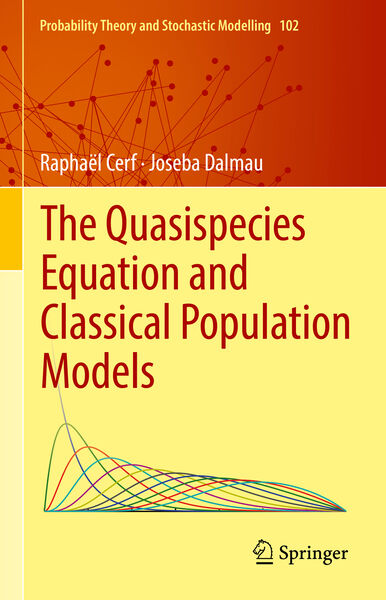
  • Produktbild: The Quasispecies Equation and Classical Population Models
  • Produktbild: The Quasispecies Equation and Classical Population Models
Band 102 - 12%

The Quasispecies Equation and Classical Population Models

12% sparen

134,99 € UVP 153,99 €

inkl. gesetzl. MwSt., Versandkostenfrei


Beschreibung

This monograph studies a series of mathematical models of the evolution of a population under mutation and selection. Its starting point is the quasispecies equation, a general non-linear equation which describes the mutation-selection equilibrium in Manfred Eigen’s famous quasispecies model. A detailed...

Beschreibung

This monograph studies a series of mathematical models of the evolution of a population under mutation and selection. Its starting point is the quasispecies equation, a general non-linear equation which describes the mutation-selection equilibrium in Manfred Eigen’s famous quasispecies model. A detailed analysis of this equation is given under the assumptions of finite genotype space, sharp peak landscape, and class-dependent fitness landscapes. Different probabilistic representation formulae are derived for its solution, involving classical combinatorial quantities like Stirling and Euler numbers.

It is shown how quasispecies and error threshold phenomena emerge in finite population models, and full mathematical proofs are provided in the case of the Wright–Fisher model. Along the way, exact formulas are obtained for the quasispecies distribution in the long chain regime, on the sharp peak landscape and on class-dependent fitness landscapes.

Finally, several other classical population models are analyzed, with a focus on their dynamical behavior and their links to the quasispecies equation. 

This book will be of interest to mathematicians and theoretical ecologists/biologists working with finite population models.


Rezension

“This book is a welcome and timely addition to the existing literature on rigorous mathematical analysis of various genetics models, with a special focus on a careful understanding of the impact of stochastic effects. The book is written with the potential reader in mind, such that it is a real pleasure to read. It should be interesting to anyone working at the interface of mathematics and population genetics.” (Artem S. Novozhilov, Mathematical Reviews, August, 2023)
“The text is written in an easy-to-read style and is suitable for use in various courses, including probability theory, Markov chains, mathematical ecology and population dynamics. The book can be expected to provide several ideas for further investigation of finite population models.” (Attila Dénes, zbMATH 1507.92072, 2023)

Produktdetails

Einband

Gebundene Ausgabe

Erscheinungsdatum

31.07.2022

Abbildungen

X, 242 p. 1 illus.

Verlag Springer

Produktdetails

Einband

Gebundene Ausgabe

Erscheinungsdatum

31.07.2022

Abbildungen

X, 242 p. 1 illus.

Verlag Springer
Seitenzahl

242

Maße (L/B/H)

24,1/16/2 cm

Gewicht

495 g

Auflage

22001 Auflage 1st edition 2022

Sprache

Englisch

ISBN

978-3-031-08662-5

Herstelleradresse

Springer-Verlag GmbH
Europaplatz 3
69115 Heidelberg
DE

Email: ProductSafety@springernature.com

Noch keine Bewertungen vorhanden

Verfassen Sie die erste Bewertung zu diesem Artikel

Helfen Sie anderen Kundinnen und Kunden durch Ihre Meinung.

Kundinnen und Kunden meinen

Bewertungen (0)

  • Produktbild: The Quasispecies Equation and Classical Population Models
  • Produktbild: The Quasispecies Equation and Classical Population Models
  • 1. Introduction.- Part I.Finite Genotype Space.- 2. The Quasispecies equation.- 3. Non-Overlapping Generations.- 4. Overlapping Generations.- 5. Probabilistic Representations.- Part II. The Sharp Peak Landscape.- 6. Long Chain Regime.- 7. Error Threshold and Quasispecies.- 8. Probabilistic Derivation.- 9. Summation of the Series.- 10. Error Threshold in Infinite Populations.- Part III. Error Threshold in Finite Populations.- 11.Phase Transition.- 12. Computer Simulations.- 13. Heuristics.- 14. Shape of the Critical Curve.- 15. Framework for the Proofs.- Part IV. Proof for Wright-Fisher.- 16. Strategy of the Proof.- 17. The Non-Neutral Phase M.- 18. Mutation Dynamics.- 19. The Neutral Phase N.- 20. Synthesis.- Part V. Class-Dependent Fitness Landscapes.- 21. Generalized Quasispecies Distributions.- 22. Error Threshold.- 23. Probabilistic Representation.- 24. Probabilistic Interpretations.- 25. Infinite Population Models.- Part VI. A Glimpse at the Dynamics.- 26. Deterministic Level.- 27. From Finite to Infinite Population.- 28. Class-Dependent Landscapes.- A. Markov Chains and Classical Results.- References.- Index.