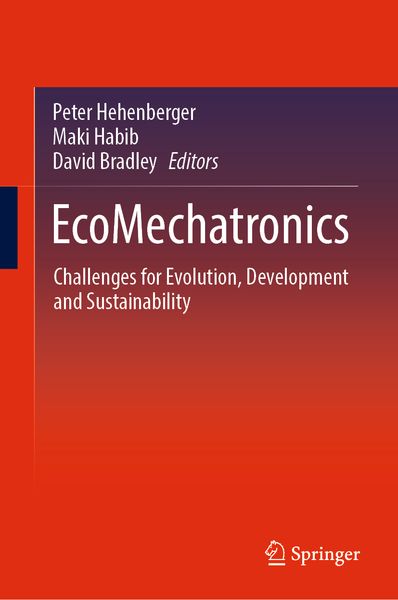
Produktbild: EcoMechatronics
- 12%

EcoMechatronics Challenges for Evolution, Development and Sustainability

12% sparen

163,99 € UVP 186,99 €

inkl. gesetzl. MwSt., Versandkostenfrei


Beschreibung

Produktdetails

Einband

Gebundene Ausgabe

Erscheinungsdatum

23.11.2022

Herausgeber

Peter Hehenberger + weitere

Verlag

Springer

Seitenzahl

366

Maße (L/B/H)

24,1/16/2,6 cm

Gewicht

830 g

Auflage

1st ed. 2022

Sprache

Englisch

ISBN

978-3-031-07554-4

Beschreibung

Portrait

Dr Peter Hehenberger is Professor for Integrated Product Development, Head of the “Smart Mechatronics Engineering” Research Group and Academic Director of the “Institute for Agile Transformation” at the School of Engineering, University of Applied Sciences Upper Austria, Wels/Austria.

Core research interests cover “Sustainability in Development and Production of Mechatronic Systems” and “Engineering Processes” along with topics on “Digital Transformation”.

He has published over 140 peer-reviewed papers in international journals and conference proceedings and been guest editor for three journal special issues. In addition, he has authored or co-authored six books related to his research field.

He has practical experience with industry and design projects and has been a key researcher and manager of several successful national and international research projects.

Dr Hehenberger is active in the research community where he is refers to his researcharea of “Mechatronic Design” as group member of IFIP WG5.1 “Global Product development for the whole life-cycle”, IFAC TC 4.2 “Mechatronic Systems” and SAE SETC “Small Powertrains and Energy Systems Technology Conference Technical Board”.

Professor Maki Habib specialises in Robotics and Mechatronics having obtained his Ph.D. in Intelligent and Autonomous Robotics from the University of Tsukuba, Japan, he was a research scientist at RIKEN, Japan, a senior researcher at RISO-Laboratories, Japan, and visiting researcher at EPFL, Switzerland. He has also been a Visiting Expert at the Asian Development Bank (ADB) serving the Malaysian industry, an Associate Professor at UTM, Malaysia, and a Senior Manager at MCRIA, Malaysia. He was a leading senior research scientist with GMD-Japan where he led the Telecooperation Research Group and an Associate Professor with Monash University (Australia/Malaysia) to develop and lead the Mechatronics Engineering program. He was appointed as a Full Professor of Robotics and Mechatronics at Swinburne University (Australia/Malaysia) an invited Professor at KAIST, South Korea, and a Resident Professor at Saga University, Japan. Since Sept. 2007, he has been a Full Professor of Robotics and Mechatronics at the American Univerity Cairo.

He was and continues to be, a consultant and technical advisor to many international industrial companies and research consortiums, such as Toyota and ABB. He also has research collaborations with many international research groups associated with research centers and universities.

His current main areas of research include:

Robotics for Humanitarian Demining Use; Autonomous Electric Vehicles; Nanorobotics for Biomedical Purposes; Robots for the Physically Impaired using Biological Signals (such as EEG and EMG); Industry 4.0, Internet of Things (IoT), and CPSs; EcoMechatronics and Bioinspired Design; Intelligent Drone Systems; Robotics and Industrial Automation; Telecooperation, Distributed Mixed Realities, and Collaborative Control.

David Bradley is Professor Emeritus at Abertay University in the UK having previously been at Lancaster University & Bangor University. He has had extensive experience of the design and implementation of mechatronic systems with applications ranging from the construction industry to energy systems, manufacturing, prosthetics and healthcare, including issues such as privacy and system integration. He is the author or co-author or contributing editor of 8 books, five of which have mechatronics as their main area, along with over 50 journal and papers and 130 plus conference papers. He has acted as a consultant on mechatronics course design in Singapore, South Africa and Colombia and has lectured on mechatronics at institutions in the US, Europe, South Africa and Asia. He was a co-founder of the Mechatronics Forum conference series and has been a keynote speaker at conferences in Europe and elsewhere. He remains activein the field of mechatronics research as well as acting as a consultant/adviser to several research groups working on mechatronics related projects.

Produktdetails

Einband

Gebundene Ausgabe

Erscheinungsdatum

23.11.2022

Herausgeber

Verlag

Springer

Seitenzahl

366

Maße (L/B/H)

24,1/16/2,6 cm

Gewicht

830 g

Auflage

1st ed. 2022

Sprache

Englisch

ISBN

978-3-031-07554-4

Herstelleradresse

Springer-Verlag KG
Sachsenplatz 4-6
1201 Wien
AT

Email: GPSR Kontakt

Noch keine Bewertungen vorhanden

Verfassen Sie die erste Bewertung zu diesem Artikel

Helfen Sie anderen Kundinnen und Kunden durch Ihre Meinung.

Kundinnen und Kunden meinen

Bewertungen (0)

  • Produktbild: EcoMechatronics
  • EcoMechatronics: Concepts, Objectives, and Outcomes.- Re-Envisioning Innovation for Sustainability.- Mechatronic applications in Respect of Sustainability & Climate Change.- EcoMechatronics and Bioinspired Design: Ecology, Circular Economy and Sustainability.- A Holistic and Sustainable View on the Product Creation Process for Mechatronic Systems.- Applied Sensor Technologies.- MBSE for Mechatronic Systems Design with Human, Energetic, Cyber and Physical Aspects.- Concurrent Multi-domain Modelling and Simulation for Energy-efficient Mechatronic Systems.- Artificial Intelligence, Ethics & Privacy.- Mechatronic Applications in Rail Systems and Technologies.- Sustainable Mechatronic Solution for Agricultural Precision Farming Inspired by Space Robotics Technologies.- The Achievement of Sustainability in the Built Environment.- Eco-design of Hydropower Device in River.- Micro/Nano Positioning Systems with Piezoelectric Actuators and Their Role on Sustainability and Ecosystem.- Energy Saving in Industrial Mechatronic Systems Through Optimal Motion Planning.- Minimisation of C02 Footprint of Hybrid Propulsion Systems for Mobility and Power Tool Applications.- Developing Education in Mechatronics to Support the Challenges for Evolution, Development and Sustainability.- Education and Simulation for Electric and Mechatronic Systems in Renewable Energy.- Robot-Assisted Teaching – The Future of Education?.- EcoMechatronics: Enabling Technologies, and Future Prospects.