KI-Beratung Beta

Gutscheinbedingungen

**Gültig bis 18.11.2026 auf englischsprachige Klassiker (klassiker-32728) online auf thalia.at und in der Thalia App. Einzelne Artikel können ausgeschlossen sein. Ausgenommen sind preisgebundene Artikel & eBooks. Pro Einkauf einmal einlösbar. Click & Collect nur bei Onlinevorabzahlung möglich. Keine Barauszahlung. Nicht kombinierbar mit anderen Aktionen und Gutscheinen. Gutschein wird auf max. 500€ Bestellwert angerechnet. Nicht gültig für Geschenkkarten, Versandkosten und Services.

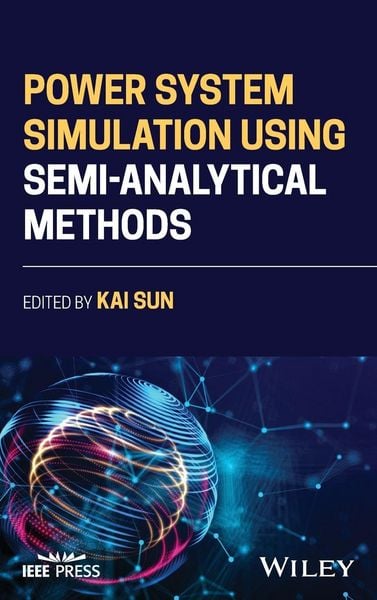
  • Produktbild: Power System Simulation Using Semi-Analytical Methods
  • Produktbild: Power System Simulation Using Semi-Analytical Methods

Power System Simulation Using Semi-Analytical Methods

122,99 €

inkl. gesetzl. MwSt., Versandkostenfrei


Beschreibung

POWER SYSTEM SIMULATION USING SEMI-ANALYTICAL METHODS

Robust coverage of semi-analytical and traditional numerical methods for power system simulation

In Power System Simulation Using Semi-Analytical Methods, distinguished researcher Dr. Kai Sun delivers a comprehensive treatment of semi-analytical simulation...

Beschreibung

POWER SYSTEM SIMULATION USING SEMI-ANALYTICAL METHODS

Robust coverage of semi-analytical and traditional numerical methods for power system simulation

In Power System Simulation Using Semi-Analytical Methods, distinguished researcher Dr. Kai Sun delivers a comprehensive treatment of semi-analytical simulation and current semi-analytical methods for power systems. The book presents semi-analytical solutions on power system dynamics via mathematical tools, and covers parallel contingency analysis and simulations. The book offers an overview of power system simulation and contingency analysis supported by data, tables, illustrations, and case studies on realistic power systems and experiments.

Readers will find open-source code in MATLAB along with examples for key algorithms introduced in the book. You'll also find:

  • A thorough background on power system simulation, including models, numerical solution methods, and semi-analytical solution methods
  • Comprehensive explorations of semi-analytical power system simulation via a variety of mathematical methods such as the Adomian decomposition, differential transformation, homotopy analysis and holomorphic embedding methods
  • Practical discussions of semi-analytical simulations for realistic large-scale power grids
  • Fulsome treatments of parallel power system simulation

Perfect for power engineers and applied mathematicians with an interest in high-performance simulation of power systems and other large-scale network systems, Power System Simulation Using Semi-Analytical Methods will also benefit researchers and postgraduate students studying power system engineering.

Produktdetails

Einband

Gebundene Ausgabe

Erscheinungsdatum

26.09.2023

Herausgeber Kai Sun
Verlag John Wiley & Sons Inc

Produktdetails

Einband

Gebundene Ausgabe

Erscheinungsdatum

26.09.2023

Herausgeber Kai Sun
Verlag John Wiley & Sons Inc
Seitenzahl

368

Maße (L/B/H)

23,4/16/2,7 cm

Gewicht

646 g

Auflage

1. Auflage

Sprache

Englisch

ISBN

978-1-119-98801-4

Herstelleradresse

Libri GmbH
Europaallee 1
36244 Bad Hersfeld
DE

Email: gpsr@libri.de

Noch keine Bewertungen vorhanden

Verfassen Sie die erste Bewertung zu diesem Artikel

Helfen Sie anderen Kundinnen und Kunden durch Ihre Meinung.

Kundinnen und Kunden meinen

Bewertungen (0)

Die Leseprobe wird geladen.
  • Produktbild: Power System Simulation Using Semi-Analytical Methods
  • Produktbild: Power System Simulation Using Semi-Analytical Methods
  • About the Editor xiii

    List of Contributors xv

    Preface xvii

    1 Power System Simulation: From Numerical to Semi-Analytical 1
    Kai Sun

    1.1 Timescales of Simulation 1

    1.2 Power System Models 3

    1.2.1 Overview 3

    1.2.1.1 Simplifying a Power System Model 3

    1.2.1.2 A Practical Power System Model 4

    1.2.2 Generator Models 5

    1.2.2.1 Sixth-Order Model 6

    1.2.2.2 Fourth-Order Model 7

    1.2.2.3 Second-Order Model 9

    1.2.3 Controller Models 9

    1.2.3.1 Governor and Turbine Models 9

    1.2.3.2 Excitation System Model 12

    1.2.3.3 Power System Stabilizer 14

    1.2.4 Load Models 14

    1.2.4.1 Composite Load Model 15

    1.2.4.2 ZIP Load Model 15

    1.2.4.3 Motor Load Model 17

    1.2.5 Network Model 17

    1.2.6 Classical Power System Model 18

    1.3 Numerical Simulation 20

    1.3.1 Explicit Integration Methods 21

    1.3.1.1 Forward Euler Method 22

    1.3.1.2 Modified Euler Method 22

    1.3.1.3 Runge-Kutta Methods 23

    1.3.2 Implicit Integration Methods 24

    1.3.2.1 Stiffness of ODEs 24

    1.3.2.2 Backward Euler Method 26

    1.3.2.3 Trapezoidal-Rule Method 26

    1.3.2.4 Comparison with Explicit Methods 28

    1.3.3 Solving Differential-Algebraic Equations 28

    1.3.3.1 Partitioned Solution Approach 28

    1.3.3.2 Simultaneous Solution Approach 29

    1.4 Semi-Analytical Simulation 30

    1.4.1 Drawbacks with Numerical Simulations 30

    1.4.2 Emerging Methods for Semi-Analytical Power System Simulation 31

    1.4.3 Approaches to Semi-Analytical Solutions 33

    1.4.3.1 Analytical Expansion Approach 33

    1.4.3.2 Analytical Homotopy Approach 35

    1.4.4 Forms of Semi-Analytical Solutions 40

    1.4.4.1 Power Series Form 40

    1.4.4.2 Other Series Forms 40

    1.4.4.3 Fractional Forms 41

    1.4.5 Schemes on Semi-Analytical Power System Simulation 41

    1.5 Parallel Power System Simulation 43

    1.5.1 Parallelization in Space 44

    1.5.1.1 Natural Decoupling 44

    1.5.1.2 Network Partitioning 44

    1.5.2 Parallelization in Time 45

    1.5.3 Parallelization of Semi-Analytical Solutions 48

    1.6 Final Remark 48

    References 49

    2 Power System Simulation Using Power Series-Based Semi-Analytical Methods 53
    Bin Wang

    2.1 Power Series-Based SAS for Simulating Power System ODEs 53

    2.1.1 Power Series-Based SAS for ODEs 53

    2.1.2 SAS-Based Fault-On Trajectory Simulation and Its Application in Direct Methods 56

    2.1.2.1 SAS-Based Simulation of Fault-On Trajectories 56

    2.1.2.2 Application of SAS in Direct Methods 60

    2.2 Power Series-Based SAS for Simulating Power System DAEs 63

    2.2.1 Power Series-Based SAS for Power System DAEs 63

    2.2.2 SAS-Based Simulation of Power System DAEs 66

    2.3 Adaptive Time-Stepping Method for SAS-Based Simulation 69

    2.3.1 Error-Rate Upper Bound 69

    2.3.2 Adaptive Time-Stepping for SAS-Based Simulation 70

    2.4 Numerical Examples 72

    2.4.1 SAS vs. RK4 and BDF 72

    2.4.2 SAS Derivation 74

    2.4.3 Application of SAS-Based Simulation on Polish 2383-Bus Power System 75

    References 78

    3 Power System Simulation Using Differential Transformation Method 81
    Yang Liu and Kai Sun

    3.1 Introduction to Differential Transformation 81

    3.2 Solving the Ordinary Differential Equation Model 85

    3.2.1 Derivation Process 85

    3.2.1.1 Governor Model 85

    3.2.1.2 Turbine Model 86

    3.2.1.3 Power System Stablizer Model 86

    3.2.1.4 Synchronous Machine Model 86

    3.2.1.5 Exciter Model 88

    3.2.2 Solution Algorithm 89

    3.2.3 Case Study 91

    3.2.3.1 Scanning Contingencies 92

    3.2.3.2 Numerical Stability 94

    3.2.3.3 Accuracy and Time Performance 98

    3.3 Solving the Different