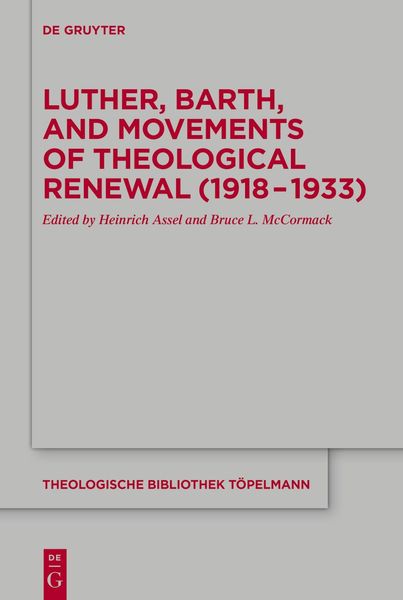
Luther, Barth, and Movements of Theological Renewal (1918-1933)
-
- Taschenbuch ausgewählt
- eBook
-
Sprache:Englisch
23,99 €
UVP
29,95 €
inkl. gesetzl. MwSt.,
- Kostenlose Lieferung ab 30 € Einkaufswert
- Versandkostenfrei für Bonuscard-Kund*innen
Beschreibung
Produktdetails
Einband
Taschenbuch
Erscheinungsdatum
18.07.2022
Herausgeber
Heinrich Assel + weitereVerlag
De GruyterSeitenzahl
278
Maße (L/B/H)
23/15,5/2 cm
Gewicht
472 g
Auflage
1
Sprache
Englisch
ISBN
978-3-11-099155-0
The essays contained in this book originated as lectures at an international conference held in Princeton organized by Christine Helmer (Northwestern) and the editors of this book.
This book itself illuminates in a fresh way the formation, cross-fertilization, break-up, and re-organization of movements of theological renewal during the tumultuous years of the Weimar Republic. Three Protestant movements, in particular, demand our attention: the dialectical theology (Karl Barth, Friedrich Gogarten, Rudolf Bultmann); the Luther Renaissance which found adherents amongst the students of Karl Holl (Hans Joachim Iwand, Rudolf Herrmann and Emmanuel Hirsch) and Lutheran confessional movement (Werner Elert and Paul Althaus). Attention is also given to Bultmann’s close conversation-partner Martin Heidegger. Rounding out the picture thus drawn is Martin Buber, representing the Jewish Renaissance that flourished briefly in the Weimar years.
The goal of this book is twofold: to trace the most significant developments that occurred within and across these movements and, most importantly, to assess the uses made of Luther’s theology in all phases of these developments and in relation to dramatically different sets of issues (ranging from the doctrines of revelation, reconciliation and sin to theories of the state). We find Luther at the heart of a number of debates. So important was he that the divergences between and within the various movements can rightly be seen as a dispute over his legacy.
Most of the theologians and philosophers treated in this book were educated in the pre-war years - and some at least of what they learned survived in a transfigured form the impact of the collapse of the Wilhelminian Empire. That is especially clear in the impact of the Jeiwsh philosopher of religion Hermann Cohen on K. Barth, R. Bultmann, and R. Hermann.
During the years of peace (prior to the stock market crash in 1929), divergences could be accepted with some degree of equanimity by most of those engaged in renewal. To be sure, tensions already existed which could, at any time, have led to splits within the dialectical theology most especially - but did not have to do so. The commentary of R. Bultmann on F. Gogarten’s Ich glaube an den dreieinigen Gott , which is published for the first time in this volume, gives vivid expression to these latent tendencies. For the time being, however, a spirit of cooperation and rigorous academic engagement prevailed. That changed with the onset of the Great Depression. After the national election held on 14 September1930 (which saw the National Socialists become the second largest party in the Reichstag , the fortunes of all movements were increasingly held hostage to the uses made of theology to devise theological accounts of the state which stood in differing degrees of support or open resistance to government policy. The result was a realignment of forces within church and theology
Noch keine Bewertungen vorhanden
Verfassen Sie die erste Bewertung zu diesem Artikel
Helfen Sie anderen Kundinnen und Kunden durch Ihre Meinung.
Kurze Frage zu unserer Seite
Vielen Dank für Ihr Feedback
Wir nutzen Ihr Feedback, um unsere Produktseiten zu verbessern. Bitte haben Sie Verständnis, dass wir Ihnen keine Rückmeldung geben können. Falls Sie Kontakt mit uns aufnehmen möchten, können Sie sich aber gerne an unseren Kund*innenservice wenden.
zum Kundenservice