Gutscheinbedingungen

**Gültig von 22.06.2026 ab 19 Uhr bis 23.06.2026 24 Uhr auf Spielzeug, Schreibwaren, Filme, Geschenke & Trends, Musik, tolino eReader & Zubehör, Hörbücher und Hörbuch-Downloads (außer Abo), nicht preisgebundene Bücher und Kalender online auf thalia.at und in der Thalia App. Einzelne Artikel können ausgeschlossen sein. Aufgrund der Buchpreisbindung sind deutschsprachige Bücher und eBooks ausgenommen. Zusätzlich ausgenommen sind preisgebundene Artikel, Abos & Flatrates, eBooks, Games, Geschenkkarten/-boxen, Shelfies, Software, Zeitschriften sowie einzelne Artikel von tonies®. Pro Einkauf einmal einlösbar. Click & Collect nur bei Onlinevorabzahlung möglich. Keine Barauszahlung. Nicht kombinierbar mit anderen Aktionen und Gutscheinen. Gutschein wird auf max. 500€ Bestellwert angerechnet. Nicht gültig für Versandkosten und Services.

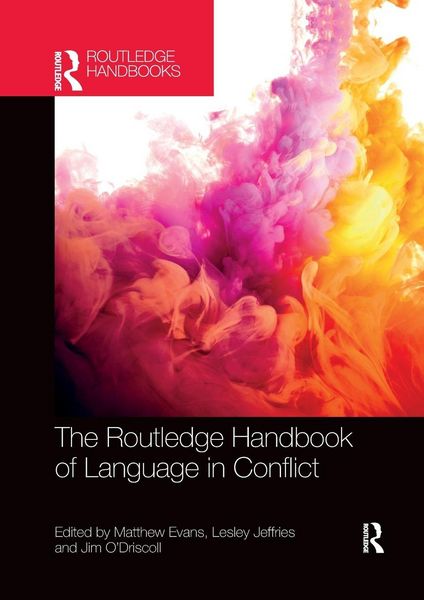
  • Produktbild: The Routledge Handbook of Language in Conflict
  • Produktbild: The Routledge Handbook of Language in Conflict

The Routledge Handbook of Language in Conflict

64,99 €

inkl. gesetzl. MwSt., Versandkostenfrei


Beschreibung

Produktdetails

Einband

Taschenbuch

Erscheinungsdatum

13.06.2022

Abbildungen

schwarz-weiss Illustrationen

Herausgeber

Matthew Evans + weitere

Verlag

Taylor & Francis

Seitenzahl

612

Maße (L/B/H)

24,6/17,4/3,3 cm

Gewicht

1000 g

Sprache

Englisch

ISBN

978-1-03-233838-5

Beschreibung

Rezension

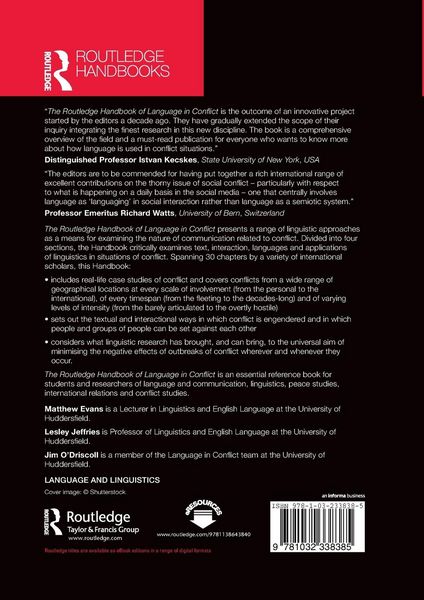
"The Routledge Handbook of Language in Conflict is the outcome of an innovative project started by the editors a decade ago. They have gradually extended the scope of their inquiry integrating the finest research in this new discipline. The book is a comprehensive overview of the field and a must-read publication for everyone who wants to know more about how language is used in conflict situations."

Distinguished Professor Istvan Kecskes, State University of New York, USA

"The editors are to be commended for having put together a rich international range of excellent contributions on the thorny issue of social conflict - particularly with respect to what is happening on a daily basis in the social media - one that centrally involves language as 'languaging' in social interaction rather than language as a semiotic system."

Professor Emeritus Richard Watts, University of Bern, Switzerland

Produktdetails

Einband

Taschenbuch

Erscheinungsdatum

13.06.2022

Abbildungen

schwarz-weiss Illustrationen

Herausgeber

Verlag

Taylor & Francis

Seitenzahl

612

Maße (L/B/H)

24,6/17,4/3,3 cm

Gewicht

1000 g

Sprache

Englisch

ISBN

978-1-03-233838-5

Herstelleradresse

Libri GmbH
Europaallee 1
36244 Bad Hersfeld
DE

Email: gpsr@libri.de

Kundinnen und Kunden meinen

0 Bewertungen

Informationen zu Bewertungen

Zur Abgabe einer Bewertung ist eine Anmeldung im Konto notwendig. Die Authentizität der Bewertungen wird von uns nicht überprüft. Wir behalten uns vor, Bewertungstexte, die unseren Richtlinien widersprechen, entsprechend zu kürzen oder zu löschen.

Die Bewertungen sind nach Format, Anzahl Sterne und Datum sortiert.

Verfassen Sie die erste Bewertung zu diesem Artikel

Helfen Sie anderen Kund*innen durch Ihre Meinung

Kundinnen und Kunden meinen

0 Bewertungen filtern

Die Leseprobe wird geladen.
  • Produktbild: The Routledge Handbook of Language in Conflict
  • Produktbild: The Routledge Handbook of Language in Conflict
  • List of Figures

    List of Tables

    List of Contributors

    Acknowledgements

    Introduction: the origins of the Routledge Handbook of Language in Conflict

    Section 1: Text in conflict

    1: Introduction: textual choice and communication in conflict

    2: Discursive (re)construction of the prelude to the 2003 Iraq War in op/ed pieces: dialectics of argument and rhetoric

    3: Stark choices and brutal simplicity: the blunt instrument of constructed opposition in news editorials

    4: Projecting your 'opponent''s views: linguistic negation and the potential for conflict

    5: Ideological positioning in conflict: the United States and Egypt's domestic political trajectory

    6: Homosexuality in Latvian and Polish parliamentary debates 1994-2013: a historical approach to conflict in political discourse

    7: Conflict and categorisation: a corpus and discourse study of naming participants in forced migration

    8: Hate speech: conceptualisations, interpretations and reactions

    Section 2: Interaction in conflict

    9: Introduction

    10: Conflict, disagreement and (im)politeness

    11: Offence and conflict talk

    12: Conflict interaction: insights from Conversation Analysis

    13: Conflict in political discourse: conflict as congenital to political discourse

    14: Discourse features of disputing in small claims hearings

    15: Leadership in conflict: disagreement and consensus negotiation in a start-up team

    16: Interaction and conflict in digital communication

    Section 3: Languages in conflict

    17: Introduction: conflict with the stuff of language

    18: Ethnicity, conflict and language choice: the case of northern Ghana

    19: Language and conflict in the Mapuche context

    20: Linguistic Landscape as an arena of conflict: language removal, exclusion and ethnic identity construction in Lithuania

    21: "You are shamed for speaking it or for not speaking it good enough": the paradoxical status of Spanish in the US Latino community

    22: Hate crimes: language, vulnerability and conflict

    23: Language ideologies in conflict at the workplace

    Section 4: Linguistics in conflict

    24: Introduction: the potential for Linguistics to change conflict in the 'real' world

    25: The value of linguistics in assessing potential threats in an airport setting

    26: Threatening contexts: an examination of threatening language from linguistic, legal and law enforcement perspectives

    27: Talk in mediation: metaphors in acrimonious talk

    28: Conflicts of policy and self-representation in the UK asylum process

    29: On agency, witnessing and surviving: interpreters in situations of violent conflict

    30: The Irish language in Belfast: the role of a language in post-conflict resolution

    Afterword

    Index