KI-Beratung Beta

Gutscheinbedingungen

**Gültig am 27.11.2026 auf Spielzeug, Schreibwaren, Filme, Geschenke & Trends, Musik, tolino eReader & Zubehör, Hörbücher und Hörbuch-Downloads, nicht preisgebundene Bücher und Kalender online auf thalia.at und in der Thalia App. Einzelne Artikel können ausgeschlossen sein. Aufgrund der Buchpreisbindung sind deutschsprachige Bücher und eBooks ausgenommen. Zusätzlich ausgenommen sind Abos & Flatrates, Games, Geschenkkarten/-boxen, Shelfies, Software, Zeitschriften sowie einzelne Artikel von tonies®. Pro Einkauf einmal einlösbar. Click & Collect nur bei Onlinevorabzahlung möglich. Keine Barauszahlung. Nicht kombinierbar mit anderen Aktionen und Gutscheinen. Gutschein wird auf max. 500€ Bestellwert angerechnet. Nicht gültig für Versandkosten und Services.

  • Produktbild: A Materialist Theory of the Mind
  • Produktbild: A Materialist Theory of the Mind

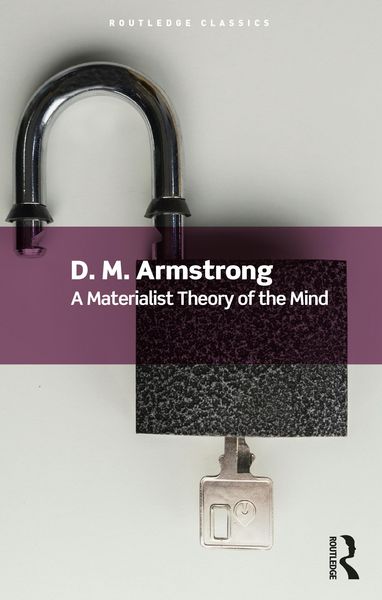
A Materialist Theory of the Mind

Aus der Reihe Routledge Classics

28,99 €

inkl. gesetzl. MwSt., zzgl. Versandkosten


  • Kostenlose Lieferung ab 30 € Einkaufswert
  • Versandkostenfrei für Bonuscard-Kund*innen

Beschreibung

D. M. Armstrong's A Materialist Theory of the Mind is widely known as one of the most important defences of the view that mental states are nothing but physical states of the brain. A landmark of twentieth-century philosophy of mind, it launched the physicalist revolution in approaches to the mind and...

Beschreibung

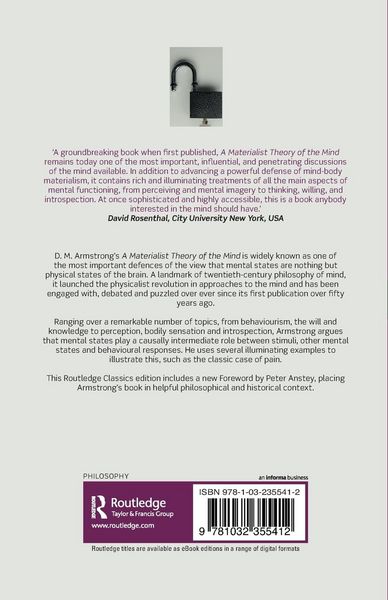
D. M. Armstrong's A Materialist Theory of the Mind is widely known as one of the most important defences of the view that mental states are nothing but physical states of the brain. A landmark of twentieth-century philosophy of mind, it launched the physicalist revolution in approaches to the mind and has been engaged with, debated and puzzled over ever since its first publication over fifty years ago.

Ranging over a remarkable number of topics, from behaviourism, the will and knowledge to perception, bodily sensation and introspection, Armstrong argues that mental states play a causally intermediate role between stimuli, other mental states and behavioural responses. He uses several illuminating examples to illustrate this, such as the classic case of pain.

This Routledge Classics edition includes a new Foreword by Peter Anstey, placing Armstrong's book in helpful philosophical and historical context.

Rezension

'A groundbreaking book when first published, A Materialist Theory of the Mind remains today one of the most important, influential, and penetrating discussions of the mind available. In addition to advancing a powerful defense of mind-body materialism, it contains rich and illuminating treatments of all the main aspects of mental functioning, from perceiving and mental imagery to thinking, willing, and introspection. At once sophisticated and highly accessible, this is a book anybody interested in the mind should have.' - David Rosenthal, City University New York, USA

Produktdetails

Einband

Taschenbuch

Erscheinungsdatum

06.10.2022

Verlag Taylor & Francis
Seitenzahl

436

Produktdetails

Einband

Taschenbuch

Erscheinungsdatum

06.10.2022

Verlag Taylor & Francis
Seitenzahl

436

Maße (L/B/H)

21,6/14/2,3 cm

Gewicht

545 g

Sprache

Englisch

ISBN

978-1-03-235541-2

Herstelleradresse

Produktsicherheitsverantwortliche/r
Europaallee 1
36244 Bad Hersfeld
DE

Email: gpsr@libri.de

Noch keine Bewertungen vorhanden

Verfassen Sie die erste Bewertung zu diesem Artikel

Helfen Sie anderen Kundinnen und Kunden durch Ihre Meinung.

Kundinnen und Kunden meinen

Bewertungen (0)

Die Leseprobe wird geladen.
  • Produktbild: A Materialist Theory of the Mind
  • Produktbild: A Materialist Theory of the Mind
  • Foreword to the Routledge Classics Edition Peter Anstey Acknowledgements Preface to the 1993 Edition Introduction Part 1: Theories of Mind 1. A Classification of Theories of Mind 2. Dualism 3. The Attribute Theory 4. A Difficulty for any Non-Materialist Theory of Mind 5. Behaviourism 6. The Central-State Theory Part 2: The Concept of Mind 7. The Will (1) 8. The Will (2) 9. Knowledge and Inference 10. Perception and Belief 11. Perception and Behaviour 12. The Secondary Qualities 13. Mental Images 14. Bodily Sensations 15. Introspection 16. Belief and Thought Part 3: The Nature of Mind 17. Identification of the Mental with the Physical Bibliography Index