KI-Beratung Beta

Gutscheinbedingungen

**Gültig am 25.11.2026 auf fremdsprachige Bücher online auf thalia.at und in der Thalia App. Einzelne Artikel können ausgeschlossen sein. Ausgenommen sind preisgebundene Artikel & eBooks. Pro Einkauf einmal einlösbar. Click & Collect nur bei Onlinevorabzahlung möglich. Keine Barauszahlung. Nicht kombinierbar mit anderen Aktionen und Gutscheinen. Gutschein wird auf max. 500€ Bestellwert angerechnet. Nicht gültig für Geschenkkarten, Versandkosten und Services.

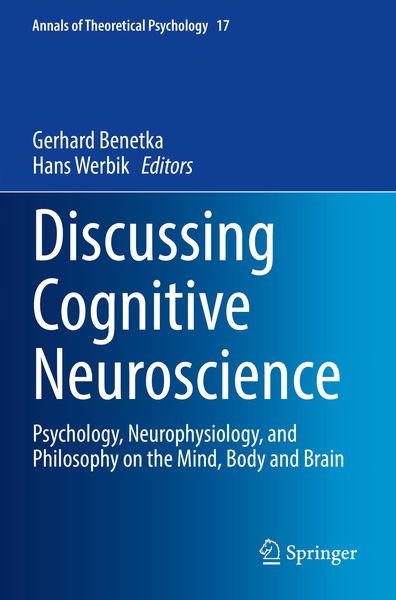
  • Produktbild: Discussing Cognitive Neuroscience
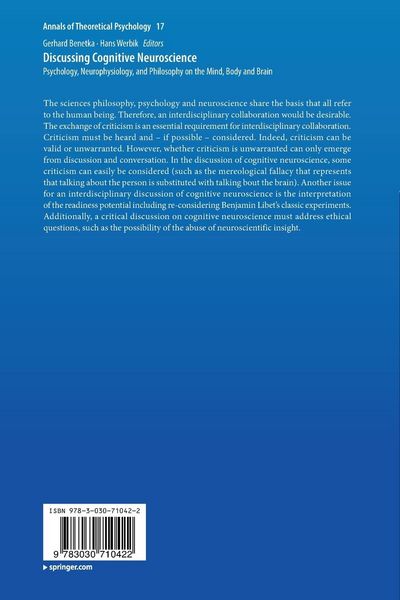
  • Produktbild: Discussing Cognitive Neuroscience
Band 17

Discussing Cognitive Neuroscience Psychology, Neurophysiology, and Philosophy on the Mind, Body and Brain

71,99 €

inkl. gesetzl. MwSt., Versandkostenfrei


Beschreibung

The sciences philosophy, psychology and neuroscience share the basis that all refer to the human being. Therefore, an interdisciplinary collaboration would be desirable. The exchange of criticism is an essential requirement for interdisciplinary collaboration. Criticism must be heard and – if possible...

Beschreibung

The sciences philosophy, psychology and neuroscience share the basis that all refer to the human being. Therefore, an interdisciplinary collaboration would be desirable. The exchange of criticism is an essential requirement for interdisciplinary collaboration. Criticism must be heard and – if possible – considered. Indeed, criticism can be valid or unwarranted. However, whether criticism is unwarranted can only emerge from discussion and conversation. In the discussion of cognitive neuroscience, some criticism can easily be considered (such as the mereological fallacy that represents that talking about the person is substituted with talking bout the brain). Another issue for an interdisciplinary discussion of cognitive neuroscience is the interpretation of the readiness potential including re-considering Benjamin Libet’s classic experiments. Additionally, a critical discussion on cognitive neuroscience must address ethical questions, such as the possibility of the abuse of neuroscientific insight.


Produktdetails

Einband

Taschenbuch

Erscheinungsdatum

23.05.2022

Abbildungen

VII, 171 p. 3 illus.

Verlag Springer

Produktdetails

Einband

Taschenbuch

Erscheinungsdatum

23.05.2022

Abbildungen

VII, 171 p. 3 illus.

Verlag Springer
Seitenzahl

171

Maße (L/B/H)

23,5/15,5/1,1 cm

Gewicht

289 g

Auflage

22001 Auflage 1st ed. 2021

Sprache

Englisch

ISBN

978-3-030-71042-2

Herstelleradresse

Springer-Verlag GmbH
Europaplatz 3
69115 Heidelberg
DE

Email: ProductSafety@springernature.com

Noch keine Bewertungen vorhanden

Verfassen Sie die erste Bewertung zu diesem Artikel

Helfen Sie anderen Kundinnen und Kunden durch Ihre Meinung.

Kundinnen und Kunden meinen

Bewertungen (0)

  • Produktbild: Discussing Cognitive Neuroscience
  • Produktbild: Discussing Cognitive Neuroscience

  • Chapter 1. Critique of neuropsychology – A polemic.- Chapter 2. Living body (Leib) or physical dataset? Antonio Damsio’s and Thomas Fuchs’s holistic conception of the human being as opposite standpoint to reductionist models.- Chapter 3. The person and the brain.- Chapter 4. The neuropsychological discourse in philosophical critique - Bennett/Hacker and the consequences.- Chapter 5. Persistent biologism and the misuse of neuropsychology – an activity-theoretical contribution.- Chapter 6. Measuring free will with the readiness potential? New data on an old misunderstanding.- Chapter 7. The brain as protagonist – Without the brain all is nothing.- Chapter 8. Is it possible to simulate “thought”?