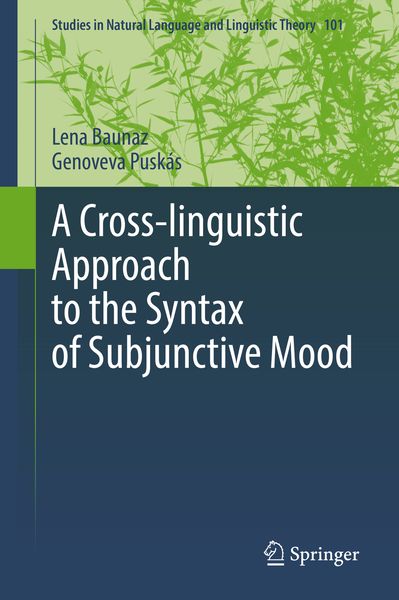
A Cross-linguistic Approach to the Syntax of Subjunctive Mood
-
- Hardcover ausgewählt
- Taschenbuch
- eBook
-
Sprache:Englisch
115,99 €
UVP
131,99 €
inkl. gesetzl. MwSt.,
Beschreibung
Produktdetails
Einband
Gebundene Ausgabe
Erscheinungsdatum
12.07.2022
Abbildungen
IX, 217 p. 1 illus.
Verlag
SpringerSeitenzahl
217
Maße (L/B/H)
24,1/16/1,8 cm
Gewicht
460 g
Auflage
22001 Auflage 1st edition 2022
Sprache
Englisch
ISBN
978-3-031-04539-4
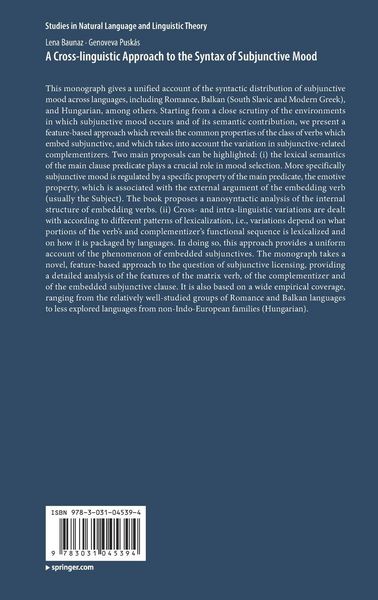
This monograph gives a unified account of the syntactic distribution of subjunctive mood across languages, including Romance, Balkan (South Slavic and Modern Greek), and Hungarian, among others. Starting from a close scrutiny of the environments in which subjunctive mood occurs and of its semantic contribution, we present a feature-based approach which reveals the common properties of the class of verbs which embed subjunctive, and which takes into account the variation in subjunctive-related complementizers. Two main proposals can be highlighted: (i) the lexical semantics of the main clause predicate plays a crucial role in mood selection. More specifically subjunctive mood is regulated by a specific property of the main predicate, the emotive property, which is associated with the external argument of the embedding verb (usually the Subject). The book proposes a nanosyntactic analysis of the internal structure of embedding verbs. (ii) Cross- and intra-linguistic variations are dealt with according to different patterns of lexicalization, i.e., variations depend on what portions of the verb’s and complementizer’s functional sequence is lexicalized and on how it is packaged by languages. In doing so, this approach provides a uniform account of the phenomenon of embedded subjunctives. The monograph takes a novel, feature-based approach to the question of subjunctive licensing, providing a detailed analysis of the features of the matrix verb, of the complementizer and of the embedded subjunctive clause. It is also based on a wide empirical coverage, ranging from the relatively well-studied groups of Romance and Balkan languages to less explored languages from non-Indo-European families (Hungarian).
Noch keine Bewertungen vorhanden
Verfassen Sie die erste Bewertung zu diesem Artikel
Helfen Sie anderen Kundinnen und Kunden durch Ihre Meinung.
Kurze Frage zu unserer Seite
Vielen Dank für Ihr Feedback
Wir nutzen Ihr Feedback, um unsere Produktseiten zu verbessern. Bitte haben Sie Verständnis, dass wir Ihnen keine Rückmeldung geben können. Falls Sie Kontakt mit uns aufnehmen möchten, können Sie sich aber gerne an unseren Kund*innenservice wenden.
zum Kundenservice