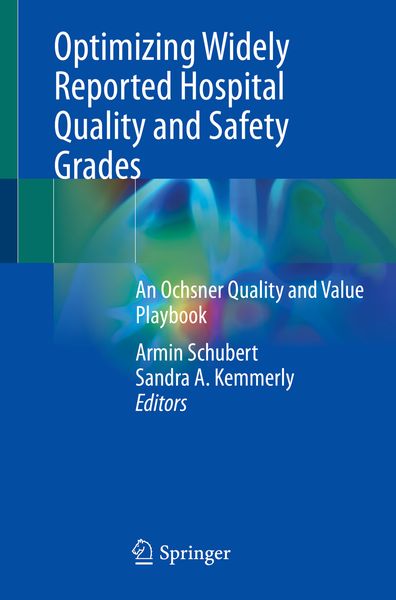
Optimizing Widely Reported Hospital Quality and Safety Grades An Ochsner Quality and Value Playbook
-
- Taschenbuch ausgewählt
- eBook
-
Sprache:Englisch
106,99 €
UVP
120,99 €
inkl. gesetzl. MwSt.,
Beschreibung
Produktdetails
Einband
Taschenbuch
Erscheinungsdatum
27.07.2022
Herausgeber
Armin Schubert + weitereVerlag
SpringerSeitenzahl
418
Maße (L/B/H)
23,5/15,5/2,3 cm
Gewicht
743 g
Auflage
1st ed. 2022
Sprache
Englisch
ISBN
978-3-031-04140-2
This practical, engaging book provides concise, real life-tested guidance to healthcare teams concerned with widely reported and incentivized hospital quality and safety metrics, offering both a conceptual approach and specific advice and frameworks for reviewing quality and safety numerator events, from the perspective and experience of clinicians and administrators working within the Ochsner Health System.
The text opens with the rationale for closely managing widely (including publicly) reported hospital patient quality and safety measures. Attention is given to the financial implications of quality performance, with respect to both penalties and payment incentives used by payer organizations. It then reviews the major public ratings and their relevant methodologies, including CMS, AHRQ and NSHN. In addition, it addresses ratings by proprietary organizations that have a large member clientele, such as Vizient, USNews, Leapfrog, Healthgrades, CareChex and others. Each metric - for example, the AHRQ Patient Safety Indicators (PSIs), and other metrics such as readmission rate, risk adjusted complications, hospital-acquired conditions and mortality - is addressed in a stand-alone chapter. For each, the importance, approach to review, opportunity for optimization, and engagement of healthcare staff are reviewed and discussed.
Overall, this book forefronts the benefits of a collaborative approach within a health system. The concurrent review process, multidisciplinary collaboration among quality improvement, clinical documentation, coding and medical staff personnel are all emphasized. Also described in detail is the approach to and specific opportunities for medical staff education and engagement. Additional key topics include Engagement of the Medical Staff and House Staff (i.e., residents and other trainees), Futile Care, Surgical Quality Improvement (NSQIP), Nursing Provider Partnership, and Translation of Data Review to Successful Performance Improvement. Specialty chapters on pediatric, neurologic and transplant quality metrics are also included.
Kundinnen und Kunden meinen
Verfassen Sie die erste Bewertung zu diesem Artikel
Helfen Sie anderen Kund*innen durch Ihre Meinung
Kurze Frage zu unserer Seite
Vielen Dank für Ihr Feedback
Wir nutzen Ihr Feedback, um unsere Produktseiten zu verbessern. Bitte haben Sie Verständnis, dass wir Ihnen keine Rückmeldung geben können. Falls Sie Kontakt mit uns aufnehmen möchten, können Sie sich aber gerne an unseren Kund*innenservice wenden.
zum Kundenservice