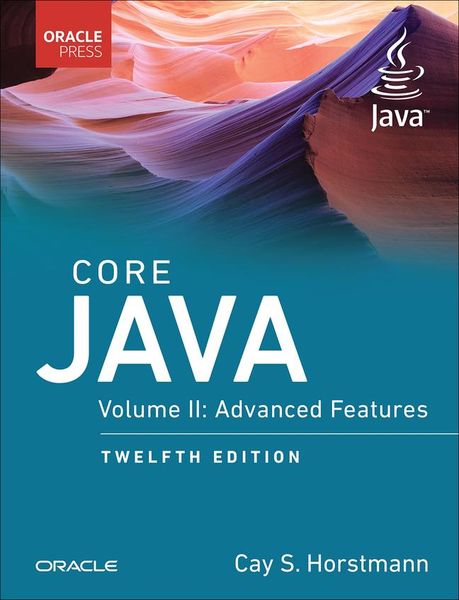
Core Java Advanced Features, Volume 2
-
- Taschenbuch ausgewählt
- eBook
-
Sprache:Englisch
-
Auflage:12th edition
64,99 €
inkl. gesetzl. MwSt.,
Beschreibung
Produktdetails
Einband
Taschenbuch
Erscheinungsdatum
15.04.2022
Verlag
Pearson AcademicSeitenzahl
944
Maße (L/B/H)
23,5/17,8/5,1 cm
Gewicht
1606 g
Auflage
12th edition
Sprache
Englisch
ISBN
978-0-13-787107-0
The Classic Guide to Advanced Java Programming: Fully Updated for Java 17
"This is the definitive reference and instructional work for Java and the Java ecosystem."
--Andrew Binstock, Java Magazine
Core Java is the leading no-nonsense tutorial and reference for experienced programmers who want to write robust Java code for real-world applications. Now, Core Java, Volume II: Advanced Features, Twelfth Edition, has been revised to cover the new features and enhancements in the Java 17 long-term support release. As always, all chapters have been completely updated, outdated material has been removed, and the new APIs are covered in detail.
This volume focuses on the advanced topics that a programmer needs to know for professional software development and includes authoritative coverage of enterprise programming, networking, databases, security, modularization, internationalization, code processing, and native methods, as well as complete chapters on the Streams, XML, and Date and Time APIs. In addition, the chapter on Advanced Swing and Graphics covers techniques that are applicable to both client-side user interfaces and server-side generation of graphics and images.
Cay S. Horstmann clearly explains sophisticated new features with depth and completeness and demonstrates how to use them to build professional-quality applications. Horstmann's thoroughly tested sample code reflects modern Java style and best practices. The examples are carefully crafted for easy understanding and maximum practical value, so you can rely on them to jump-start your own programs.
- Master advanced techniques, idioms, and best practices for writing reliable Java code
- Make the most of enhanced Java I/O APIs, object serialization, and regular expressions
- Efficiently connect to network services, implement servers and the new HTTP/2 client, and harvest web data
- Process code via the Scripting and Compiler APIs, and use annotations to generate code and files
- Deepen your understanding of the Java Platform Module System, including recent refinements
- Leverage the Java security model, user authentication, and the security librarys cryptographic functions
- Preview powerful new APIs for accessing "foreign" functions and memory
See Core Java, Volume I: Fundamentals, Twelfth Edition, for expert coverage of Java programming fundamentals, including objects, generics, collections, lambda expressions, concurrency, and functional programming.
Register your book for convenient access to downloads, updates, and/or corrections as they become available. See inside book for details.
Noch keine Bewertungen vorhanden
Verfassen Sie die erste Bewertung zu diesem Artikel
Helfen Sie anderen Kundinnen und Kunden durch Ihre Meinung.
Kurze Frage zu unserer Seite
Vielen Dank für Ihr Feedback
Wir nutzen Ihr Feedback, um unsere Produktseiten zu verbessern. Bitte haben Sie Verständnis, dass wir Ihnen keine Rückmeldung geben können. Falls Sie Kontakt mit uns aufnehmen möchten, können Sie sich aber gerne an unseren Kund*innenservice wenden.
zum Kundenservice