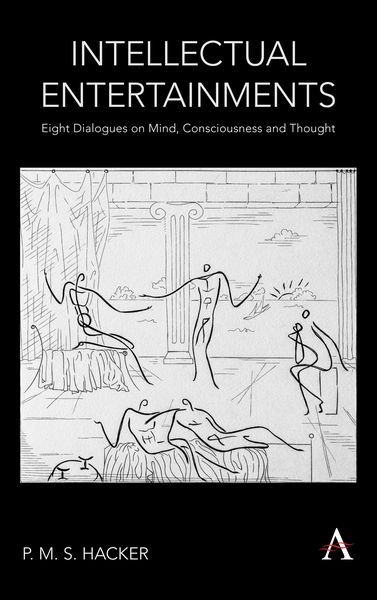
Intellectual Entertainments Eight Dialogues on Mind, Consciousness and Thought
-
- Hardcover
- Taschenbuch
- eBook ausgewählt
-
Form:Einzelkauf Download
-
Sprache:Englisch
-
eBook Format:PDF
- PDF 13,90 € ausgewählt
- ePUB 13,90 €
13,90 €
inkl. gesetzl. MwSt.Beschreibung
Produktdetails
Format
Kopierschutz
Ja
Family Sharing
Nein
Text-to-Speech
Nein
Erscheinungsdatum
28.10.2019
Verlag
Anthem PressSeitenzahl
240 (Printausgabe)
Dateigröße
10531 KB
Sprache
Englisch
EAN
9781785271533
'Intellectual Entertainments' consists of eight philosophical dialogues, each with five participants, some living, some imaginary and some dead. The dialogues take place either in Elysium or in an imaginary Oxford Common Room. Each historical figure speaks in his own idiom with a distinctive turn of phrase. The imaginary figures speak in the accent and idiom of their respective countries (English, Scottish, American, Australian).
The themes of the dialogues are topics of perennial interest to any educated person with an intellectual bent. Two dialogues are concerned with the nature of the mind and the relation between mind and body - whether the mind is separable from the body, whether it is identical with the brain or whether such claims are confused. A second pair of dialogues examines the nature of consciousness and of conscious experience, and whether conscious experience is characterized by its distinctive 'feel' and by what it is like to undergo it. It investigates the puzzling question of what consciousness is for and whether there could be 'zombies' who behave just as we do, but who lack consciousness. A further pair of dialogues probes the nature of thought, the relationship between the ability to think and mastery of a language, and the question of what we think in - words, images or something else. One dialogue discusses the perennial question of the objectivity or subjectivity of perceptual qualities such as colour and sound, and whether a mindless world would also be colourless. A final dialogue consists of vehement argument on the 'ownership' of pain: whether two people can have the same pain or only similar pains.
The dialogues are written in a colloquial style. They presuppose no antecedent philosophical knowledge, but only intellectual curiosity. Each subject is presented from different points of view, presented by a different protagonist, and the various points of view are subjected to criticism. The exchanges are sometimes amusing, sometimes passionate and vehement. The different views advanced are often the views of distinguished living philosophers or great philosophers now deceased, as is made clear by the endnote references to sources. The overall aim of the dialogues is both to amuse and to demystify academic mystery-mongering. Holy cows of current academic philosophy are sacrificed at the altar of reason and sound argument.
Noch keine Bewertungen vorhanden
Verfassen Sie die erste Bewertung zu diesem Artikel
Helfen Sie anderen Kundinnen und Kunden durch Ihre Meinung.
Kurze Frage zu unserer Seite
Vielen Dank für Ihr Feedback
Wir nutzen Ihr Feedback, um unsere Produktseiten zu verbessern. Bitte haben Sie Verständnis, dass wir Ihnen keine Rückmeldung geben können. Falls Sie Kontakt mit uns aufnehmen möchten, können Sie sich aber gerne an unseren Kund*innenservice wenden.
zum Kundenservice