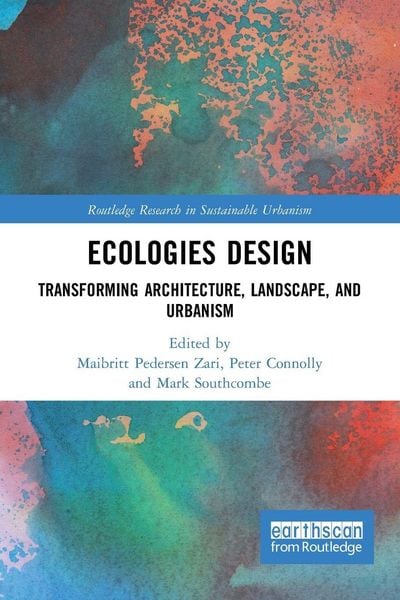
Ecologies Design Transforming Architecture, Landscape, and Urbanism
-
- Hardcover
- Taschenbuch ausgewählt
- eBook
-
Sprache:Englisch
72,99 €
inkl. gesetzl. MwSt.,
Beschreibung
Produktdetails
Einband
Taschenbuch
Erscheinungsdatum
29.04.2022
Abbildungen
schwarz-weiss Illustrationen, Raster,schwarz-weiss, Zeichnungen, schwarz-weiss, Tabellen, schwarz-weiss
Herausgeber
Maibritt Pedersen Zari + weitereVerlag
Taylor & FrancisSeitenzahl
322
Maße (L/B/H)
23,4/15,6/1,7 cm
Gewicht
454 g
Sprache
Englisch
ISBN
978-0-367-49105-5
The notion of ecology has become central to contemporary design discourse. This reflects contemporary concerns for our planet and a new understanding of the primary entanglement of the human species with the rest of the world.
The use of the term 'ecology' with design tends to refer to how to integrate ecologies into design and cities and be understood in a biologically-scientific and technical sense. In practice, this scientific-technical knowledge tends to be only loosely employed. The notion of ecology is also often used metaphorically in relation to the social use of space and cities. This book argues that what it calls the 'biological' and 'social' senses of ecology are both important and require distinctly different types of knowledge and practice. It proposes that science needs to be taken much more seriously in 'biological ecologies', and that 'social ecologies' can now be understood non-metaphorically as assemblages. Furthermore, this book argues that design practice itself can be understood much more rigorously, productively and relevantly if understood ecologically. The plural term 'ecologies design' refers to these three types of ecological design. This book is unique in bringing these three perspectives on ecological design together in one place. It is significant in proposing that a strong sense of ecologies design practice will only follow from the interconnection of these three types of practice.
Ecologies Design brings together leading international experts and relevant case studies in the form of edited research essays, case studies and project work. It provides an overarching critique of current ecologically-oriented approaches and offers evidence and exploration of emerging and effective methods, techniques and concepts. It will be of great interest to academics, professionals and students in the built environment disciplines.
Noch keine Bewertungen vorhanden
Verfassen Sie die erste Bewertung zu diesem Artikel
Helfen Sie anderen Kundinnen und Kunden durch Ihre Meinung.
Kurze Frage zu unserer Seite
Vielen Dank für Ihr Feedback
Wir nutzen Ihr Feedback, um unsere Produktseiten zu verbessern. Bitte haben Sie Verständnis, dass wir Ihnen keine Rückmeldung geben können. Falls Sie Kontakt mit uns aufnehmen möchten, können Sie sich aber gerne an unseren Kund*innenservice wenden.
zum Kundenservice