KI-Beratung Beta

Gutscheinbedingungen

**Gültig am 01.10.2026 ab einem Mindestbestellwert von 30€ auf Spielzeug, Schreibwaren, Filme, Geschenke & Trends, Musik, tolino eReader & Zubehör, Hörbücher und Hörbuch-Downloads, nicht preisgebundene Bücher und Kalender online auf thalia.at und in der Thalia App. Einzelne Artikel können ausgeschlossen sein. Aufgrund der Buchpreisbindung sind deutschsprachige Bücher und eBooks ausgenommen. Zusätzlich ausgenommen sind Abos & Flatrates, Games, Geschenkkarten/-boxen, Shelfies, Software, Zeitschriften sowie einzelne Artikel von tonies®. Pro Einkauf einmal einlösbar. Click & Collect nur bei Onlinevorabzahlung möglich. Keine Barauszahlung. Nicht kombinierbar mit anderen Aktionen und Gutscheinen. Gutschein wird auf max. 500€ Bestellwert angerechnet. Nicht gültig für Versandkosten und Services. Preisgebundene Artikel sind vom Mindestbestellwert ausgeschlossen.

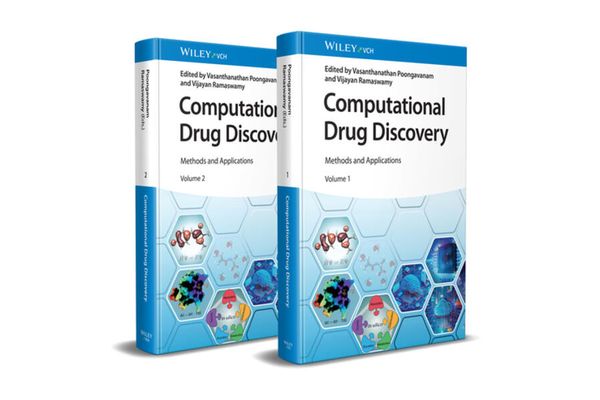
Produktbild: Computational Drug Discovery
- 15%

Computational Drug Discovery Methods and Applications

15% sparen

275,99 € UVP 328,00 €

inkl. gesetzl. MwSt., Versandkostenfrei


Beschreibung

Produktdetails

Einband

Gebundene Ausgabe

Erscheinungsdatum

21.02.2024

Abbildungen

27

Herausgeber

Vasanthanathan Poongavanam + weitere

Verlag

Wiley-VCH

Seitenzahl

736

Maße (L/B/H)

25,1/17,6/4,4 cm

Gewicht

1700 g

Auflage

1. Auflage

Sprache

Englisch

ISBN

978-3-527-35166-4

Beschreibung

Portrait


Vasanthanathan Poongavanam is a senior researcher in the Department of Chemistry-BMC, Uppsala University, Sweden. Before starting at Uppsala University in a researcher position with Jan Kihlberg in 2016, he was a postdoctoral fellow at the University of Vienna, Austria, and at the University of Southern Denmark. He obtained his Ph.D. in medicinal chemistry as


a Drug Research Academy Fellow at the University of Copenhagen, Denmark, on computational modeling of Cytochrome P450. His research interests focus on understanding the molecular properties that govern the pharmacokinetic profile of molecules beyond the Ro5 space, including macrocycles and PROTACs.


Vijayan Ramaswamy is a research scientist with the Structural Chemistry group at the Institute for Applied Cancer Science, University of Texas MD Anderson Cancer, TX, USA. Before starting at the MD Anderson Cancer in 2016, he was a postdoctoral fellow at Rutgers University, NJ, USA, and at Temple University, PA, USA. He received his Ph.D as a CSIR senior research fellow from the Indian Institute of Chemical Biology, Kolkata, India. His research focuses on applying computational chemistry methods to drive small-molecule drug discovery programs, particularly in oncology and neurodegenerative diseases.


Produktdetails

Einband

Gebundene Ausgabe

Erscheinungsdatum

21.02.2024

Abbildungen

27

Herausgeber

Verlag

Wiley-VCH

Seitenzahl

736

Maße (L/B/H)

25,1/17,6/4,4 cm

Gewicht

1700 g

Auflage

1. Auflage

Sprache

Englisch

ISBN

978-3-527-35166-4

Herstelleradresse

Wiley-VCH GmbH
Boschstraße 12
69469 Weinheim
DE

Email: wiley-vch@kolibri360.de

Noch keine Bewertungen vorhanden

Verfassen Sie die erste Bewertung zu diesem Artikel

Helfen Sie anderen Kundinnen und Kunden durch Ihre Meinung.

Kundinnen und Kunden meinen

Bewertungen (0)

Die Leseprobe wird geladen.
  • Produktbild: Computational Drug Discovery

  • Preface


    Volume 1:


    PART I. MOLECULAR DYNAMICS AND RELATED METHODS IN DRUG DISCOVERY


    Binding Free Energy Calculations in Drug Discovery


    Gaussian Accelerated Molecular Dynamics in Drug Discovery


    MD Simulations for Drug-Target (Un)Binding Kinetics


    Solvation Thermodynamics and its Competitive Saturation as a Paradigm of Co-Solvent Methods


    PART II. QUANTUM MECHANICS APPLICATION FOR DRUG DISCOVERY


    QM/MM Approaches for Structure Based Drug Design: Techniques and Applications


    Recent Advances in Practical Quantum Mechanics and Mixed-QM/MM Driven X-Ray Crystallography and Cryo-Electron Microscopy (Cryo-EM) and their Impact on Structure-Based Drug Discovery


    Quantum-Mechanical Analyses of Interactions for Biochemical Applications


    PART III. ARTIFICIAL INTELLIGENCE IN PRE-CLINICAL DRUG DISCOVERY


    The Role of Computer Aided Drug Design in Drug Discovery - An Introduction


    AI-Based Protein Structure Predictions and their Implications in Drug Discovery


    Deep Learning for the Structure-Based Binding Free Energy Prediction of Small Molecule Ligands


    Using Artificial Intelligence for the De Novo Drug Design and Retrosynthesis


    Reliability and Applicability Assessment for Machine Learning Models


    Volume 2:


    PART IV. CHEMICAL SPACE AND KNOWLEDGE BASED DRUG DISCOVERY


    Enumerable Libraries and Accessible Chemical Space


    Navigating Chemical Space


    Visualization, Exploration, and Screening of Chemical Space in Drug Discovery


    SAR Knowledge Based for Driving Drug Discovery


    Cambridge Structural Database (CSD) - Drug Discovery through Data Mining and Knowledge Based Tools


    PART V. STRUCTURE-BASED VIRTUAL SCREENING USING DOCKING


    Structure-Based Ultra-Large Scale Virtual Screenings


    Community Benchmarking Exercises for Docking and Scoring


    PART VI. IN SILICO ADMET MODELLING


    Advances in the Application of In Silico ADMET Models - An Industry Perspective


    PART VII. COMPUTATIONAL APPROACHES FOR NEW THERAPEUTIC MODALITIES


    Modelling the Structures of Ternary Complexes Mediated by Molecular Glues


    Free Energy Calculations in Covalent Drug Design


    PART VIII. COMPUTING TECHNOLOGIES DRIVING DRUG DISCOVERY


    Orion® A Cloud-Native Molecular Design Platform


    Cloud-Native Rendering Platform and GPUs Aid Drug Discovery


    The Quantum Computing Paradigm