KI-Beratung Beta

Gutscheinbedingungen

**Gültig am 27.11.2026 auf Spielzeug, Schreibwaren, Filme, Geschenke & Trends, Musik, tolino eReader & Zubehör, Hörbücher und Hörbuch-Downloads, nicht preisgebundene Bücher und Kalender online auf thalia.at und in der Thalia App. Einzelne Artikel können ausgeschlossen sein. Aufgrund der Buchpreisbindung sind deutschsprachige Bücher und eBooks ausgenommen. Zusätzlich ausgenommen sind Abos & Flatrates, Games, Geschenkkarten/-boxen, Shelfies, Software, Zeitschriften sowie einzelne Artikel von tonies®. Pro Einkauf einmal einlösbar. Click & Collect nur bei Onlinevorabzahlung möglich. Keine Barauszahlung. Nicht kombinierbar mit anderen Aktionen und Gutscheinen. Gutschein wird auf max. 500€ Bestellwert angerechnet. Nicht gültig für Versandkosten und Services.

Produktbild: Methods and Techniques in Deep Learning

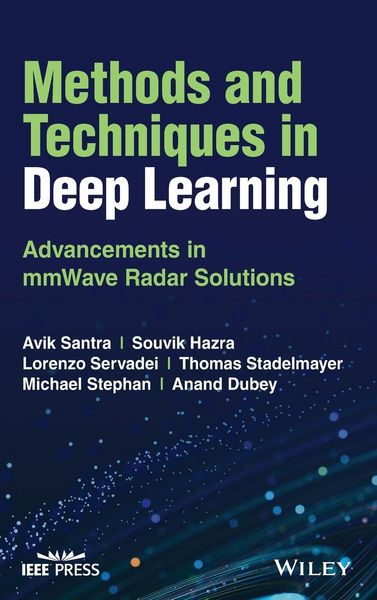
Methods and Techniques in Deep Learning Advancements in Mmwave Radar Solutions

135,99 €

inkl. gesetzl. MwSt., Versandkostenfrei


Beschreibung

Methods and Techniques in Deep Learning

Introduces multiple state-of-the-art deep learning architectures for mmWave radar in a variety of advanced applications

Methods and Techniques in Deep Learning: Advancements in mmWave Radar Solutions provides a timely and authoritative overview of the use of artificial...

Beschreibung

Methods and Techniques in Deep Learning

Introduces multiple state-of-the-art deep learning architectures for mmWave radar in a variety of advanced applications

Methods and Techniques in Deep Learning: Advancements in mmWave Radar Solutions provides a timely and authoritative overview of the use of artificial intelligence (AI)-based processing for various mmWave radar applications. Focusing on practical deep learning techniques, this comprehensive volume explains the fundamentals of deep learning, reviews cutting-edge deep metric learning techniques, describes different typologies of reinforcement learning (RL) algorithms, highlights how domain adaptation (DA) can be used for improving the performance of machine learning (ML) algorithms, and more. Throughout the book, readers are exposed to product-ready deep learning solutions while learning skills that are relevant for building any industrial-grade, sensor-based deep learning solution.

A team of authors with more than 70 filed patents and 100 published papers on AI and sensor processing illustrates how deep learning is enabling a range of advanced industrial, consumer, and automotive applications of mmWave radars. In-depth chapters cover topics including multi-modal deep learning approaches, the elemental blocks required to formulate Bayesian deep learning, how domain adaptation (DA) can be used for improving the performance of machine learning algorithms, and geometric deep learning are used for processing point clouds. In addition, the book:

  • Discusses various advanced applications and how their respective challenges have been addressed using different deep learning architectures and algorithms
  • Describes deep learning in the context of computer vision, natural language processing, sensor processing, and mmWave radar sensors
  • Demonstrates how deep parametric learning reduces the number of trainable parameters and improves the data flow
  • Presents several human-machine interface (HMI) applications such as gesture recognition, human activity classification, human localization and tracking, in-cabin automotive occupancy sensing

Methods and Techniques in Deep Learning: Advancements in mmWave Radar Solutions is an invaluable resource for industry professionals, researchers, and graduate students working in systems engineering, signal processing, sensors, data science, and AI.

Produktdetails

Einband

Gebundene Ausgabe

Erscheinungsdatum

08.12.2022

Verlag John Wiley & Sons Inc
Seitenzahl

336

Produktdetails

Einband

Gebundene Ausgabe

Erscheinungsdatum

08.12.2022

Verlag John Wiley & Sons Inc
Seitenzahl

336

Maße (L/B/H)

23,5/15,7/2,3 cm

Gewicht

643 g

Auflage

1. Auflage

Sprache

Englisch

ISBN

978-1-119-91065-7

Herstelleradresse

Libri GmbH
Europaallee 1
36244 Bad Hersfeld
DE

Email: gpsr@libri.de

Noch keine Bewertungen vorhanden

Verfassen Sie die erste Bewertung zu diesem Artikel

Helfen Sie anderen Kundinnen und Kunden durch Ihre Meinung.

Kundinnen und Kunden meinen

Bewertungen (0)

Die Leseprobe wird geladen.
  • Produktbild: Methods and Techniques in Deep Learning
  • Preface

    Acronyms

    1 Introduction to Radar Processing & Deep Learning 1

    1.1 Basics of Radar Systems 1

    1.1.1 Fundamentals 2

    1.1.2 Signal Modulation 2

    1.2 FMCW Signal Processing 6

    1.2.1 Frequency-Domain Analysis 7

    1.3 Target Detection & Clustering 14

    1.4 Target Tracking 19

    1.4.1 Track Management 21

    1.4.2 Track Filtering 22

    1.5 Target Representation 28

    1.5.1 Image Representation 30

    1.5.2 Point-Cloud Maps 34

    1.6 Target Recognition 36

    1.6.1 Feedforward Network 37

    1.6.2 Convolutional Neural Networks (CNN) 37

    1.6.3 Recurrent Neural Network (RNN) 43

    1.6.4 Autoencoder & Variational Autoencoder 47

    1.6.5 Generative Adversial Network 51

    1.6.6 Transformer 54

    1.7 Training a Neural Network 56

    1.7.1 Forward Pass & Backpropagation 57

    1.7.2 Optimizers 62

    1.7.3 Loss Functions 65

    1.8 Questions to the Reader 66

    Bibliography 68

    2 Deep Metric Learning 75

    2.1 Introduction 78

    2.2 Pairwise methods 79

    2.2.1 Contrastive Loss 79

    2.2.2 Triplet Loss 80

    2.2.3 Quadruplet Loss 81

    2.2.4 N-Pair Loss 82

    2.2.5 Big Picture 83

    2.3 End-to-end Learning 84

    2.3.1 Cosine Similarity 86

    2.3.2 Euclidean Distance 95

    2.3.3 Big Picture 100

    2.4 Proxy methods 103

    2.5 Advanced Methods 103

    2.5.1 Statistical Distance 104

    2.5.2 Structured Metric Learning 108

    2.6 Application Gesture Sensing 110

    2.6.1 Radar System Design 111

    2.6.2 Data Set and Preparation 112

    2.6.3 Architecture and Metric Learning Procedure 114

    2.6.4 Results 123

    2.7 Questions to the Reader 129

    Bibliography 130

    3 Deep Parametric Learning 135

    3.1 Introduction 135

    3.2 Radar Parametric Neural Network 140

    3.2.1 2D Sinc Filters 142

    3.2.2 2D Morlet Wavelets 143

    3.2.3 Adaptive 2D Sinc Filters 145

    3.2.4 Complex Frequency Extraction Layer 146

    3.3 Multilevel Wavelet Decomposition Network 150

    3.4 Application Activity Classification 153

    3.4.1 Proposed Parametric Networks 155

    3.4.2 State-of-art Networks 158

    3.4.3 Results & Discussion 160

    3.5 Conclusion 167

    3.6 Question to Readers 168

    Bibliography 168

    4 Deep Reinforcement Learning 173

    4.1 Useful Notation and Equations 173

    4.1.1 Markov Decision Process 173

    4.1.2 Solving the Markov Decision Process 174

    4.1.3 Bellman Equations 175

    4.2 Introduction 175

    4.3 On-Policy Reinforcement Learning 179

    4.4 Off-Policy Reinforcement Learning 180

    4.5 Model-Based Reinforcement Learning 180

    4.6 Model-Free Reinforcement Learning 181

    4.7 Value-Based Reinforcement Learning 181

    4.8 Policy-Based Reinforcement Learning 183

    4.9 Online Reinforcement Learning 183

    4.10 Offline Reinforcement Learning 184

    4.11 Reinforcement Learning with

    Discrete Actions 184

    4.12 Reinforcement Learning with

    Continuous Actions 185

    4.13 Reinforcement Learning Algorithms

    for Radar Applications 185

    4.14 Application Tracker's Parameter Optimization 189

    4.14.1 Motivation 190

    4.14.2 Background 192

    4.14.3 Approach 202

    4.14.4 Experimental 208

    4.14.5 Outcomes of the proposed Approach 219

    4.15 Conclusion 220

    4.16 Questions to the Reader 220

    Bibliography 221

    5 Cross-Modal Learning 229

    5.1 Introduction 229

    5.2 Self-Supervised Multi-Modal Learning 233

    5.2.1 Generating Audio Statistics 233

    5.2.2 Predicting sounds from images 234

    5.2.3 Audio Features Clustering 234

    5.2.4 Binary Coding Model 235

    5.2.5 Training 235

    5.2.6 Results 235

    5.3 Joint Embeddings Learning 237

    5.3.1 Feature Representations 237

    5.3.2 Joi