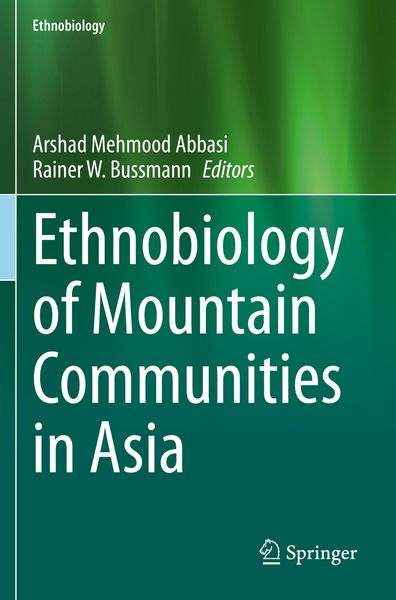
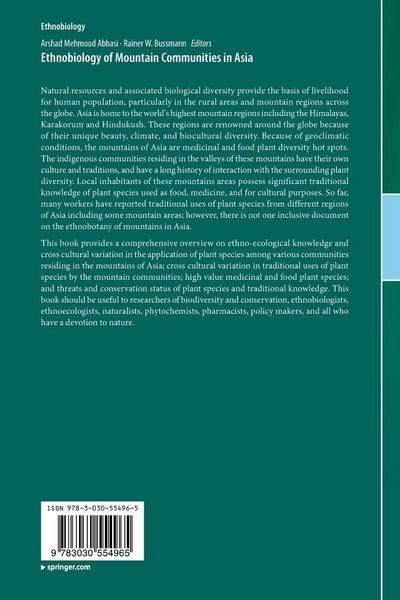
About Dr. Rainer W. Bussmann Dr. Bussmann earned his M.Sc. (Diploma) in Biology at Universität Tübingen, Germany, in 1993 and his doctorate at Universität Bayreuth, Germany, in 1994. He is an ethnobotanist and vegetation ecologist, and currently Affiliate Scientist at Museo Nacional de Historia Natural in La Paz, Bolivia, and co-director of Saving Knowledge, La Paz, Bolivia, as well as Principal Scientist at the Department of Ethnobotany, Institute of Botany, Ilia State University, both of which he co-founded. Before retiring from Missouri Botanical Garden, Dr. Bussmann was director of the William L. Brown Center at Missouri Botanical Garden, William L. Brown Curator of Economic Botany, and Senior Curator. Before accepting the directorship of WLBC, he held academic appointments as Research Fellow in Geography and the Environment at University of Texas at Austin from 2006 to 2007, as Associate Professor of Botany and Scientific Director of Harold Lyon Arboretum at University of Hawaii from 2003 to 2006, and as Assistant Professor at University of Bayreuth from 1997 to 2003, following a postdoc at the same institution from 1994 to 1997. He holds affiliate faculty appointments at Washington University St. Louis, USA; University of Missouri St. Louis, USA; Florida Atlantic University Boca Raton, USA; Universidade Federal da Paraíba, Brazil; Universidád Nacional Mayor de San Marcos, Perú; and at Ilia State University, Republic of Georgia, and serves as external thesis advisor at multiple other universities worldwide. His work focuses on ethnobotanical research, and the preservation of traditional knowledge, in Bolivia, Peru, Madagascar, the Caucasus, and the Himalayas. To date, Dr. Bussmann has authored over 250 peer reviewed papers, over 900 book chapters, and authored or edited over 35 books.
Dr. Bussmann is a past President of the Society for Economic Botany and has served as board/council member of the International Society for Ethnopharmacology, Society of Ethnobiology, Botanical Society of America, and International Society of Ethnobiology.
Dr. Rainer W. Bussmann Principal Scientist, Department of Ethnobotany, Institute of Botany, Ilia State University, Tbilisi, Georgia
Director, Saving Knowledge, La Paz, Bolivia
About Dr. Arshad Mehmood Abbasi Dr. Arshad Mehmood Abbasi is working as Assistant Professor of Environmental Sciences at COMSATS University, Islamabad, Abbottabad Campus-Pakistan. Dr. Abbasi received his PhD in Ethnobotanical and Nutraceuticals aspects of plant species of Lesser Himalayas, Pakistan from Quaid-i-Azam University Islamabad Pakistan in 2013. He served as post-doctorate research fellow in the School of Food Science in South China University of Technology from 2014-2016. Dr. Abbasi research is mainly focused on: plant resource utilization by mountain communities of Himalayan region of Pakistan with particular reference to ethnobotanical and nutraceuticals aspects. To date Dr. Abbasi has authored 90+ research articles and 4 Book Chapters. Dr. Abbasi has also two international books in his credit: “ Medicinal Plant Biodiversity of Lesser Himalayas-Pakistan ” and Wild Edible Vegetables of Lesser Himalayas: Ethnobotanical and Nutraceutical Aspects published by Springer, USA in 2012 and 2015, respectively. So far, Dr. Abbasi has been awarded three outstanding research awards by Higher Education Commission (HEC) of Pakistan, Best researcher awards (2017 & 2019) by host University and foreign expert certificate by Chinese Government along with many other certificates. Dr. Abbasi isalso serving as volunteer editor and reviewer of several journals of international repute including Journal of Ethnobiology and Ethnomedicines, Journal of Herbal Medicine, Food Chemistry, Pharmaceutical Biology, European Journal of Medicinal Plants, Pakistan Journal of Pharmaceutical Sciences, Asian Pacific Journal of Tropical Biomedicine and Pakistan Journal of Botany among several others. Dr. Abbasi is also member of International Society of Ethnobiology; Society of Ethnobiology, University of North Texas, USA; American Chemical Society (ASC) and Institutional APIFP Champion: Asia Pacific Institute of Food Professionals.
Dr. Arshad Mehmood Abbasi Department of Environmental Sciences, COMSATS University Islamabad Abbottabad Campus, 22060 Pakistan