KI-Beratung Beta

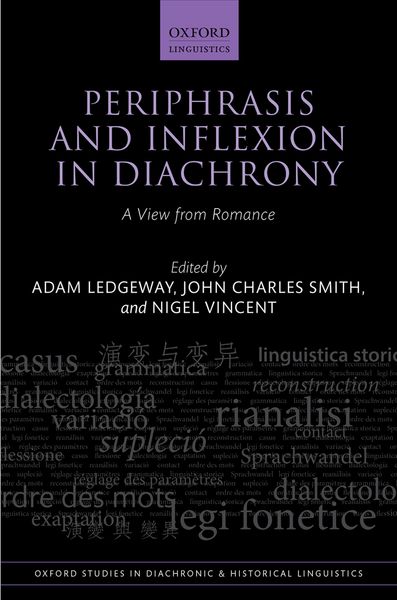
Produktbild: Periphrasis and Inflexion in Diachrony
Band 48

Periphrasis and Inflexion in Diachrony A View from Romance

  • Form:Einzelkauf Download
  • Sprache:Englisch

130,60 €

inkl. gesetzl. MwSt.

Beschreibung

This volume brings together contributions from leading specialists in syntax and morphology to explore the complex relation between periphrasis and inflexion from both a synchronic and diachronic perspective. The chapters draw on data from across the Romance language family, including standard and regional...

Beschreibung

This volume brings together contributions from leading specialists in syntax and morphology to explore the complex relation between periphrasis and inflexion from both a synchronic and diachronic perspective. The chapters draw on data from across the Romance language family, including standard and regional varieties and dialects. The relation between periphrasis and inflexion raises questions for both syntax and morphology, and understanding the phenomena involved requires cooperation across these sub-domains. For example, the components that express many periphrases can be interrupted by other words in a way that is common in syntax but not in morphology, and in some contexts, a periphrastic form may be semantically equivalent to a single-word inflected form, with which it arguably forms part of a paradigmatic set. Patterns of this kind are found across Romance, albeit with significant local differences. Moreover, diachrony is essential in understanding these phenomena, and the rich historical documentation available for Romance allows an in-depth exploration of the changes and variation involved, as different members of the family may instantiate different stages of development. Studying these changes also raises important questions about the relation between attested and reconstructed patterns. Although the empirical focus of the volume is on the Romance languages, the analyses and conclusions presented shed light on the development and nature of similar structures in other language families and provide valuable insights relevant to linguistic theory more broadly.

Produktdetails

Format

PDF

Kopierschutz

Ja

Family Sharing

Nein

Text-to-Speech

Nein

Produktdetails

Format

PDF

Format

eBooks im PDF-Format haben eine festgelegte Seitengröße und eignen sich daher nur bedingt zum Lesen auf einem tolino eReader oder Smartphone. Für den vollen Lesegenuss empfehlen wir Ihnen bei PDF-eBooks die Verwendung eines Tablets oder Computers.

Kopierschutz

Ja

Kopierschutz

Zum Lesen dieses eBooks auf eReadern außerhalb der tolino Familie sowie am PC benötigen Sie eine Adobe ID. Weitere Hinweise zum Lesen von kopiergeschützten eBooks finden Sie unter Hilfe/Downloads.

Family Sharing

Nein

Family Sharing

Mit Family Sharing können Sie eBooks innerhalb Ihrer Familie (max. sechs Mitglieder im gleichen Haushalt) teilen. Sie entscheiden selbst, welches Buch Sie mit welchem Familienmitglied teilen möchten. Auch das parallele Lesen durch verschiedene Familienmitglieder ist durch Family Sharing möglich. Um eBooks zu teilen oder geteilt zu bekommen, muss jedes Familienmitglied ein Konto bei Thalia oder einem anderen tolino-Buchhändler haben. Weitere Informationen finden Sie unter Hilfe/Family-Sharing.

Text-to-Speech

Nein

Text-to-Speech

Bedeutet Ihnen Stimme mehr als Text? Mit der Funktion Text-to-Speech können Sie sich im tolino webReader und in der aktuellen Thalia – Lesen & Hören App das eBook vorlesen lassen. Weitere Informationen finden Sie unter Hilfe/Text-to-Speech.

Erscheinungsdatum

03.03.2022

Herausgeber
Verlag Oxford University Press
Seitenzahl

384 (Printausgabe)

Dateigröße

4850 KB

Sprache

Englisch

EAN

9780192643810

Barrierefreiheit
  • keine Information zur Barrierefreiheit bekannt

Noch keine Bewertungen vorhanden

Verfassen Sie die erste Bewertung zu diesem Artikel

Helfen Sie anderen Kundinnen und Kunden durch Ihre Meinung.

Kundinnen und Kunden meinen

Bewertungen (0)

Weitere Artikel finden Sie in

Die Leseprobe wird geladen.
  • Produktbild: Periphrasis and Inflexion in Diachrony