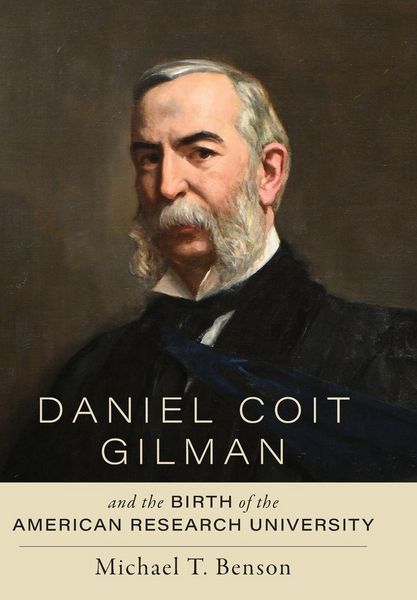
Daniel Coit Gilman and the Birth of the American Research University
49,99 €
UVP
56,20 €
inkl. gesetzl. MwSt.,
Beschreibung
Produktdetails
Einband
Gebundene Ausgabe
Erscheinungsdatum
01.10.2022
Abbildungen
schwarz-weiss Illustrationen
Verlag
Johns Hopkins University PressSeitenzahl
376
Maße (L/B/H)
23,4/15,6/2,5 cm
Gewicht
680 g
Sprache
Englisch
ISBN
978-1-4214-4416-1
One of the most remarkable education leaders of the late nineteenth century and the creator of the modern American research university finally gets his due.
Daniel Coit Gilman, a Yale-trained geographer who first worked as librarian at his alma mater, led a truly remarkable life. He was selected as the third president of the University of California; was elected as the first president of Johns Hopkins University, where he served for twenty-five years; served as one of the original founders of the Association of American Universities; and--at an age when most retired--was hand-picked by Andrew Carnegie to head up his eponymous institution in Washington, DC.
In Daniel Coit Gilman and the Birth of the American Research University, Michael T. Benson argues that Gilman's enduring legacy will always be as the father of the modern research university--a uniquely American invention that remains the envy of the entire world. In the past half-century, nothing has been written about Gilman that takes into account his detailed journals, reviews his prodigious correspondence, or considers his broad external board service. This book fills an enormous void in the history of the birth of the new American system of higher education, especially as it relates to graduate education. The late 1800s, Benson points out, is one of the most pivotal periods in the development of the American university model; this book reveals that there is no more important figure in shaping that model than Daniel Coit Gilman.
Benson focuses on Gilman's time deliberating on, discussing, developing, refining, and eventually implementing the plan that brought the modern research university to life in 1876. He also explains how many university elements that we take for granted--the graduate fellowships, the emphasis on primary investigations and discovery, the funding of the best laboratory and research spaces, the scholarly journals, the university presses, the sprawling health sciences complexes with teaching hospitals--were put in place by Gilman at Johns Hopkins University. Ultimately, the book shows, Gilman and his colleagues forced all institutions to reexamine their own model and to make the requisite changes to adapt, survive, thrive, compete, and contribute.
Noch keine Bewertungen vorhanden
Verfassen Sie die erste Bewertung zu diesem Artikel
Helfen Sie anderen Kundinnen und Kunden durch Ihre Meinung.
Kurze Frage zu unserer Seite
Vielen Dank für Ihr Feedback
Wir nutzen Ihr Feedback, um unsere Produktseiten zu verbessern. Bitte haben Sie Verständnis, dass wir Ihnen keine Rückmeldung geben können. Falls Sie Kontakt mit uns aufnehmen möchten, können Sie sich aber gerne an unseren Kund*innenservice wenden.
zum Kundenservice