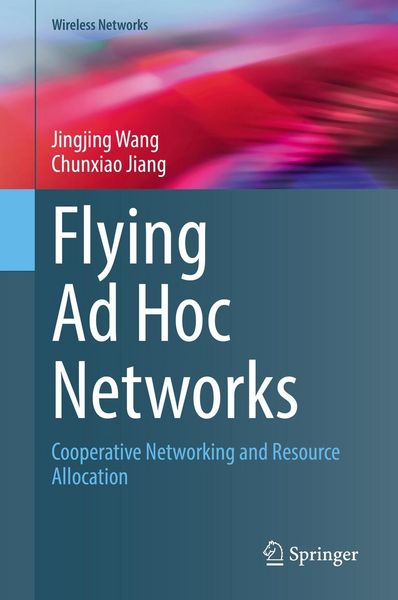
Flying Ad Hoc Networks Cooperative Networking and Resource Allocation
-
- Hardcover
- Taschenbuch
- eBook ausgewählt
-
Form:Einzelkauf Download
-
Sprache:Englisch
131,99 €
inkl. gesetzl. MwSt.Beschreibung
Produktdetails
Format
Kopierschutz
Nein
Family Sharing
Nein
Text-to-Speech
Nein
Erscheinungsdatum
10.02.2022
Verlag
Springer Nature SingaporeSeitenzahl
287 (Printausgabe)
Dateigröße
17009 KB
Sprache
Englisch
EAN
9789811688508
Relying on unmanned autonomous flight control programs, unmanned aerial vehicles (UAVs) equipped with radio communication devices have been actively developed around the world. Given their low cost, flexible maneuvering and unmanned operation, UAVs have been widely used in both civilian operations and military missions, including environmental monitoring, emergency communications, express distribution, even military surveillance and attacks, for example. Given that a range of standards and protocols used in terrestrial wireless networks are not applicable to UAV networks, and that some practical constraints such as battery power and no-fly zone hinder the maneuverability capability of a single UAV, we need to explore advanced communication and networking theories and methods for the sake of supporting future ultra-reliable and low-latency applications. Typically, the full potential of UAV network's functionalities can be tapped with the aid of the cooperation of multiple drones relying on their ad hoc networking, in-network communications and coordinated control. Furthermore, some swarm intelligence models and algorithms conceived for dynamic negotiation, path programming, formation flight and task assignment of multiple cooperative drones are also beneficial in terms of extending UAV's functionalities and coverage, as well as of increasing their efficiency. We call the networking and cooperation of multiple drones as the terminology 'flying ad hoc network (FANET)', and there indeed are numerous new challenges to be overcome before the idespread of so-called heterogeneous FANETs. In this book, we examine a range of technical issues in FANETs, from physical-layer channel modeling to MAC-layer resource allocation, while also introducing readers to UAV aided mobile edge computing techniques.
Noch keine Bewertungen vorhanden
Verfassen Sie die erste Bewertung zu diesem Artikel
Helfen Sie anderen Kundinnen und Kunden durch Ihre Meinung.
Kurze Frage zu unserer Seite
Vielen Dank für Ihr Feedback
Wir nutzen Ihr Feedback, um unsere Produktseiten zu verbessern. Bitte haben Sie Verständnis, dass wir Ihnen keine Rückmeldung geben können. Falls Sie Kontakt mit uns aufnehmen möchten, können Sie sich aber gerne an unseren Kund*innenservice wenden.
zum Kundenservice