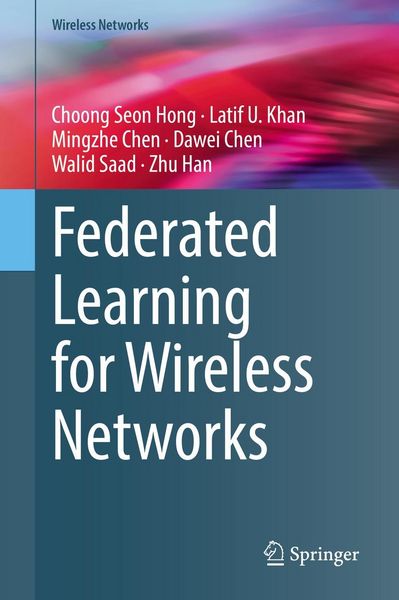
Federated Learning for Wireless Networks
-
- Hardcover
- Taschenbuch
- eBook ausgewählt
-
Form:Einzelkauf Download
-
Sprache:Englisch
164,99 €
inkl. gesetzl. MwSt.Beschreibung
Produktdetails
Format
Kopierschutz
Nein
Family Sharing
Nein
Text-to-Speech
Nein
Erscheinungsdatum
01.01.2022
Verlag
Springer Nature SingaporeSeitenzahl
253 (Printausgabe)
Dateigröße
10851 KB
Sprache
Englisch
EAN
9789811649639
Recently machine learning schemes have attained significant attention as key enablers for next-generation wireless systems. Currently, wireless systems are mostly using machine learning schemes that are based on centralizing the training and inference processes by migrating the end-devices data to a third party centralized location. However, these schemes lead to end-devices privacy leakage. To address these issues, one can use a distributed machine learning at network edge. In this context, federated learning (FL) is one of most important distributed learning algorithm, allowing devices to train a shared machine learning model while keeping data locally. However, applying FL in wireless networks and optimizing the performance involves a range of research topics. For example, in FL, training machine learning models require communication between wireless devices and edge servers via wireless links. Therefore, wireless impairments such as uncertainties among wireless channel states, interference, and noise significantly affect the performance of FL. On the other hand, federated-reinforcement learning leverages distributed computation power and data to solve complex optimization problems that arise in various use cases, such as interference alignment, resource management, clustering, and network control. Traditionally, FL makes the assumption that edge devices will unconditionally participate in the tasks when invited, which is not practical in reality due to the cost of model training. As such, building incentive mechanisms is indispensable for FL networks.
This book provides a comprehensive overview of FL for wireless networks. It is divided into three main parts: The first part briefly discusses the fundamentals of FL for wireless networks, while the second part comprehensively examines the design and analysis of wireless FL, covering resource optimization, incentive mechanism, security and privacy. It also presents several solutions based on optimizationtheory, graph theory, and game theory to optimize the performance of federated learning in wireless networks. Lastly, the third part describes several applications of FL in wireless networks.
Noch keine Bewertungen vorhanden
Verfassen Sie die erste Bewertung zu diesem Artikel
Helfen Sie anderen Kundinnen und Kunden durch Ihre Meinung.
Kurze Frage zu unserer Seite
Vielen Dank für Ihr Feedback
Wir nutzen Ihr Feedback, um unsere Produktseiten zu verbessern. Bitte haben Sie Verständnis, dass wir Ihnen keine Rückmeldung geben können. Falls Sie Kontakt mit uns aufnehmen möchten, können Sie sich aber gerne an unseren Kund*innenservice wenden.
zum Kundenservice