KI-Beratung Beta

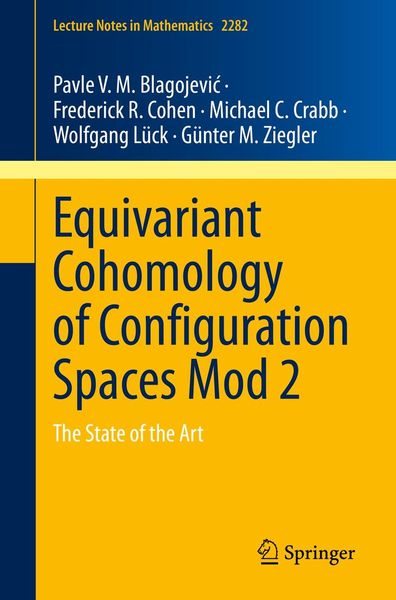
Produktbild: Equivariant Cohomology of Configuration Spaces Mod 2
Band 2282

Equivariant Cohomology of Configuration Spaces Mod 2 The State of the Art

  • Form:Einzelkauf Download
  • Sprache:Englisch

60,49 €

inkl. gesetzl. MwSt.

Beschreibung

This book gives a brief treatment of the equivariant cohomology of the classical configuration space F(R^d,n) from its beginnings to recent developments. This subject has been studied intensively, starting with the classical papers of Artin (1925/1947) on the theory of braids, and progressing through...

Beschreibung

This book gives a brief treatment of the equivariant cohomology of the classical configuration space F(R^d,n) from its beginnings to recent developments. This subject has been studied intensively, starting with the classical papers of Artin (1925/1947) on the theory of braids, and progressing through the work of Fox and Neuwirth (1962), Fadell and Neuwirth (1962), and Arnol'd (1969). The focus of this book is on the mod 2 equivariant cohomology algebras of F(R^d,n), whose additive structure was described by Cohen (1976) and whose algebra structure was studied in an influential paper by Hung (1990). A detailed new proof of Hung's main theorem is given, however it is shown that some of the arguments given by him on the way to his result are incorrect, as are some of the intermediate results in his paper.

This invalidates a paper by three of the authors, Blagojevic, Lück and Ziegler (2016), who used a claimed intermediate result in order to derive lower bounds for the existence of k-regular and l-skew embeddings. Using the new proof of Hung's main theorem, new lower bounds for the existence of highly regular embeddings are obtained: Some of them agree with the previously claimed bounds, some are weaker.

Assuming only a standard graduate background in algebraic topology, this book carefully guides the reader on the way into the subject. It is aimed at graduate students and researchers interested in the development of algebraic topology in its applications in geometry.

Produktdetails

Format

PDF

Kopierschutz

Nein

Family Sharing

Nein

Text-to-Speech

Nein

Produktdetails

Format

PDF

Format

eBooks im PDF-Format haben eine festgelegte Seitengröße und eignen sich daher nur bedingt zum Lesen auf einem tolino eReader oder Smartphone. Für den vollen Lesegenuss empfehlen wir Ihnen bei PDF-eBooks die Verwendung eines Tablets oder Computers.

Kopierschutz

Nein

Kopierschutz

Dieses eBook können Sie uneingeschränkt auf allen Geräten der tolino Familie, allen sonstigen eReadern und am PC lesen. Das eBook ist nicht kopiergeschützt und kann ein personalisiertes Wasserzeichen enthalten. Weitere Hinweise zum Lesen von eBooks mit einem personalisierten Wasserzeichen finden Sie unter Hilfe/Downloads.

Family Sharing

Nein

Family Sharing

Mit Family Sharing können Sie eBooks innerhalb Ihrer Familie (max. sechs Mitglieder im gleichen Haushalt) teilen. Sie entscheiden selbst, welches Buch Sie mit welchem Familienmitglied teilen möchten. Auch das parallele Lesen durch verschiedene Familienmitglieder ist durch Family Sharing möglich. Um eBooks zu teilen oder geteilt zu bekommen, muss jedes Familienmitglied ein Konto bei Thalia oder einem anderen tolino-Buchhändler haben. Weitere Informationen finden Sie unter Hilfe/Family-Sharing.

Text-to-Speech

Nein

Text-to-Speech

Bedeutet Ihnen Stimme mehr als Text? Mit der Funktion Text-to-Speech können Sie sich im tolino webReader und in der aktuellen Thalia – Lesen & Hören App das eBook vorlesen lassen. Weitere Informationen finden Sie unter Hilfe/Text-to-Speech.

Erscheinungsdatum

01.01.2022

Verlag Springer
Seitenzahl

210 (Printausgabe)

Dateigröße

9157 KB

Sprache

Englisch

EAN

9783030841386

Barrierefreiheit
  • keine Information zur Barrierefreiheit bekannt

Noch keine Bewertungen vorhanden

Verfassen Sie die erste Bewertung zu diesem Artikel

Helfen Sie anderen Kundinnen und Kunden durch Ihre Meinung.

Kundinnen und Kunden meinen

Bewertungen (0)

Weitere Artikel finden Sie in

  • Produktbild: Equivariant Cohomology of Configuration Spaces Mod 2