KI-Beratung Beta

Gutscheinbedingungen

**Gültig bis 31.10.2026 ab einem Mindestbestellwert von 30€ auf Spielzeug, Schreibwaren, Filme, Geschenke & Trends, Musik, tolino eReader & Zubehör, Hörbücher und Hörbuch-Downloads, nicht preisgebundene Bücher und Kalender online auf thalia.at und in der Thalia App. Einzelne Artikel können ausgeschlossen sein. Aufgrund der Buchpreisbindung sind deutschsprachige Bücher und eBooks ausgenommen. Zusätzlich ausgenommen sind Abos & Flatrates, Games, Geschenkkarten/-boxen, Shelfies, Software, Zeitschriften sowie einzelne Artikel von tonies®. Pro Einkauf einmal einlösbar. Click & Collect nur bei Onlinevorabzahlung möglich. Keine Barauszahlung. Nicht kombinierbar mit anderen Aktionen und Gutscheinen. Gutschein wird auf max. 500€ Bestellwert angerechnet. Nicht gültig für Versandkosten und Services. Preisgebundene Artikel sind vom Mindestbestellwert ausgeschlossen.

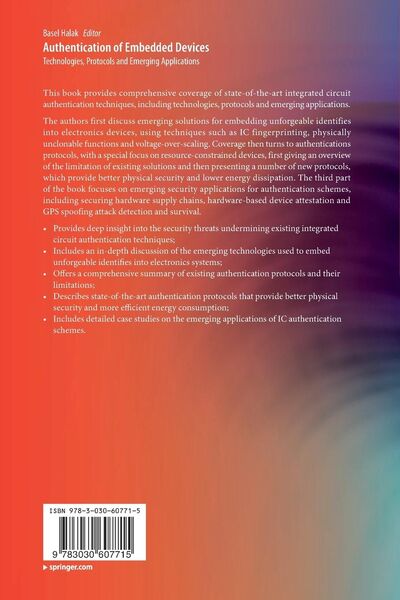
  • Produktbild: Authentication of Embedded Devices
  • Produktbild: Authentication of Embedded Devices
- 11%

Authentication of Embedded Devices Technologies, Protocols and Emerging Applications

11% sparen

62,99 € UVP 71,49 €

inkl. gesetzl. MwSt., Versandkostenfrei


Beschreibung

Produktdetails

Einband

Taschenbuch

Erscheinungsdatum

23.01.2022

Abbildungen

XV, 188 p. 74 illus., 36 illus. in color.

Herausgeber

Basel Halak

Verlag

Springer

Seitenzahl

188

Maße (L/B/H)

23,5/15,5/1,2 cm

Gewicht

318 g

Sprache

Englisch

ISBN

978-3-030-60771-5

Beschreibung

Portrait

Dr Basel Halak is the director of the embedded systems and IoT program at the University of Southampton, a visiting professor at the Technical University of Kaiserslautern,a visiting professor at the Kazakh-British Technical University, a fellow of the royal academy of engineering and a senior fellow of the higher education academy. He has written over 70-refereed conference and journal papers, and authored two books, including the first textbook on Physically Unclonable Functions. His research expertise include evaluation of security of hardware devices, development of appropriate countermeasures, the development of mathematical formalisms of reliability issues in CMOS circuits (e.g. crosstalk, radiation, ageing), and the use of fault tolerance techniques to improve the robustness of electronics systems against such issues.. Dr Halak lectures on digital design, Secure Hardware and Cryptography, supervises a number of MSc and PhD students, and is the ECS Exchange Coordinators. He is also leading European Masters in Embedded Computing Systems (EMECS) , a two year course run in collaboration with Kaiserslautern University in Germany and the Norwegian University of Science and Technology in Trondheim (electronics and communication). Dr Halak serves on several technical program committees such as HOST, IEEE DATE, IVSW, ICCCA, ICCCS, MTV and EWME. He is an associate editor of IEEE access and an editor of the IET circuit devices and system journal. He is also a member of the hardware security-working group of the World Wide Web Consortium (W3C).

Produktdetails

Einband

Taschenbuch

Erscheinungsdatum

23.01.2022

Abbildungen

XV, 188 p. 74 illus., 36 illus. in color.

Herausgeber

Basel Halak

Verlag

Springer

Seitenzahl

188

Maße (L/B/H)

23,5/15,5/1,2 cm

Gewicht

318 g

Sprache

Englisch

ISBN

978-3-030-60771-5

Herstelleradresse

Springer-Verlag KG
Sachsenplatz 4-6
1201 Wien
AT

Email: ProductSafety@springernature.com

Noch keine Bewertungen vorhanden

Verfassen Sie die erste Bewertung zu diesem Artikel

Helfen Sie anderen Kundinnen und Kunden durch Ihre Meinung.

Kundinnen und Kunden meinen

Bewertungen (0)

  • Produktbild: Authentication of Embedded Devices
  • Produktbild: Authentication of Embedded Devices
  • Introduction.- Integrated Circuit Fingerprinting.- Novel PUF designs for device Identification.- Authentication Protocols: Standards, limitation and research opportunities.- Hardware-based Authentication Protocols for better physical security.- Energy Efficient Authentication Protocols.- Case study 1: Securing Hardware Supply Chain.- Case study 2: GPS spoofing attack detection and survival.