Gutscheinbedingungen

**Gültig von 22.06.2026 ab 19 Uhr bis 23.06.2026 24 Uhr auf Spielzeug, Schreibwaren, Filme, Geschenke & Trends, Musik, tolino eReader & Zubehör, Hörbücher und Hörbuch-Downloads (außer Abo), nicht preisgebundene Bücher und Kalender online auf thalia.at und in der Thalia App. Einzelne Artikel können ausgeschlossen sein. Aufgrund der Buchpreisbindung sind deutschsprachige Bücher und eBooks ausgenommen. Zusätzlich ausgenommen sind preisgebundene Artikel, Abos & Flatrates, eBooks, Games, Geschenkkarten/-boxen, Shelfies, Software, Zeitschriften sowie einzelne Artikel von tonies®. Pro Einkauf einmal einlösbar. Click & Collect nur bei Onlinevorabzahlung möglich. Keine Barauszahlung. Nicht kombinierbar mit anderen Aktionen und Gutscheinen. Gutschein wird auf max. 500€ Bestellwert angerechnet. Nicht gültig für Versandkosten und Services.

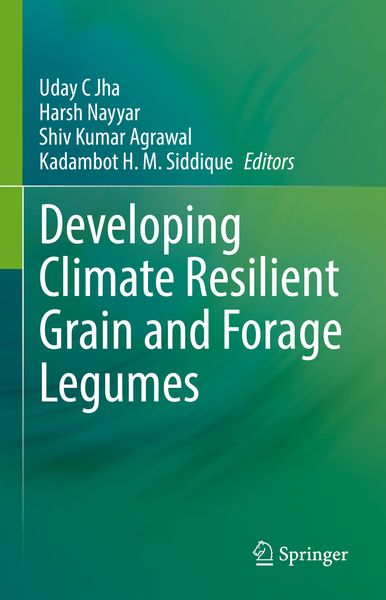
Produktbild: Developing Climate Resilient Grain and Forage Legumes

Developing Climate Resilient Grain and Forage Legumes

179,99 €

inkl. gesetzl. MwSt., Versandkostenfrei


Beschreibung

Produktdetails

Einband

Gebundene Ausgabe

Erscheinungsdatum

28.05.2022

Herausgeber

Uday C. Jha + weitere

Verlag

Springer Singapore

Seitenzahl

327

Maße (L/B/H)

24,1/16/2,4 cm

Auflage

1st ed. 2022

Sprache

Englisch

ISBN

978-981-16-9847-7

Beschreibung

Portrait

Dr. Uday C Jha graduated from Visva-Bharati University, Santiniketan, India. He is working in the area of grain legume breeding, genetics, and genomics for abiotic stress tolerance since 2010 at the Indian Institute of Pulses Research, Kanpur, ICAR, India. He has more than 32 peered-reviewed international publications and 1 edited book. He has attended and delivered oral and poster presentation in various national and international conferences. He is associated in developing six chickpea varieties. Dr. Jha was awarded with ISPRD fellowship in 2016 by the Indian Society of Pulses & Research Development (ISPRD) and Young Scientist Award by IJBSM society in 2017 at Jaipur India. He has also received the Chickpea Team Award in 2020 from IIPR, Kanpur. He is serving as editorial board member of the journal BMC Plant Biology .


Professor Harsh Nayyar is currently a professor in the Department of Botany, Panjab University, Chandigarh. He graduated from Punjab Agricultural University, India, and worked at the Indian Council of Agricultural Research and H.P. Agricultural University, Palampur, India, prior to his present position. His research program aims to study the responses of various food legumes such as chickpea, lentil, mungbean, and urdbean to abiotic stresses like heat, drought, and cold as well as their combination. He is developing convenient and easy screening methods to identify stress-tolerant legumes and also investigating the mechanisms at various organizational levels underlying stress tolerance. He has published about 140 research papers in peer-reviewed high impact factor research journals.


Dr Shiv Kumar holds a Ph.D. in plant breeding from the GB Pant University of Agriculture and Technology, Pantnagar, India. His area of expertise includes crop improvement through resistance breeding, widening the genetic base through pre-breeding, and development of genetic and genomic resources in food legumes. Duringthe 30 years of his professional career, he, in collaboration with national partners, has contributed to the development of 59 lentil, 5 mung bean, 2 urdbean, 1 rice, and 3 grass pea varieties and published 196 peer-reviewed journal articles, 72 book chapters, 9 books, 7 technical bulletins, and 2 training manuals. He is a fellow of professional societies including the International Legumes Society, the Indian Society of Genetics and Plant Breeding, and the Indian Society of Pulses Research and Development.


Professor Dr. Kadambot Siddique   is the Hackett Professor of Agriculture Chair and Director of The UWA Institute of Agriculture, The University of Western Australia.  He has a national and international reputation in agricultural science, especially in the fields of crop physiology, production agronomy, farming systems, genetic resources, breeding research in cereal, grain and pasture legumes, and oilseed crops. He has publishedmore than 580 scientific papers and book chapters and books. Professor Siddique is a highly cited researcher (Hi Ci) in agricultural science and plant and animal science (Thomson Reuters/ Clarivate Analytics).He is a fellow of the Australian Academy of Technological Sciences and Engineering (FTSE), the Australian Agricultural Institute, and the Indian National Academy of Agricultural Sciences (FNAAS).  Prof. Siddique is a fellow of the African Academy of Sciences (FAAS) (first Australia to be elected to the Academy). He is also a fellow of the Indian Society of Plant Physiology.

Produktdetails

Einband

Gebundene Ausgabe

Erscheinungsdatum

28.05.2022

Herausgeber

Verlag

Springer Singapore

Seitenzahl

327

Maße (L/B/H)

24,1/16/2,4 cm

Auflage

1st ed. 2022

Sprache

Englisch

ISBN

978-981-16-9847-7

Herstelleradresse

Springer-Verlag KG
Sachsenplatz 4-6
1201 Wien
AT

Email: ProductSafety@springernature.com

Kundinnen und Kunden meinen

0 Bewertungen

Informationen zu Bewertungen

Zur Abgabe einer Bewertung ist eine Anmeldung im Konto notwendig. Die Authentizität der Bewertungen wird von uns nicht überprüft. Wir behalten uns vor, Bewertungstexte, die unseren Richtlinien widersprechen, entsprechend zu kürzen oder zu löschen.

Die Bewertungen sind nach Format, Anzahl Sterne und Datum sortiert.

Verfassen Sie die erste Bewertung zu diesem Artikel

Helfen Sie anderen Kund*innen durch Ihre Meinung

Kundinnen und Kunden meinen

0 Bewertungen filtern

  • Produktbild: Developing Climate Resilient Grain and Forage Legumes
  • Chapter 1. Improving chickpea genetic gain under rising drought and heat stress using breeding approaches and modern technologies.- Chapter 2. Breeding chickpea for climate resilience: An overview.- Chapter 3. Reduction of Phytic Acid and Enhancement of Bioavailable Micronutrients in Common Beans (Phaseolus vulgaris L.) in Changing Climatic Scenario.- Chapter 4. Developing climate resilient Cowpea (Vigna unguiculata [L].Walp) through genomics-assisted breeding approaches.- Chapter 5. Fenugreek, a legume spice and multi-use crop adapted to a changing climate.- Chapter 6. Grass pea an inherent abiotic stress  tolerant legume: Current status and future scope under changing environment.- Chapter 7. Breeding groundnut cultivars for resilience to climate change effects.- Chapter 8. Horse gram, an underutilized climate-resilient legume: Breeding and genomic approach for improving future genetic gain.-Chapter 9. Understanding abiotic stress responses in lentil under changing climate regimes.- Chapter 10. Approaches towards developing heat and drought tolerance in Mungbean.- Chapter 11. A Review on Stress Physiology and Breeding Potential of an underutilized, multipurpose legume: Rice Bean (Vigna umbellata).- Chapter 12. Physiological Traits Based Breeding to Achieve Higher Yield in soybean Crop.- Chapter 13. Sunnhemp-A Climate Smart Crop.