
KI-Beratung Beta

Gutscheinbedingungen

**Gültig am 25.11.2026 auf fremdsprachige Bücher online auf thalia.at und in der Thalia App. Einzelne Artikel können ausgeschlossen sein. Ausgenommen sind preisgebundene Artikel & eBooks. Pro Einkauf einmal einlösbar. Click & Collect nur bei Onlinevorabzahlung möglich. Keine Barauszahlung. Nicht kombinierbar mit anderen Aktionen und Gutscheinen. Gutschein wird auf max. 500€ Bestellwert angerechnet. Nicht gültig für Geschenkkarten, Versandkosten und Services.

  • Produktbild: Methodological Considerations in Morphological Processing Research
  • Produktbild: Methodological Considerations in Morphological Processing Research
Band 49

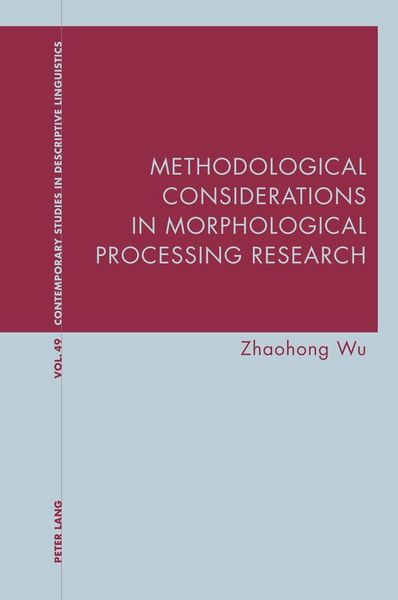
Methodological Considerations in Morphological Processing Research

68,05 €

inkl. gesetzl. MwSt., Versandkostenfrei


Beschreibung

This book falls in the broad subject area of psycholinguistics and second-language acquisition. More specifically, this book is written for researchers stepping into the field of morphological processing so that they are not overwhelmed by the large number of individual studies and do not lose sight...

Beschreibung

This book falls in the broad subject area of psycholinguistics and second-language acquisition. More specifically, this book is written for researchers stepping into the field of morphological processing so that they are not overwhelmed by the large number of individual studies and do not lose sight of the whole picture. With a comprehensive review of the relevant factors that first- and second-language morphological processing researchers need to take into consideration, including material- and procedure-related factors, participant individual differences, and participant group-level differences, this book is a useful theoretical reference work for morphological processing researchers. By considering the various potential confounding factors reviewed in this book, researchers are in a better position to more scientifically and meticulously reduce or eliminate the effects of potential covariates so that they can focus on their independent variables of interest. It may also help researchers in evaluating previous studies and their findings and whether or not these studies may have failed to consider possible confounding factors.

Produktdetails

Einband

Taschenbuch

Erscheinungsdatum

24.12.2021

Abbildungen

20

Herausgeber Graeme Davis + weitere

Produktdetails

Einband

Taschenbuch

Erscheinungsdatum

24.12.2021

Abbildungen

20

Herausgeber
Verlag Peter Lang Ltd. International Academic Publishers
Seitenzahl

258

Maße (L/B/H)

22,9/15,2/1,5 cm

Gewicht

379 g

Auflage

1

Sprache

Englisch

ISBN

978-1-80079-634-8

EU-Ansprechpartner

Kolibri 360 GmbH
Ettore-Bugatti-Straße 6-14
51149 Köln
DE
produktsicherheit@kolibri360.de

Herstelleradresse

Peter Lang
Avenue du Théâtre 7
1005 Lausanne
CH
orders@peterlang.com

Noch keine Bewertungen vorhanden

Verfassen Sie die erste Bewertung zu diesem Artikel

Helfen Sie anderen Kundinnen und Kunden durch Ihre Meinung.

Kundinnen und Kunden meinen

Bewertungen (0)

Die Leseprobe wird geladen.
  • Produktbild: Methodological Considerations in Morphological Processing Research
  • Produktbild: Methodological Considerations in Morphological Processing Research

  • Contents: Introduction: Different Approaches to Morphology – Different Accounts of Morphological Processing in the L1 Psycholinguistic Literature – Research Methods Employed in the L1 and L2 Morphological Processing Literature – Controversies in the L2 Morphological Processing Literature – Overview of the Book – Material-and Procedure-Related Factors in L1 and L2 Morphological Processing: The Material-Related Factors of Frequency – The Material-Related Factors of Length – The Material-Related Factors of Neighborhood Size (or Density) and Neighborhood Frequency – The Material-Related Factors of Morphological Family – The Material-Related Semantic Factors – The Material-Related Factor of Stem Homograph – The Material-Related Factors of Affix Characteristics – The Material-Related Factor of Presentation Context (Words in Isolation vs. Words in Context) – The Material-Related Factor of Grammatical Class – The Material-Related Factor of Prime Lexicality – The Material-Related Factor of Boundness of the Stem (Free vs. Bound) – The Material-Related Factor of Concreteness – The Material-Related Factor of Stem Priming vs. Suffix Priming – The Material-Related Factor of Stem Alternation – The Material-Related Factor of Conditional Root Uniqueness Point (CRUP) for Prefixed Words – The Material-Related Factor of Relatedness Proportion – The Material-Related Factor of Orthographic Familiarity – The Material-Related Factor of Word Formation Type – The Material-Related Factor of the Spelling-Meaning Consistency of Prefixes – The Material-Related Factor of Linearity and Structural Complexity of Derivations – The Material-Related Factor of Linear vs. Structural Distance on L2 (in)sensitivity to Agreement Violations – The Material-Related Factor of the Paradigmatic Effect of Entropy – The Material-Related Factors That Are Uniquely Relevant to Compound Processing – The Procedure-Related Factors That Could Possibly Affect Morphological Processing – Participant Individual-Level Differences in L1 and L2 Morphological Processing: Cognition-Related Individual Differences – Experience-Related Individual Differences – Age-Related Individual Differences – Participant Group-Level Differences in L1 and L2 Morphological Processing: Participant Group-Level Differences in L1 Morphology – Participant Group-Level Differences in L1 Orthography and Writing System – Participant Group-Level Differences in L1 Prosodic Structure or L1 Phonology – Participant Group-Level Differences in Sex – Participant Group-Level Differences in Handedness – General Discussions and Implications: A Brief Summary of Modulating Factors in Morphological Processing – Educational Implications.