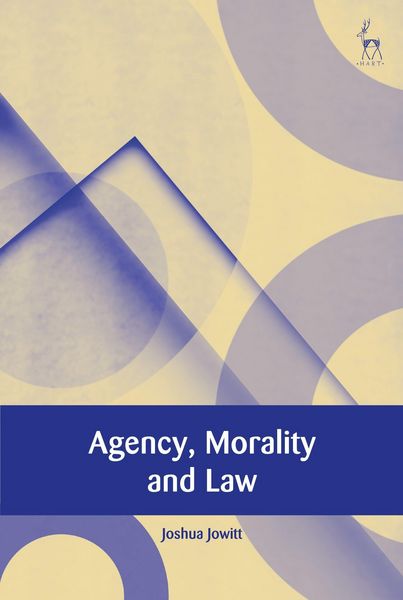
Agency Morality & Law
-
- Hardcover ausgewählt
- Taschenbuch
- eBook
-
Sprache:Englisch
127,99 €
inkl. gesetzl. MwSt.,
Beschreibung
Produktdetails
Einband
Gebundene Ausgabe
Erscheinungsdatum
12.01.2023
Herausgeber
Mark Van Hoecke + weitereVerlag
Hart PublishingSeitenzahl
184
Maße (L/B/H)
23,4/15,6/2,5 cm
Gewicht
420 g
Sprache
Englisch
ISBN
978-1-5099-4768-3
This book argues that this seemingly innocuous question is of central importance to the philosophy of law and, by extension, of the very concept of law itself. It advances a position grounded in the secular natural law tradition, and in doing so addresses the two success criteria for this position head on:
Firstly, that commitment to the existence of a supreme moral principle is required;
Secondly, that any supreme moral principle must be identifiable through human reason.
The book argues that these conditions are met by Alan Gewirth's Principle of Generic Consistency (PGC), which - through a dialectically necessary argument - locates the existence of universally applicable moral norms in the concept of agency. Given the very purpose of law is to guide action, legal norms must be located in a unified hierarchy of practical reason. It follows that, if law is to succeed in claiming to be capable of guiding our action, moral permissibility with reference to the PGC is a necessary condition of a rule's legal validity.
This strong theory of natural law is defended throughout, both against moral sceptics and positions within contemporary legal positivism.
Noch keine Bewertungen vorhanden
Verfassen Sie die erste Bewertung zu diesem Artikel
Helfen Sie anderen Kundinnen und Kunden durch Ihre Meinung.
Kurze Frage zu unserer Seite
Vielen Dank für Ihr Feedback
Wir nutzen Ihr Feedback, um unsere Produktseiten zu verbessern. Bitte haben Sie Verständnis, dass wir Ihnen keine Rückmeldung geben können. Falls Sie Kontakt mit uns aufnehmen möchten, können Sie sich aber gerne an unseren Kund*innenservice wenden.
zum Kundenservice