Gutscheinbedingungen

**Gültig am 28.06.2026 auf Spielzeug, Schreibwaren, Filme, Geschenke & Trends, Musik, tolino eReader & Zubehör, Hörbücher und Hörbuch-Downloads (außer Abo), nicht preisgebundene Bücher und Kalender online auf thalia.at und in der Thalia App. Einzelne Artikel können ausgeschlossen sein. Aufgrund der Buchpreisbindung sind deutschsprachige Bücher und eBooks ausgenommen. Zusätzlich ausgenommen sind preisgebundene Artikel, Abos & Flatrates, eBooks, Games, Geschenkkarten/-boxen, Shelfies, Software, Zeitschriften sowie einzelne Artikel von tonies®. Pro Einkauf einmal einlösbar. Click & Collect nur bei Onlinevorabzahlung möglich. Keine Barauszahlung. Nicht kombinierbar mit anderen Aktionen und Gutscheinen. Gutschein wird auf max. 500€ Bestellwert angerechnet. Nicht gültig für Versandkosten und Services.

  • Produktbild: Civil Society and Peacebuilding in Sub-Saharan Africa in the Anthropocene
  • Produktbild: Civil Society and Peacebuilding in Sub-Saharan Africa in the Anthropocene
Band 34

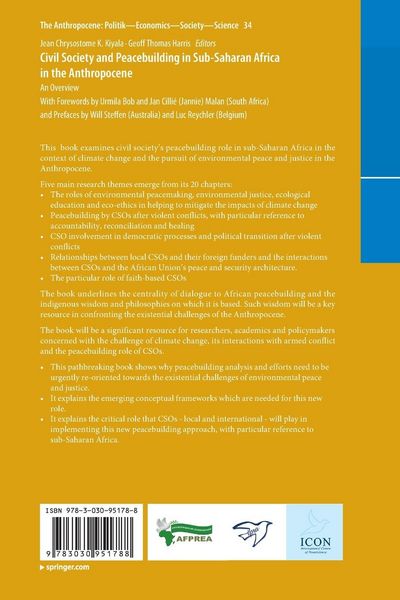
Civil Society and Peacebuilding in Sub-Saharan Africa in the Anthropocene An Overview

171,99 €

inkl. gesetzl. MwSt., Versandkostenfrei


Beschreibung

Produktdetails

Einband

Taschenbuch

Erscheinungsdatum

23.04.2022

Herausgeber

Jean Chrysostome K. Kiyala + weitere

Verlag

Springer

Seitenzahl

580

Maße (L/B/H)

23,5/15,5/3,3 cm

Gewicht

920 g

Auflage

1st edition 2022

Sprache

Englisch

ISBN

978-3-030-95178-8

Beschreibung

Portrait

Jean Chrysostome K. Kiyala (South Africa, DRC) is Assoc. Prof., Univ. of Bandundu, DRC & Senior Lecturer, International Centre of Nonviolence, Durban Univ. of Technology (DUT). He holds Diplomas & B.A.s in Philosophy, Theology, Mission and in Religious Studies, M.Phil. from St Augustine College, a conferred M. Tech. in Public Management, and in 2016, he was awarded a Ph.D. in Management Sciences (Peacebuilding programme) by DUT. His research interests comprise child soldiering, restorative justice, transitional justice, and peacebuilding. Geoff Harris (South Africa, Australia) is Prof., International Centre for Nonviolence, Durban University of Technology, where he set up its postgraduate Peacebuilding Programme. His  research interests include restorative justice, reintegration of prisoners and demilitarisation. He held posts at La Trobe Univ., Australia (1969-71), Univ. of Papua New Guinea (1972-78), Lincoln Univ., New Zealand (1978-80), Univ. ofNew England, Australia (1980-99), Univ. of Natal and Univ. of KwaZulu-Natal (1999-2011) and at DUT (2012- ), South Africa.


Produktdetails

Einband

Taschenbuch

Erscheinungsdatum

23.04.2022

Herausgeber

Verlag

Springer

Seitenzahl

580

Maße (L/B/H)

23,5/15,5/3,3 cm

Gewicht

920 g

Auflage

1st edition 2022

Sprache

Englisch

ISBN

978-3-030-95178-8

Herstelleradresse

Springer-Verlag KG
Sachsenplatz 4-6
1201 Wien
AT

Email: GPSR Kontakt

Kundinnen und Kunden meinen

0 Bewertungen

Informationen zu Bewertungen

Zur Abgabe einer Bewertung ist eine Anmeldung im Konto notwendig. Die Authentizität der Bewertungen wird von uns nicht überprüft. Wir behalten uns vor, Bewertungstexte, die unseren Richtlinien widersprechen, entsprechend zu kürzen oder zu löschen.

Die Bewertungen sind nach Format, Anzahl Sterne und Datum sortiert.

Verfassen Sie die erste Bewertung zu diesem Artikel

Helfen Sie anderen Kund*innen durch Ihre Meinung

Kundinnen und Kunden meinen

0 Bewertungen filtern

  • Produktbild: Civil Society and Peacebuilding in Sub-Saharan Africa in the Anthropocene
  • Produktbild: Civil Society and Peacebuilding in Sub-Saharan Africa in the Anthropocene
  • 1 General Introduction.- 2 Peace Ecology in the Anthropocene for Africa.- 3 Civil Society, Climate Change, Security Risks Management and Peacebuilding in the Anthropocene.- 4 Faith-based Organisations and Environmental Peace: Impact of Laudato Si’ and Its Relevance in the Anthropocene.- 5 Healing Nature and Creation in the Anthropocene: A Reflection on the Role of Religion.- 6 Empowering Women to Build Peace: A Case Study of Grace to Heal Trust in Lupane District.- 7 Peacebuilding through Indigenous Knowledge Systems: Lessons from Civil Society Organisations in Zimbabwe.- 8 Civil Society and Peacebuilding in the Kivu Provinces of the Democratic Republic of Congo.- 9 Zimbabwe’s National Peace and Reconciliation Commission and Civil Society: Partners in Peacebuilding?.- 10 Civil Society and Peacebuilding in the Democratic Republic of Congo: Opportunities, Challenges and Recommendations.- 11 Promoting Democratisation in DR Congo: The Case Study of Act for Transparent and Peaceful Elections.- 12 Civil Society Organisations and School Peace Clubs in South Africa: An Outcome Evaluation.- 13 The Challenges and Opportunities for Civil Society in Peacebuilding: Lessons from the Matabeleland Collective, Zimbabwe.- 14 The Role of Civil Society Participation in Social Cohesion Processes in KwaZulu-Natal, South Africa.-15 Building the Capacity of Civil Society Organisations in Nonviolent Campaigning: A Case Study from South Sudan.- 16 How Informal Peace Committees Complement Macro-infrastructures for Peace in Zimbabwe.- 17 Protecting and Nurturing Children Born from Rape in South Kivu Communities: A Challenge for Civil Society.- 18 Indigenous Peacebuilding Approaches and the Accountability of Former Child Soldiers: African Case Studies.- 19 Navigating Channels for Civil Society Participation in Conflict Prevention and Peace-Making in the African Peace & Security Architecture.- 20 Centre-periphery Relations Between Civil Society Organisations and External Funding Partners: A Case Study of South Kivu’s Peace and Development Agenda.