KI-Beratung Beta

Gutscheinbedingungen

**Gültig am 25.11.2026 auf fremdsprachige Bücher online auf thalia.at und in der Thalia App. Einzelne Artikel können ausgeschlossen sein. Ausgenommen sind preisgebundene Artikel & eBooks. Pro Einkauf einmal einlösbar. Click & Collect nur bei Onlinevorabzahlung möglich. Keine Barauszahlung. Nicht kombinierbar mit anderen Aktionen und Gutscheinen. Gutschein wird auf max. 500€ Bestellwert angerechnet. Nicht gültig für Geschenkkarten, Versandkosten und Services.

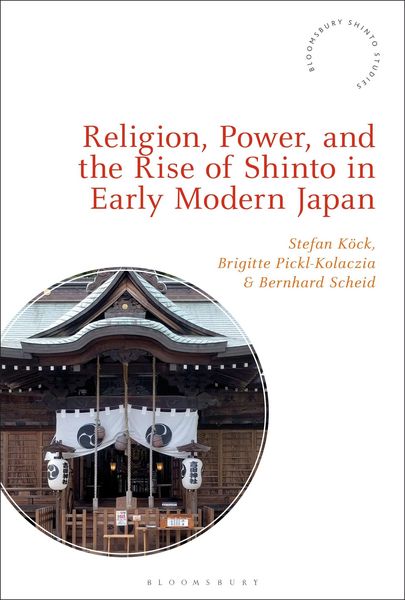
  • Produktbild: Religion, Power, and the Rise of Shinto in Early Modern Japan
  • Produktbild: Religion, Power, and the Rise of Shinto in Early Modern Japan

Religion, Power, and the Rise of Shinto in Early Modern Japan

59,99 €

inkl. gesetzl. MwSt., Versandkostenfrei


Beschreibung

This book sheds new light on the relationship between religion and state in early modern Japan, and demonstrates the growing awareness of Shinto in both the political and the intellectual elite of Tokugawa Japan, even though Buddhism remained the privileged means of stately religious control. The first...

Beschreibung

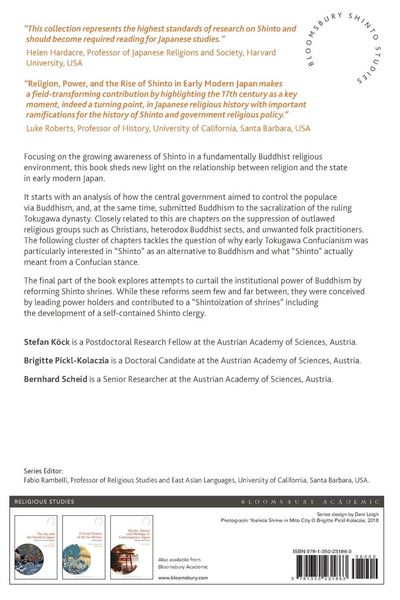
This book sheds new light on the relationship between religion and state in early modern Japan, and demonstrates the growing awareness of Shinto in both the political and the intellectual elite of Tokugawa Japan, even though Buddhism remained the privileged means of stately religious control. The first part analyses how the Tokugawa government aimed to control the populace via Buddhism and at the same time submitted Buddhism to the sacralization of the Tokugawa dynasty. The second part focuses on the religious protests throughout the entire period, with chapters on the suppression of Christians, heterodox Buddhist sects, and unwanted folk practitioners. The third part tackles the question of why early Tokugawa Confucianism was particularly interested in "Shinto" as an alternative to Buddhism and what "Shinto" actually meant from a Confucian stance. The final part of the book explores attempts to curtail the institutional power of Buddhism by reforming Shinto shrines, an important step in the so called "Shintoization of shrines" including the development of a self-contained Shinto clergy.

Produktdetails

Einband

Taschenbuch

Erscheinungsdatum

17.11.2022

Abbildungen

10 bw illus

Herausgeber Stefan Köck + weitere

Produktdetails

Einband

Taschenbuch

Erscheinungsdatum

17.11.2022

Abbildungen

10 bw illus

Herausgeber
Verlag Bloomsbury Publishing
Seitenzahl

300

Maße (L/B/H)

23,4/15,6/1,6 cm

Gewicht

459 g

Sprache

Englisch

ISBN

978-1-350-23186-3

Herstelleradresse

Libri GmbH
Europaallee 1
36244 Bad Hersfeld
DE

Email: gpsr@libri.de

Noch keine Bewertungen vorhanden

Verfassen Sie die erste Bewertung zu diesem Artikel

Helfen Sie anderen Kundinnen und Kunden durch Ihre Meinung.

Kundinnen und Kunden meinen

Bewertungen (0)

Die Leseprobe wird geladen.
  • Produktbild: Religion, Power, and the Rise of Shinto in Early Modern Japan
  • Produktbild: Religion, Power, and the Rise of Shinto in Early Modern Japan
  • Introduction: Tokugawa Religious Orthopraxy and the Phenomenon of Domain Shinto, Bernhard Scheid
    Part 1: Tokugawa Orthopraxy
    1. Anti-Christian Temple Certification (terauke) in Early Modern Japan: Establishment, Practice, and Challenges, Nam-lin Hur (University of British Columbia, Canada)
    2. Ieyasu's Posthumous Title and the Tokugawa Discourse on "Divine Country," Sonehara Satoshi (Tohoku University, Japan)

    Part 2: Unwanted Religious Groups
    3. Anti-Christian Measures and Religious Institutions in the Nagasaki Port City in the Early Edo Period (1614-1644), Carla Tronu (University of Kyoto, Japan)
    4. When the Lotus went Underground: the Nichiren Buddhist Fujufuse Movement and its Early Modern Persecution, Jacqueline I. Stone (Princeton University, USA)
    5. "Deviant Practices" and "Strange Acts": Late Tokugawa Judicial Perspectives on Heteropraxy, Kate Wildman Nakai (Sophia University, Japan)

    Part 3: Intellectual Challenges
    6. Shinto as a Quasi-Confucian Ideology, Inoue Tomokatsu (Saitama University, Japan)
    7. Buddhist-Confucian Polemics and the Position of Shinto, W.J. Boot (Leiden University, the Netherlands)
    8. Ikeda Mitsumasa and Confucian Ritual, James McMullen (University of Oxford, UK)
    9. Calendars and Graves: Shibukawa Harumi's Critique of Hoshina Masayuki and Yamazaki Ansai, Hayashi Makoto (Aichi Gakuin University, Japan)

    Part 4: Institutional Challenges
    10. Shinto in the 1660s and 1670s: The Shrine Clauses of 1665 as an Expression of Domain Shinto,
    Mark Teeuwen (University of Oslo, Norway)
    11. Domain Shinto and shinto-uke in Okayama-han, Stefan Köck (Austrian Academy of Sciences, Austria)
    12. "Kami is kami, Buddha is Buddha": Religious Policies in Mito Domain in the Later 17th Century,
    Brigitte Pickl-Kolaczia (Austrian Academy of Sciences, Austria)
    13. Shinto Priests and the Yoshida in Izumi Province, Yannick Bardy (University of Lille, France)
    14. Conflicts over Shrine Priests' Faith and Affiliation: the Shirakawa, Yoshida, and Hirata Atsutane,
    Anne Walthall (UC Irvine, USA)

    Bibliography

    Index