
Managing Information in the Roman Economy
-
- Hardcover
- Taschenbuch ausgewählt
- eBook
-
Sprache:Englisch
151,99 €
UVP
175,99 €
inkl. gesetzl. MwSt.,
Beschreibung
Produktdetails
Einband
Taschenbuch
Erscheinungsdatum
24.12.2021
Abbildungen
XIII, 339 p. 6 illus.
Herausgeber
Cristina Rosillo-López + weitereVerlag
SpringerSeitenzahl
339
Maße (L/B/H)
21/14,8/2 cm
Gewicht
461 g
Auflage
21001 Auflage 1st ed. 2021
Sprache
Englisch
ISBN
978-3-030-54102-6
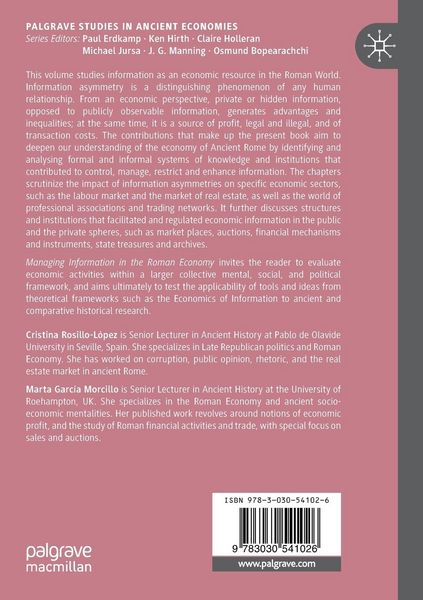
This volume studies information as an economic resource in the Roman World. Information asymmetry is a distinguishing phenomenon of any human relationship. From an economic perspective, private or hidden information, opposed to publicly observable information, generates advantages and inequalities; at the same time, it is a source of profit, legal and illegal, and of transaction costs. The contributions that make up the present book aim to deepen our understanding of the economy of Ancient Rome by identifying and analysing formal and informal systems of knowledge and institutions that contributed to control, manage, restrict and enhance information. The chapters scrutinize the impact of information asymmetries on specific economic sectors, such as the labour market and the market of real estate, as well as the world of professional associations and trading networks. It further discusses structures and institutions that facilitated and regulated economic information in the public andthe private spheres, such as market places, auctions, financial mechanisms and instruments, state treasures and archives.
Managing Asymmetric Information in the Roman Economy
invites the reader to evaluate economic activities within a larger collective mental, social, and political framework, and aims ultimately to test the applicability of tools and ideas from theoretical frameworks such as the Economics of Information to ancient and comparative historical research.
Noch keine Bewertungen vorhanden
Verfassen Sie die erste Bewertung zu diesem Artikel
Helfen Sie anderen Kundinnen und Kunden durch Ihre Meinung.
Kurze Frage zu unserer Seite
Vielen Dank für Ihr Feedback
Wir nutzen Ihr Feedback, um unsere Produktseiten zu verbessern. Bitte haben Sie Verständnis, dass wir Ihnen keine Rückmeldung geben können. Falls Sie Kontakt mit uns aufnehmen möchten, können Sie sich aber gerne an unseren Kund*innenservice wenden.
zum Kundenservice