KI-Beratung Beta

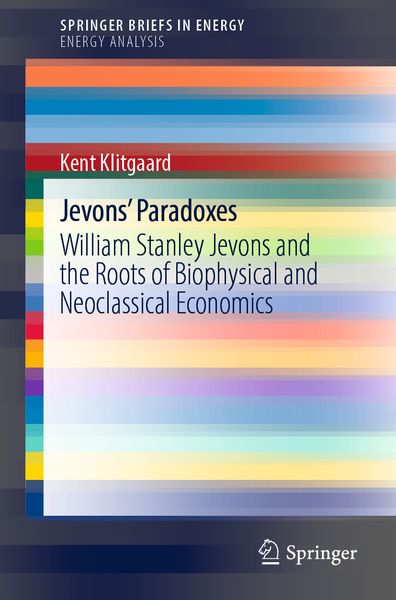
  • Produktbild: Jevons' Paradoxes
  • Produktbild: Jevons' Paradoxes

Jevons' Paradoxes William Stanley Jevons and the Roots of Biophysical and Neoclassical Economics

Aus der Reihe Energy Analysis

52,99 €

inkl. gesetzl. MwSt., Versandkostenfrei


Beschreibung

In 1865, economist William Stanley Jevons published The Coal Question , describing the crucial role that coal played in British economic development. Here, he enunciated what has come to be known as the Jevons paradox, which stated that improvements in resource efficiency leads to greater resource use...

Beschreibung

In 1865, economist William Stanley Jevons published The Coal Question , describing the crucial role that coal played in British economic development. Here, he enunciated what has come to be known as the Jevons paradox, which stated that improvements in resource efficiency leads to greater resource use as the expansion of scale occasioned by lower operating costs overwhelms the savings due to greater efficiency. The implications for any sustainability scenario are enormous and a major theme of this book. While The Coal Question provided the theory that was a precursor to peak oil and resource limits to growth, it was followed six years later by the Theory of Political Economy , the first English-language work of neoclassical economics, which denies the importance of energy as a special commodity. 
In spite of this apparent contradiction, in this book biophysical economist Kent Klitgaard makes clear that there is no epistemological break between The Coal Question and Theory of Political Economy . Indeed, the Jevons paradox makes little sense in the absence of a behavioral theory grounded in marginal utility, which recognizes the satisfaction that each of us gains as consumers of one more unit of a good or service. Jevons could not solve this paradox in light of his belief that coal mines were becoming exhausted and more expensive to operate, and that there was no substitute for coal. However, he was uninterested in questions of sustainability; rather, he wanted to maintain British industrial and imperial dominance. Did the eventual substitution of oil for coal simply allow us to run through other resources at an accelerated rate? Indeed, the petroleum economy of the 20th and early 21st centuries has presented vastly expanded opportunities for the operation of the Jevons Paradox. This book shows the connections among the different paradoxes in Jevons’ work, and exposes the potentially fatal flaws that confound technological solutions to the sustainability challenge.

Produktdetails

Einband

Taschenbuch

Erscheinungsdatum

18.01.2022

Abbildungen

XVIII, 120 p. 11 illus., 1 illus. in color.

Verlag Springer

Produktdetails

Einband

Taschenbuch

Erscheinungsdatum

18.01.2022

Abbildungen

XVIII, 120 p. 11 illus., 1 illus. in color.

Verlag Springer
Seitenzahl

120

Maße (L/B/H)

23,5/15,5/0,8 cm

Gewicht

224 g

Auflage

1st ed. 2022

Sprache

Englisch

ISBN

978-3-030-93588-7

Herstelleradresse

Springer-Verlag KG
Sachsenplatz 4-6
1201 Wien
AT

Email: ProductSafety@springernature.com

Noch keine Bewertungen vorhanden

Verfassen Sie die erste Bewertung zu diesem Artikel

Helfen Sie anderen Kundinnen und Kunden durch Ihre Meinung.

Kundinnen und Kunden meinen

Bewertungen (0)

  • Produktbild: Jevons' Paradoxes
  • Produktbild: Jevons' Paradoxes
  • Good Jevons, Bad Jevons: William Stanley Jevons and the Roots of Neoclassical and Biophysical Economics.- Jevons the Empiricist: Gold; Coal; and Sunspots.- Jevons the Theorist: The Theory of Political Economy and the Roots of Neoclassical Economics.- Energy, Labor, and the Industrial Revolution.- Conclusion: Jevons’ Many Paradoxes and Thoughts for the Future.