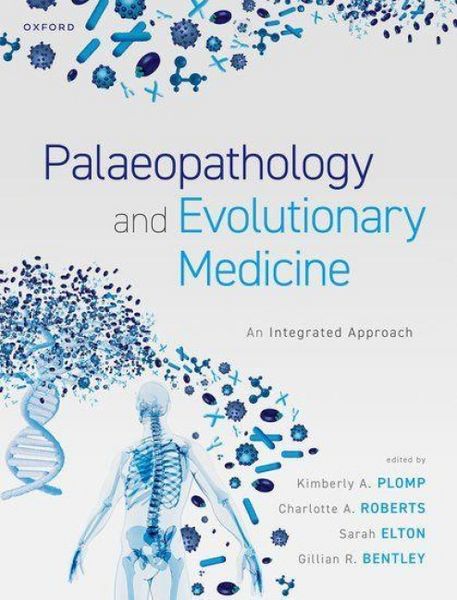
Palaeopathology and Evolutionary Medicine An Integrated Approach
-
- Hardcover
- Taschenbuch ausgewählt
- eBook
-
Sprache:Englisch
79,99 €
inkl. gesetzl. MwSt.,
Beschreibung
Produktdetails
Einband
Taschenbuch
Erscheinungsdatum
03.10.2022
Abbildungen
47 colour line figures and illustrations
Herausgeber
Kimberley A. Plomp + weitereVerlag
Oxford University PressSeitenzahl
384
Maße (L/B/H)
24,7/19,1/1,8 cm
Gewicht
826 g
Sprache
Englisch
ISBN
978-0-19-884972-8
Evolutionary medicine has been steadily gaining recognition, not only in modern clinical research and practice, but also in bioarchaeology (the study of archaeological human remains) and especially its sub-discipline, palaeopathology. To date, however, palaeopathology has not been necessarily recognised as particularly useful to the field and most key texts in evolutionary medicine have tended to overlook it.
This novel text is the first to highlight the benefits of using palaeopathological research to answer questions about the evolution of disease and its application to current health problems, as well as the benefits of using evolutionary thinking in medicine to help interpret historical disease processes. It presents hypothesis-driven research by experts in biological anthropology (including palaeopathology), medicine, health sciences, and evolutionary medicine through a series of unique case studies that address specific research questions. Each chapter has been co-authored by two or more researchers with different disciplinary perspectives in order to provide original, insightful, and interdisciplinary contributions that will provide new insights for both palaeopathology and evolutionary medicine.
Palaeopathology and Evolutionary Medicine is intended for graduate level students and professional researchers in a wide range of fields including the humanities (history), social sciences (anthropology, archaeology, palaeopathology, geography), and life sciences (medicine and biology). Relevant courses include evolutionary medicine, evolutionary anthropology, medical anthropology, and palaeopathology.
Noch keine Bewertungen vorhanden
Verfassen Sie die erste Bewertung zu diesem Artikel
Helfen Sie anderen Kundinnen und Kunden durch Ihre Meinung.
Kurze Frage zu unserer Seite
Vielen Dank für Ihr Feedback
Wir nutzen Ihr Feedback, um unsere Produktseiten zu verbessern. Bitte haben Sie Verständnis, dass wir Ihnen keine Rückmeldung geben können. Falls Sie Kontakt mit uns aufnehmen möchten, können Sie sich aber gerne an unseren Kund*innenservice wenden.
zum Kundenservice