KI-Beratung Beta

Gutscheinbedingungen

**Gültig am 25.11.2026 auf fremdsprachige Bücher online auf thalia.at und in der Thalia App. Einzelne Artikel können ausgeschlossen sein. Ausgenommen sind preisgebundene Artikel & eBooks. Pro Einkauf einmal einlösbar. Click & Collect nur bei Onlinevorabzahlung möglich. Keine Barauszahlung. Nicht kombinierbar mit anderen Aktionen und Gutscheinen. Gutschein wird auf max. 500€ Bestellwert angerechnet. Nicht gültig für Geschenkkarten, Versandkosten und Services.

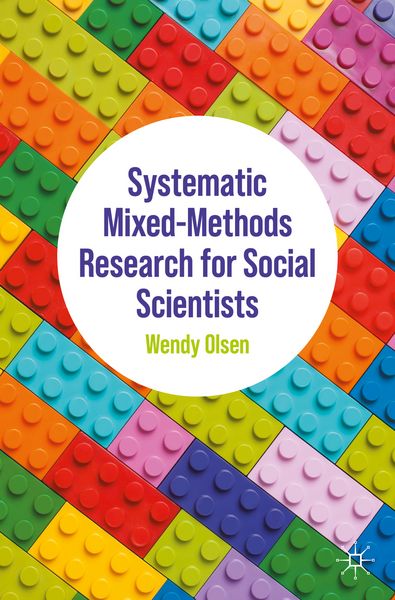
  • Produktbild: Systematic Mixed-Methods Research for Social Scientists
  • Produktbild: Systematic Mixed-Methods Research for Social Scientists

Systematic Mixed-Methods Research for Social Scientists

39,99 €

inkl. gesetzl. MwSt., Versandkostenfrei


Beschreibung

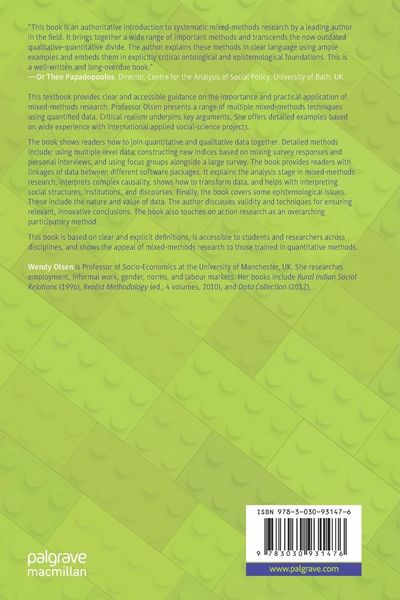
This textbook provides clear and accessible guidance on the importance and practical application of mixed-methods research. Professor Olsen presents a range of multiple mixed-methods techniques using quantified data. Critical realism underpins key arguments. She offers detailed examples based on wide...

Beschreibung

This textbook provides clear and accessible guidance on the importance and practical application of mixed-methods research. Professor Olsen presents a range of multiple mixed-methods techniques using quantified data. Critical realism underpins key arguments. She offers detailed examples based on wide experience with international applied social-science projects. 

The book shows readers how to join quantitative and qualitative data together. Detailed methods include: using multiple-level data; constructing new indices based on mixing survey responses and personal interviews; and using focus groups alongside a large survey. The book provides readers with linkages of data between different software packages. It explains the analysis stage in mixed-methods research, interprets complex causality, shows how to transform data, and helps with interpreting social structures, institutions, and discourses. Finally, the book covers some epistemological issues. These include the nature and value of data. The author discusses validity and techniques for ensuring relevant, innovative conclusions. The book also touches on action research as an overarching participatory method.

This book is based on clear and explicit definitions, is accessible to students and researchers across disciplines, and shows the appeal of mixed-methods research to those trained in quantitative methods.

Produktdetails

Einband

Taschenbuch

Erscheinungsdatum

29.07.2022

Abbildungen

XXIII, 245 p. 254 illus. in color.

Verlag Springer

Produktdetails

Einband

Taschenbuch

Erscheinungsdatum

29.07.2022

Abbildungen

XXIII, 245 p. 254 illus. in color.

Verlag Springer
Seitenzahl

245

Maße (L/B/H)

23,5/15,5/1,5 cm

Gewicht

417 g

Auflage

1st ed. 2022

Sprache

Englisch

ISBN

978-3-030-93147-6

Herstelleradresse

Springer-Verlag GmbH
Tiergartenstr. 17
69121 Heidelberg
DE

Email: ProductSafety@springernature.com

Noch keine Bewertungen vorhanden

Verfassen Sie die erste Bewertung zu diesem Artikel

Helfen Sie anderen Kundinnen und Kunden durch Ihre Meinung.

Kundinnen und Kunden meinen

Bewertungen (0)

  • Produktbild: Systematic Mixed-Methods Research for Social Scientists
  • Produktbild: Systematic Mixed-Methods Research for Social Scientists
  • Part I Setting Up Systematic Mixed Methods Research (SMMR).- 1 Mixed Methods for Research on Open Systems.- 1.1 The Link Between Quantification and Mixed Methods.- 1.2 A Conceptual Introduction to Methodology and Ontology.- 1.3 Triangulation.- 1.4 Three Domains of Reality, As Realists Approach Research.- 1.5 Conclusion.- Appendix.- References.- 2 Mixed Methods with Weakly Structuralist Regression Models.- 2.1 Modelling and Methodology for Mixed Methods.- 2.2 Strategic Structuralism.- 2.3 Logics Used in Strategic Structuralist Research.- 2.4 Conclusion.- Appendix.- References.- Part II SMMR Approaches in Practical Terms.- 3 Causality in Mixed-Methods Projects That Use Regression.- 3.1 Causality in a Regression Model.- 3.2 Stages of Research Design Amendment for Mixed-Methods Research.- 3.3 Deduction Cannot Stand Alone.- 3.4 A Quantitatively Complex Example.- 3.5 Conclusion.- References.- 4 Multiple Logics in Systematic Mixed-Methods Research.- 4.1 Multiple Logics in Statistical Research: Some Exemplars.- 4.2 An Exemplar Using Participatory Research with Panel Data.- 4.3 A Statistical Exemplar with a Randomised Control Trial for a Social Intervention.- 4.4 Warranted Arguments and Two Caveats for Strategic Structuralism.- 4.5 An Exemplar Using Correspondence Analysis Without Regression.- Appendix.- References.- 5 Factor Analysis in a Mixed-Methods Context.- 5.1 Latent Variables and Entities.- 5.2 One Could Use Exploratory or Confirmatory Factor Analysis.- 5.3 Measurement Issues for the Manifest Variables in a Confirmatory Model.- 5.4 Mixed-Methods Research Designs Using Latent Variables.- 5.5 Whether to Use Scoping Analysis or Primary Field Research.- 5.6 Research Scope and Feedback Loops.- 5.7 Closed and Open Retroduction in a Factor Analysis Context.- 5.8 The Ontological Element.- 5.9 Conclusion.- References.- 6 Qualitative Comparative Analysis (QCA): A Classic Mixed Method Using Theory.- 6.1 QCA Is an Umbrella Over Many Procedures.- 6.2 Tables Help to Summarise Qualitative Comparative Evidence.- 6.3 Data Reduction Has Been Well Theorised.- 6.4 Threshold Tests, Quasi-Sufficiency, and Next Steps in QCA.- 6.5 Conclusion.- Appendix.- References.- 7 Calibration of Fuzzy Sets, Calibration of Measurement: A Realist Synthesis.- 7.1 Two Forms of Calibration: Ordered Categories or Fuzzy Sets.- 7.2 Features of Multiple Hypothesis Tests Using Fuzzy Sets.- 7.3 Asymmetry of the Causal Mechanisms? Issues Around Counterfactuals.- 7.4 How to Make and Illustrate Deep Linkages.- Appendix.- References.- 8 From Content Analysis to Discourse Analysis: Using Systematic Analysis of Meanings and Discourses.- 8.1 Methods of Qualitative Analysis and Elaboration of Findings.- 8.2 Qualitative Methods, with a Content Analysis Example.- 8.3 Three Illustrations Demonstrating Deep Arguments Based on Depth Ontology.- 8.4 Conclusion.- Appendix.- References.- Part III Interpretation and the Validity of Research.- 9 Interpretations, Meanings, and Validity in Mixed-Methods Research.-9.1 Truth Is Not Simple in a Complex Society.- 9.2 Epistemology for Late-Modern Mixed Methods.- 9.3 Falsifying Hypotheses: Possible and Desirable, but Not Necessary.- 9.4 A Retroductive Approach.- 9.5 Conclusion.- References.- 10 Summary of the Logics and Methods for Systematic Mixed-Methods Research.- 10.1 Induction.- 10.2 Deduction.- 10.3 Retroduction.- 10.4 Synthesis.- 10.5 Recognising Relevant Irreducible Phenomena (Holism).- 10.6 Logical Linkage.- 10.7 Conclusion.- References.- 11 Glossary.