Gutscheinbedingungen

**Gültig bis 06.07.2026 auf fremdsprachige Bücher online auf thalia.at, in der Thalia App ab einem Mindestbestellwert von 30€ und in allen Thalia Buchhandlungen in Österreich. In den Buchhandlungen nur gültig auf lagernde Ware. Einzelne Artikel können ausgeschlossen sein. Ausgenommen sind preisgebundene Artikel & eBooks. Pro Einkauf einmal einlösbar. Nur gültig gegen Vorlage oder im Onlineshop hinterlegter Bonuscard. Infos zur Einlösung in der Buchhandlung sind auf der Bonuscard-Vorteilspreisseite zu finden. Click & Collect nur bei Onlinevorabzahlung möglich. Keine Einlösung bei Scan & Go-Bezahlung. Keine Barauszahlung. Nicht kombinierbar mit anderen Aktionen und Gutscheinen. Gutschein wird auf max. 500€ Bestellwert angerechnet. Nicht gültig für Versandkosten und Services.

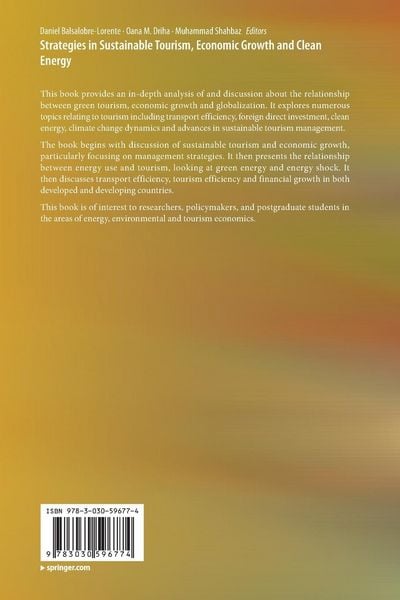
  • Produktbild: Strategies in Sustainable Tourism, Economic Growth and Clean Energy
  • Produktbild: Strategies in Sustainable Tourism, Economic Growth and Clean Energy

Strategies in Sustainable Tourism, Economic Growth and Clean Energy

198,99 €

inkl. gesetzl. MwSt., Versandkostenfrei


Beschreibung

Produktdetails

Einband

Taschenbuch

Erscheinungsdatum

02.12.2021

Herausgeber

Daniel Balsalobre-Lorente + weitere

Verlag

Springer

Seitenzahl

278

Maße (L/B/H)

23,5/15,5/1,6 cm

Gewicht

441 g

Auflage

1st ed. 2021

Sprache

Englisch

ISBN

978-3-030-59677-4

Beschreibung

Portrait

Dr. Daniel Balsalobre-Lorente holds a Ph.D. in Economics from the University of Castilla–La Mancha, where he is currently an Associate Professor. He has more than ten years of experience as a Professor of Economic Growth, Public Economics and Regional Sciences. His main research activities are focused on the energy economy, energy innovation, economic growth and development economics. He has co-authored several articles in various journals, including  Energy Policy ,  Cleaner Production Magazine  and  Environmental Science and Pollution Research , as well as several book chapters. He regularly reviews articles for journals such as  Economic Modelling  and the  Journal of Cleaner Production .

Dr. Oana M. Driha holds an International PhD. in Economics from the University of Alicante where she is currently Assistant Professor of Applied Economics. She has nine years of experience as a Professor of International  Economics and EU Economics.She has been involved as an expert in numerous EU funded projects in the field of sustainable development (green energy, climate change, sustainable tourism, etc.).  Her main research activities are focused on energy economics, energy innovation, economic growth and sustainable tourism. She has co-authored several articles in various journals, including  Resources Policy ,  Environmental Science and Pollution Research , Current Issues in Tourism or International Journal of Contemporary Hospitality Management , as well as several book chapters. She regularly reviews articles for journals such as  Journal of Cleaner Production or Technological Forecasting & Social Change .   

Dr. Muhammad Shahbaz is a Full Professor at the School of Management and Economics, Beijing Institute of Technology, China. He is also an Affiliated Visiting Scholar at the Department of Land Economy, University of Cambridge, UK, and an Adjunct Professor at COMSATS Institute of Information Technology, Lahore, Pakistan. He previously served as a Chair Professor of Energy and Sustainable Development at Montpellier Business School, France, and Principal Research Officer at COMSATS. He received his Ph.D. in Economics from the National College of Business Administration and Economics, Lahore, Pakistan. His research focuses on financial economics, energy finance, energy economics, environmental economics, development economics and tourism economics. He has published more than 300 research papers in peer-reviewed international journals, is among the world’s top 15 economics authors as ranked by IDEAS, and was selected as one of the top 5 authors on economics in developing countries by David McKenzie, Chief Economist of the World Bank. Dr. Shahbaz has published papers in various journals, including  Applied Economics ,  SocialIndicators Research ,  Renewable Energy  and the  Journal of Cleaner Production .


Produktdetails

Einband

Taschenbuch

Erscheinungsdatum

02.12.2021

Herausgeber

Verlag

Springer

Seitenzahl

278

Maße (L/B/H)

23,5/15,5/1,6 cm

Gewicht

441 g

Auflage

1st ed. 2021

Sprache

Englisch

ISBN

978-3-030-59677-4

Herstelleradresse

Springer-Verlag KG
Sachsenplatz 4-6
1201 Wien
AT

Email: GPSR Kontakt

Noch keine Bewertungen vorhanden

Verfassen Sie die erste Bewertung zu diesem Artikel

Helfen Sie anderen Kundinnen und Kunden durch Ihre Meinung.

Kundinnen und Kunden meinen

Bewertungen (0)

  • Produktbild: Strategies in Sustainable Tourism, Economic Growth and Clean Energy
  • Produktbild: Strategies in Sustainable Tourism, Economic Growth and Clean Energy
  • Chapter 1. The Impact of Tourism and Renewable Energy Use over Economic Growth in Top 10 Tourism Destinations.- Chapter 2. The Possible Influence of the Tourism Sector on Climate Change in The US. Chapter 3. Tourism Sector and Environmental Quality: Evidence from Top 20 Tourist Destinations.- Chapter 4. The Effects of Tourism, Economic Growth and Renewable Energy on Carbon Dioxide Emissions.- Chapter 5. Clean India Mission and its Impact on Cities of Tourist Importance in India.- Chapter 6. The Effects of Globalization and Terrorism on Tourist Arrivals in Turkey.- Chapter 7. Testing the Dynamic Relationship Among CO2 Emissions, Economic Growth, Energy Consumption and Tourism Development: Evidence For Uruguay.- Chapter 8. Analyzing the Tourism Development and Ecological Footprint Nexus: Evidence from the Countries with Fastest-Growing Rate of Tourism GDP.- Chapter 9. Investigating the Tourism Originating CO2 Emissionsin Top 10 Tourism-Induced Countries: Evidence from Tourism Index.- Chapter 10. Sustainable Tourism Production And Consumption As Constituents Of Sustainable Tourism GDP: Lessons From A Typical Index Of Sustainable Economic Welfare (ISEW).- Chapter 11. Developments & Challenges in The Greek Hospitality Sector for Economic Tourism Growth: The Case of Boutique Hotels.- Chapter 12. Airbnb and Overtourism: An Approach to a Social Sustainable Model Using Big Data.- Chapter 13. Determination of Standard of Living for People Involved with Tourism in Digha by Ordinal Regression Analysis.- Chapter 14. The Validation of the Tourism-Led Growth Hypothesis in the Next Leading Economies: Accounting for the Relevant Role of Education on Carbon Emissions Reduction?.