KI-Beratung Beta

  • Produktbild: Overcoming Psychologism: Husserl and the Transcendental Reform of Psychology
  • Produktbild: Overcoming Psychologism: Husserl and the Transcendental Reform of Psychology

Overcoming Psychologism: Husserl and the Transcendental Reform of Psychology

131,99 €

inkl. gesetzl. MwSt., Versandkostenfrei


Beschreibung

This book shows us how rather than abandoning psychology once he liberated phenomenology from the psychologism of the philosophy of arithmetic, Edmund Husserl remained concerned with the ways in which phenomenology held important implications for a radical reform of psychology throughout his intellectual...

Beschreibung

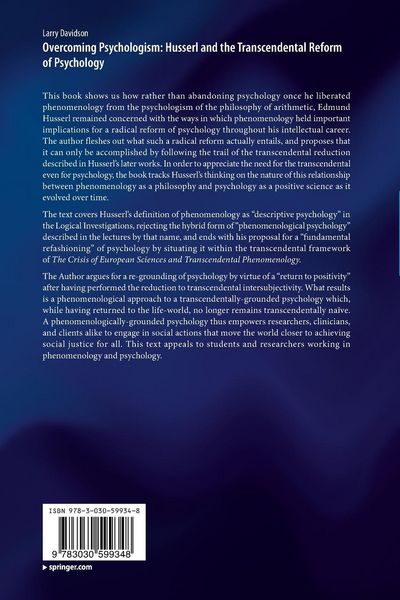
This book shows us how rather than abandoning psychology once he liberated phenomenology from the psychologism of the philosophy of arithmetic, Edmund Husserl remained concerned with the ways in which phenomenology held important implications for a radical reform of psychology throughout his intellectual career. The author fleshes out what such a radical reform actually entails, and proposes that it can only be accomplished by following the trail of the transcendental reduction described in Husserl’s later works.  In order to appreciate the need for the transcendental even for psychology, the book tracks Husserl’s thinking on the nature of this relationship between phenomenology as a philosophy and psychology as a positive science as it evolved over time.

The text covers Husserl’s definition of phenomenology as “descriptive psychology” in the Logical Investigations, rejecting the hybrid form of “phenomenological psychology” described in the lectures by that name, and endswith his proposal for a “fundamental refashioning” of psychology by situating it within the transcendental framework of  The Crisis of European Sciences and Transcendental Phenomenology.  

The Author argues for a re-grounding of psychology by virtue of a “return to positivity” after having performed the reduction to transcendental intersubjectivity. What results is a phenomenological approach to a transcendentally-grounded psychology which, while having returned to the life-world, no longer remains transcendentally naïve.  A phenomenologically-grounded psychology thus empowers researchers, clinicians, and clients alike to engage in social actions that move the world closer to achieving social justice for all.  This text appeals to students and researchers working in phenomenology and psychology. 


Rezension

“Davidson’s book seems to be meant for those who work within the tension between human science and philosophy, that is, those who identify themselves as operating holistically within (and between) the two disciplines. … Davidson’s message to a natural scientific audience in psychology and psychiatry becomes an echo of Husserl’s ethical call to the European community in the late 1930s.” (Magnus Englander, Husserl Studies, Vol. 39 (3), 2023)

Produktdetails

Einband

Taschenbuch

Erscheinungsdatum

22.11.2021

Abbildungen

XIX, 334 p. 1 illus.

Verlag Springer

Produktdetails

Einband

Taschenbuch

Erscheinungsdatum

22.11.2021

Abbildungen

XIX, 334 p. 1 illus.

Verlag Springer
Seitenzahl

334

Maße (L/B/H)

23,5/15,5/2 cm

Gewicht

540 g

Auflage

21001 Auflage 1st ed. 2021

Sprache

Englisch

ISBN

978-3-030-59934-8

Herstelleradresse

Springer-Verlag KG
Sachsenplatz 4-6
1201 Wien
AT

Email: ProductSafety@springernature.com

Noch keine Bewertungen vorhanden

Verfassen Sie die erste Bewertung zu diesem Artikel

Helfen Sie anderen Kundinnen und Kunden durch Ihre Meinung.

Kundinnen und Kunden meinen

Bewertungen (0)

  • Produktbild: Overcoming Psychologism: Husserl and the Transcendental Reform of Psychology
  • Produktbild: Overcoming Psychologism: Husserl and the Transcendental Reform of Psychology
  • Introduction.- Chapter 1. Phenomenology as Descriptive Psychology.- Chapter 2. Phenomenology as Rigorous Philosophy.- Chapter 3. Phenomenology as Transcendental Philosophy.- Chapter 4. Phenomenological Psychology.- Chapter 5. Transcendental Psychologism.- Chapter 6. The Return From the Transcendental Psychological Idealism.- Chapter 7. Conclusion: Defining our Terms.