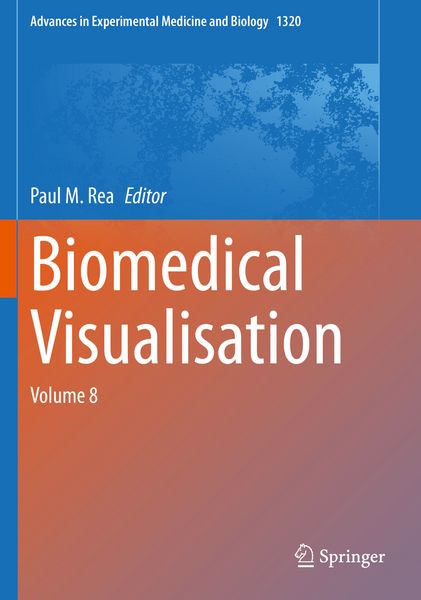
Biomedical Visualisation Volume 8
-
- Hardcover
- Taschenbuch ausgewählt
- eBook
-
Sprache:Englisch
-
Auflage:21001 Auflage 1st edition 2020
- 21001 Auflage 1st edition 2020 99,99 € ausgewählt
- 2023 156,99 €
- 1st ed. 2020 151,99 €
- 1st ed. 2020 151,99 €
- 1st ed. 2021 142,99 €
- 1st ed. 2019 99,99 €
- 1st ed. 2019 99,99 €
- 1st ed. 2019 109,99 €
- 1st ed. 2019 109,99 €
- 23001 Auflage 1st ed. 2023 144,99 €
- 23001 Auflage 1st ed. 2023 163,99 €
- 23001 Auflage 1st ed. 2022 142,99 €
- 23001 Auflage 1st ed. 2022 154,99 €
- 22001 Auflage 1st edition 2021 129,99 €
99,99 €
inkl. gesetzl. MwSt.,
Beschreibung
Produktdetails
Einband
Taschenbuch
Erscheinungsdatum
20.11.2021
Abbildungen
XV, 195 p. 87 illus., 48 illus. in color.
Herausgeber
Paul M. ReaVerlag
SpringerSeitenzahl
195
Maße (L/B/H)
25,4/17,8/1,1 cm
Gewicht
457 g
Auflage
21001 Auflage 1st edition 2020
Sprache
Englisch
ISBN
978-3-030-47485-0
This edited book explores the use of technology to enable us to visualise the life sciences in a more meaningful and engaging way. It will enable those interested in visualisation techniques to gain a better understanding of the applications that can be used in visualisation, imaging and analysis, education, engagement and training.
The reader will be able to explore the utilisation of technologies from a number of fields to enable an engaging and meaningful visual representation of the biomedical sciences, with a focus in this volume related to anatomy, and clinically applied scenarios.
The first six chapters in this volume show the wide variety of tools and methodologies that digital technologies and visualisation techniques can be utilised and adopted in the educational setting. This ranges from body painting, clinical neuroanatomy, histology and veterinary anatomy through to real time visualisations and the uses of digital and social media for anatomical education. The last four chapters represent the diversity that technology has to be able to use differing realities and 3D capture in medical visualisation, and how remote visualisation techniques have developed. Finally, it concludes with an analysis of image overlays and augmented reality and what the wider literature says about this rapidly evolving field.
Noch keine Bewertungen vorhanden
Verfassen Sie die erste Bewertung zu diesem Artikel
Helfen Sie anderen Kundinnen und Kunden durch Ihre Meinung.
Kurze Frage zu unserer Seite
Vielen Dank für Ihr Feedback
Wir nutzen Ihr Feedback, um unsere Produktseiten zu verbessern. Bitte haben Sie Verständnis, dass wir Ihnen keine Rückmeldung geben können. Falls Sie Kontakt mit uns aufnehmen möchten, können Sie sich aber gerne an unseren Kund*innenservice wenden.
zum Kundenservice