Gutscheinbedingungen

**Gültig von 22.06.2026 ab 19 Uhr bis 23.06.2026 24 Uhr auf Spielzeug, Schreibwaren, Filme, Geschenke & Trends, Musik, tolino eReader & Zubehör, Hörbücher und Hörbuch-Downloads (außer Abo), nicht preisgebundene Bücher und Kalender online auf thalia.at und in der Thalia App. Einzelne Artikel können ausgeschlossen sein. Aufgrund der Buchpreisbindung sind deutschsprachige Bücher und eBooks ausgenommen. Zusätzlich ausgenommen sind preisgebundene Artikel, Abos & Flatrates, eBooks, Games, Geschenkkarten/-boxen, Shelfies, Software, Zeitschriften sowie einzelne Artikel von tonies®. Pro Einkauf einmal einlösbar. Click & Collect nur bei Onlinevorabzahlung möglich. Keine Barauszahlung. Nicht kombinierbar mit anderen Aktionen und Gutscheinen. Gutschein wird auf max. 500€ Bestellwert angerechnet. Nicht gültig für Versandkosten und Services.

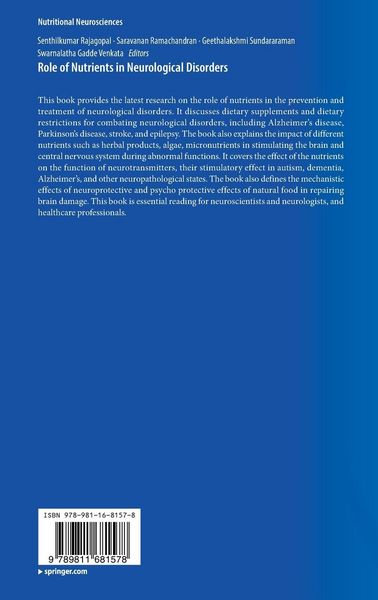
  • Produktbild: Role of Nutrients in Neurological Disorders
  • Produktbild: Role of Nutrients in Neurological Disorders

Role of Nutrients in Neurological Disorders

199,99 €

inkl. gesetzl. MwSt., Versandkostenfrei


Beschreibung

Produktdetails

Einband

Gebundene Ausgabe

Erscheinungsdatum

13.03.2022

Herausgeber

Senthilkumar Rajagopal + weitere

Verlag

Springer Singapore

Seitenzahl

383

Maße (L/B/H)

24,1/16/2,8 cm

Auflage

1st ed. 2022

Sprache

Englisch

ISBN

978-981-16-8157-8

Beschreibung

Portrait

Dr. Senthilkumar Rajagopal is an Associate Professor/Ramalingaswami Re-entry fellow [DBT] of Department of Biotechnology, REVA University, India. He completed his Ph.D. in Biochemistry at Annamalai University, India, and did his postdoctoral fellowship from University of Virginia, Harvard University and Virginia Commonwealth University. He is a recipient of Rameshwardasji Birla Smarak Kosh Endowment award from Mumbai Medical Trust, Mumbai, INDIA and awardee of prestigious Ramalingaswami Re-entry Fellowship from Department of Biotechnology, Ministry of Science and Technology, Government of India. His research has addressed Protein kinase C modulation on calcium channels currents. He has served as referee for a number of International journals, including Brain Research and on the web like Frontiers in Cellular Neuroscience, Journal of Pharmacology and Experimental Therapeutics, Molecular Biology Reports, International Journal of Pharmacology, Nutrition, Neurological diseases, and Asiacouncil of Science Editors. He has also published more than 60 research articles in the peer-reviewed international journal and authored or co-authored numerous books and book chapters. He also a member of well- known scientific associations like Indian Society for Atherosclerosis Research (ISAR) (Life member); Biophysical Society, Science Advisory Board (SAB), International Science congress Association (Life member), Society of Biological Chemist (Life member), and Nutrition Society of India.

Dr. Saravanan Ramachandran is an Associate Professor of Marine Pharmacology at Chettinad Academy of Research and Education in Kelabmakkam, Tamil Nadu, India. He has completed his Ph.D. in Marine Biotechnology from Annamalai University in India. His scientific interests are focused on understanding the effects of pharmaceuticals on marine species. He has published than 50 research articles in journals of high repute. He also possesses two patents and has submitted 65 gene sequences to the NCBI, including three entire genomes of halophytic bacteria. He is a member of the Society for Biotechnology (India) and the International Neurotoxin Association.

Dr. S. Geethalakshmi is working as an Associate Professor and Head in the Department of Biotechnology, Sree Narayana Guru College, Coimbatore, Tamilnadu. She has 15 years of teaching and research experience. Her research interest is in Bioinformatics and Biotechnology with specialization in Plant Biotechnology, Functional Genomics, and Drug designing. She has published more than 25 research articles in International and peer reviewed journals and has co-authored many book chapters and books. She is a life time member of many International scientific societies and organizations.

Dr. G. V. Swarnalatha obtained her Ph.D. in Biochemistry from University of Mysore in India. Her Ph.D. work was conducted at Central Food Technological Research Institute (CSIR-CFTRI) Mysore, India. She has obtained a patent on “A composition and method to control rotifer infestation in microalgal cultivation systems” India. She has published a book on titled “Text book of Plant Biotechnology”, and published papers in reputed international and national journals and authored or co-authored book chapters. She has more than 4 years of postgraduate teaching experience for Biochemistry and Biotechnology courses.

Produktdetails

Einband

Gebundene Ausgabe

Erscheinungsdatum

13.03.2022

Herausgeber

Verlag

Springer Singapore

Seitenzahl

383

Maße (L/B/H)

24,1/16/2,8 cm

Auflage

1st ed. 2022

Sprache

Englisch

ISBN

978-981-16-8157-8

Herstelleradresse

Springer-Verlag KG
Sachsenplatz 4-6
1201 Wien
AT

Email: ProductSafety@springernature.com

Kundinnen und Kunden meinen

0 Bewertungen

Informationen zu Bewertungen

Zur Abgabe einer Bewertung ist eine Anmeldung im Konto notwendig. Die Authentizität der Bewertungen wird von uns nicht überprüft. Wir behalten uns vor, Bewertungstexte, die unseren Richtlinien widersprechen, entsprechend zu kürzen oder zu löschen.

Die Bewertungen sind nach Format, Anzahl Sterne und Datum sortiert.

Verfassen Sie die erste Bewertung zu diesem Artikel

Helfen Sie anderen Kund*innen durch Ihre Meinung

Kundinnen und Kunden meinen

0 Bewertungen filtern

  • Produktbild: Role of Nutrients in Neurological Disorders
  • Produktbild: Role of Nutrients in Neurological Disorders
  • Part 1: Neurological disorders from Background to interplay of Genetic, Epigenetic and Environmental risk factors.- Chapter 1: Phytonutrients in Neurological Disorders.- Chapter 2: Psychobiotics in health, longevity and neurological disorders.- Chapter 3: Nutritional, dietary, and lifestyle approaches for prevention and management of Alzheimer’s disease.-Chapter 4: Qualitative and Analytical Treatment of Nonlinear Dynamical systems in Neurological Diseases.- Chapter 5: Impact of a psychological follow-up of diabetics in the management of diabetes in Morocco.- Chapter 6: Neuroprotective and anxiolytic effects of date seeds phenolic compounds in Nicotinamide-Streptozotocin-Induced type 2 diabetic rats.- Chapter 7: Role of nutrition in pathogenesis of neurological disorders.- Part 2: Specific Food and Nutritional Qualities on Neruological Disorders.- Chapter 8: Best foods for repair of brain damage.- Chapter 9: Role of micronutrients in neurological development.- Chapter 10: Algae as a potential vegetative source of PUFA for the prevention of neurological disorders.- Chapter 11: Natural foods for suppressing Dementia.- Chapter 12: Nutrients' role in the treatment of Parkinson's and Alzheimer's diseases.- Chapter 13: Novel marine derived natural products for the treatment of depressive disorder.- Chapter 14: Nanoceuticals as Theranostics against Neurodegenerative diseases.- Chapter 15: Role of Antioxidant Nutraceuticals in Neurodegenerative diseases.- Part 3: Herbal remedies for Neurological disorders.- Chapter 16: Herbal drugs: Its molecular mechanism to prevent Alzheimer’s disease with special reference to non-phenolic secondary metabolites.- Chapter 17: Preventive Role And Mechanism Of Herbal Medicine In Alzheimer’s Disease With Special Reference To Phenolic Compounds.- Chapter 18: Herbal Remedies for Autism.- Chapter 19: Action of herbal products in suppressing Parkinson’s Disorder.- Chapter 20: Impact of diet on neurotransmitters.