Gutscheinbedingungen

**Gültig bis 17.08.2026 auf Schreibwaren & Office-Artikel online auf thalia.at, in der Thalia App und in teilnehmenden Thalia Buchhandlungen in Österreich mit Schulsortiment. In den Buchhandlungen nur gültig auf lagernde Ware. Einzelne Artikel können ausgeschlossen sein. Ausgenommen sind preisgebundene Artikel. Pro Einkauf einmal einlösbar. Nur gültig gegen Vorlage oder im Onlineshop hinterlegter Bonuscard. Infos zur Einlösung in der Buchhandlung sind auf der Bonuscard-Vorteilspreisseite zu finden. Click & Collect nur bei Onlinevorabzahlung möglich. Keine Einlösung bei Scan & Go-Bezahlung. Keine Barauszahlung. Nicht kombinierbar mit anderen Aktionen und Gutscheinen. Gutschein wird auf max. 500€ Bestellwert angerechnet. Nicht gültig für Geschenkkarten, Versandkosten und Services.

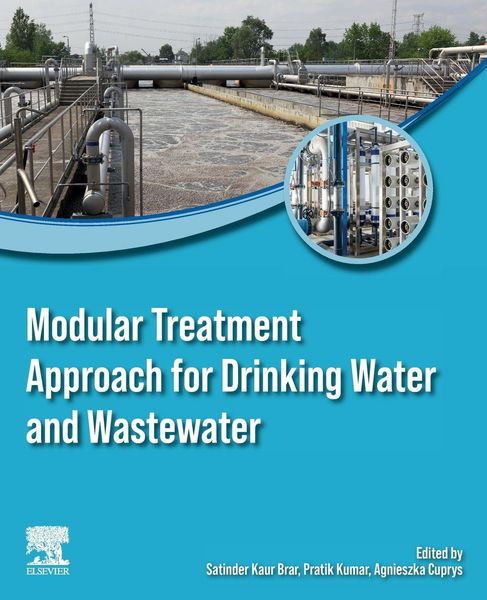
  • Produktbild: Modular Treatment Approach for Drinking Water and Wastewater
  • Produktbild: Modular Treatment Approach for Drinking Water and Wastewater
- 13%

Modular Treatment Approach for Drinking Water and Wastewater

13% sparen

124,99 € UVP 144,00 €

inkl. gesetzl. MwSt., Versandkostenfrei


Beschreibung

Produktdetails

Einband

Taschenbuch

Erscheinungsdatum

26.08.2022

Herausgeber

Satinder Kaur Brar + weitere

Verlag

Elsevier Science & Technology

Seitenzahl

370

Maße (L/B/H)

23,5/19,1/2 cm

Gewicht

637 g

Sprache

Englisch

ISBN

978-0-323-85421-4

Beschreibung

Portrait

Satinder Kaur Brar is full professor at York University, Canada. She is leading the research group on the Bioprocessing and Nano-Enzyme Formulation Facility (BANEFF) at INRS. Her research interests lie in the development of finished products (formulations) of wastewater and wastewater sludge based value-added bioproducts, such as enzymes, organic acids, food bioproducts, platform chemicals and circular economy. The facility has so far led to the successful supervision of 30 PhDs, 8 Master's and 6 postdoctoral students. She has collaborative programs with several industries in Canada and researchers from Argentina, Spain, Chile, Switzerland, France, Vietnam, China, USA, India, Thailand, Sri Lanka, Mexico, Morocco, Tunisia and Ivory Coast. She Editor-in-Chief of Nanotechnology for Environmental Engineering (Springer Journal) and has more than 400 publications, including ten books and handbooks that are academic standards and 6 patents.
Pratik Kumar is an Assistant Professor at Indian Institute of Technology, Jammu (India) in the Department of Civil Engineering. He holds a Bachelor of Engineering degree in Civil Engineering (University Gold Medallist), a Master's in technology degree in Environmental Engineering and Management (Institute Silver Medallist) and a Ph.D. in Water Science. He has authored over 25 publications in international peer-reviewed journals, more than 6 book chapters and a dozen research communications presented at various conferences.
Agnieszka Cuprys is currently a MSCA Postdoctoral Research Fellow at the Norwegian University of Life Sciences, Aas, Norway. Her research involves exploring the most eco-friendly and cost-effective methods to improve wastewater treatment plant efficiency. She holds Master of Science in Pharmaceutical Biotechnology and Ph.D. in Water Science (International Outreach Price). She has authored 11 research papers, 3 book chapters and 2 research communications at international conferences.

Produktdetails

Einband

Taschenbuch

Erscheinungsdatum

26.08.2022

Herausgeber

Verlag

Elsevier Science & Technology

Seitenzahl

370

Maße (L/B/H)

23,5/19,1/2 cm

Gewicht

637 g

Sprache

Englisch

ISBN

978-0-323-85421-4

Herstelleradresse

Libri GmbH
Europaallee 1
36244 Bad Hersfeld
DE

Email: GPSR Kontakt

Noch keine Bewertungen vorhanden

Verfassen Sie die erste Bewertung zu diesem Artikel

Helfen Sie anderen Kundinnen und Kunden durch Ihre Meinung.

Kundinnen und Kunden meinen

Bewertungen (0)

Die Leseprobe wird geladen.
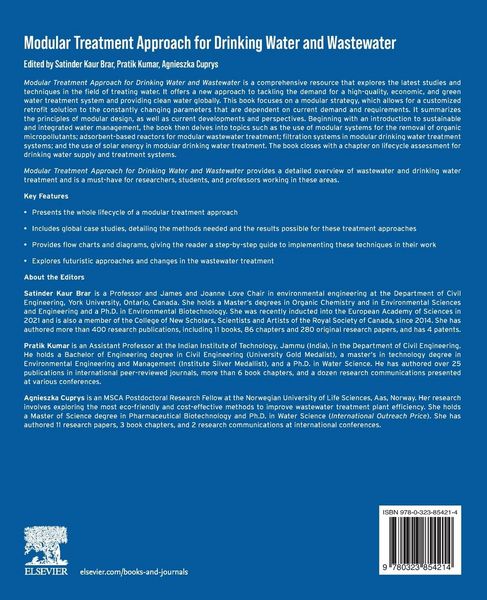
  • Produktbild: Modular Treatment Approach for Drinking Water and Wastewater
  • Produktbild: Modular Treatment Approach for Drinking Water and Wastewater
  • GENERAL SECTION
    1. Introduction
    2. Characteristic of wastewater and drinking water treatment
    3. Perspectives on use of modular systems for organic micropollutants removal
    4. Modular treatment approach in relation to the humanitarian engineering
    5. Role of nanotechnology in modular treatment approaches
    6. Recent practices of modular approach in the cold countries
    7. Phytoremediation as the modular approach for wastewater treatment
    8. Modular design of adsorbent-based reactors for wastewater treatment
    9. Modular approach in wastewater: Membrane-based reactors
    10. Electrode-based reactors in modular wastewater treatment
    11. Life Cycle Assessment (LCA)
    12. Concept of bioproduct recovery in relation to modular treatment

    DRINKING WATER TREATMENT SECTION
    13. Introduction to modular drinking water treatment system (MDWTS) and its significance
    14. Role and importance of filtration system in MDWTS
    15. Role of Membrane filtration in MDWTS
    16. Chemical treatment module system
    17. Ozonation and UV treatment system
    18. Modern approach to modular treatment using solar energy
    19. Desalination using MDWTS
    20. Review of successful bench-scale studies for a possible scale-up module solution
    21. Life Cycle Assessment (LCA)