KI-Beratung Beta

Gutscheinbedingungen

**Gültig am 27.11.2026 auf Spielzeug, Schreibwaren, Filme, Geschenke & Trends, Musik, tolino eReader & Zubehör, Hörbücher und Hörbuch-Downloads, nicht preisgebundene Bücher und Kalender online auf thalia.at und in der Thalia App. Einzelne Artikel können ausgeschlossen sein. Aufgrund der Buchpreisbindung sind deutschsprachige Bücher und eBooks ausgenommen. Zusätzlich ausgenommen sind Abos & Flatrates, Games, Geschenkkarten/-boxen, Shelfies, Software, Zeitschriften sowie einzelne Artikel von tonies®. Pro Einkauf einmal einlösbar. Click & Collect nur bei Onlinevorabzahlung möglich. Keine Barauszahlung. Nicht kombinierbar mit anderen Aktionen und Gutscheinen. Gutschein wird auf max. 500€ Bestellwert angerechnet. Nicht gültig für Versandkosten und Services.

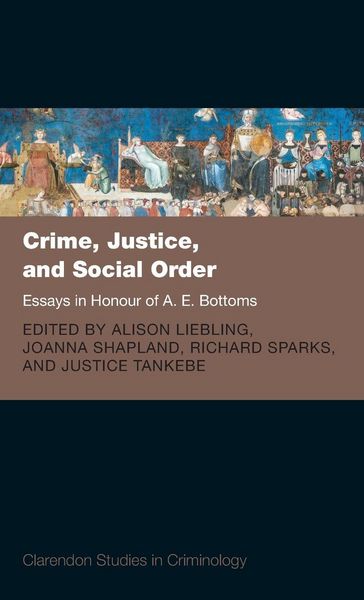
Produktbild: Crime, Justice, and Social Order

Crime, Justice, and Social Order Essays in Honour of A. E. Bottoms

193,99 €

inkl. gesetzl. MwSt., Versandkostenfrei


Beschreibung

To honour the extraordinary contribution of Professor Anthony Edward Bottoms to criminology and criminal justice, leading criminologists and penal scholars have been asked to contribute original essays on the wide range of areas in which he has written. The book starts by reflecting on the depth and...

Beschreibung

To honour the extraordinary contribution of Professor Anthony Edward Bottoms to criminology and criminal justice, leading criminologists and penal scholars have been asked to contribute original essays on the wide range of areas in which he has written. The book starts by reflecting on the depth and breadth of Anthony's contribution and his melding of perspectives from moral philosophy, social theory, empirical social science research, and criminal justice. This is no ordinary collection, because it also contains a major essay by Anthony Bottoms, on Criminology and 'positive morality', reflecting on social order and social norms. In similar vein, Jonathan Jacobs approaches criminology from a moral philosophical viewpoint, whilst Ian Loader and Richard Sparks ponder social theory and contemporary criminology. Topically, Peter Neyroud reflects on evidence-based practice and the process of trying to do experiments in relation to policing. In the second section of the book on Crime, Justice, and Communities, Loraine Gelsthorpe reminds us that justice is about people, in considering the treatment of women in community justice. Joanna Shapland draws parallels between the process of desistance from crime and the potential role of restorative justice in affecting offenders' journeys. P.-O. Wikstrom reflects on the social ecology of crime, whilst Antje Du Bois Pedain considers the theoretical and practical challenges of sentencing constructively. Finally, the book turns to Anthony Bottoms' major interest in punishment and penal order. David Garland puts penal populism under the microscope, whilst Alison Liebling explores the empirical evidence for theories of penal legitimacy. Mike Nellis looks back at the use of the creative arts in prisons in Scotland's Barlinnie Unit, whilst Justice Tankebe explores police legitimacy.

Produktdetails

Einband

Gebundene Ausgabe

Erscheinungsdatum

01.04.2022

Herausgeber Alison Liebling + weitere
Verlag Oxford Academic

Produktdetails

Einband

Gebundene Ausgabe

Erscheinungsdatum

01.04.2022

Herausgeber
Verlag Oxford Academic
Seitenzahl

446

Maße (L/B/H)

22,2/14,5/2,7 cm

Gewicht

629 g

Sprache

Englisch

ISBN

978-0-19-285960-0

Herstelleradresse

Libri GmbH
Europaallee 1
36244 Bad Hersfeld
DE

Email: gpsr@libri.de

Noch keine Bewertungen vorhanden

Verfassen Sie die erste Bewertung zu diesem Artikel

Helfen Sie anderen Kundinnen und Kunden durch Ihre Meinung.

Kundinnen und Kunden meinen

Bewertungen (0)

Die Leseprobe wird geladen.
  • Produktbild: Crime, Justice, and Social Order
    • Part 1: Introduction
    • 1: The Editors: Anthony Bottoms: An Appreciation
    • 2: Richard Sparks and Caroline Lanskey: Reflections on the Life of a British Criminologist
    • Part 2: Social Order and the Criminological Enterprise
    • 3: Professor Anthony Bottoms: Criminology and 'Positive Morality'
    • 4: Professor Jonathan Jacobs: In Dialogue with Philosophy: Recovering the Moral Sciences Through Criminology
    • 5: Dr Peter Neyroud: Learning to Experiment: The Police, Science, and Evidence-Based Practice
    • 6: Professor Ian Loader and Professor Richard Sparks: Reasonable Hopes: Social Theory, Critique and Reconstruction in Contemporary Criminology
    • Part 3: Crime, Justice, and Communities
    • 7: Professor Loraine Gelsthorpe: Keeping a Human Perspective: Some Lessons from Women and Community Justice
    • 8: Professor Joanna Shapland: Desistance from Crime and the Potential Role of Restorative Justice
    • 9: Professor Per-Olof Wikström: Towards a True Social Ecology of Crime: On the Limitations of a Criminology Without People
    • 10: Dr Antje du Bois-Pedain: Constructive Sentencing through Custody-avoiding Sanctions: Theoretical Foundations and Practical Challenges
    • Part 4: Punishment and Penal Order
    • 11: Professor David Garland: What is Penal Populism? Public Opinion, Expert Knowledge, and Penal Policy-Formation in Democratic Societies
    • 12: Professor Alison Liebling: Penal Legitimacy, Well-Being and Trust: The Role of Empirical Research in 'Morally Serious' Work
    • 13: Professor Mike Nellis: Creative Arts, Offender Rehabilitation, and Penal Reform: Remembering the Early Years of the Barlinnie Special Unit
    • 14: Dr Justice Tankebe: Rightful Authority: Exploring the Structure of Police Self-Legitimacy