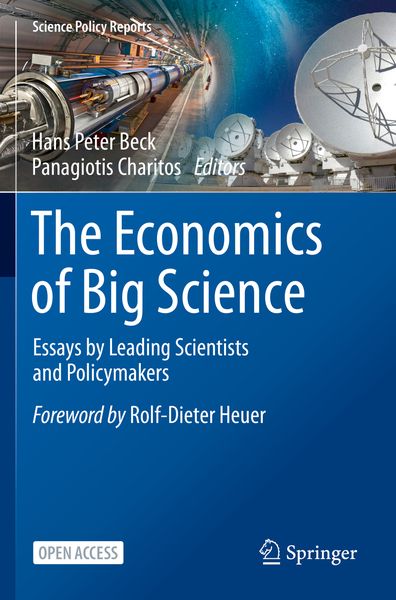
The Economics of Big Science Essays by Leading Scientists and Policymakers
-
- Englisch ausgewählt
99,99 €
inkl. gesetzl. MwSt.,
Beschreibung
Produktdetails
Einband
Taschenbuch
Erscheinungsdatum
30.10.2021
Abbildungen
VIII, 137 p. 26 illus., 24 illus. in color.
Herausgeber
Hans Peter Beck + weitereVerlag
SpringerSeitenzahl
137
Maße (L/B/H)
23,5/15,5/0,9 cm
Gewicht
236 g
Auflage
1st ed. 2021
Sprache
Englisch
ISBN
978-3-030-52393-0
The essays in this open access volume identify the key ingredients for success in capitalizing on public investments in scientific projects and the development of large-scale research infrastructures.
Investment in science – whether in education and training or through public funding for developing new research tools and technologies – is a crucial priority. Authors from big research laboratories/organizations, funding agencies and academia discuss how investing in science can produce societal benefits as well as identifying future challenges for scientists and policy makers. The volume cites different ways to assess the socio-economic impact of Research Infrastructures and their role as hubs of global collaboration, creativity and innovation. It highlights the different benefits stemming from fundamental research at the local, national and global level, while also inviting us to rethink the notion of “benefit” in the 21st century.
Public investment is required to maintain the pace of technological and scientific advancements over the next decades. Far from advocating a radical transformation and massive expansion in funding, the authors suggest ways for maintaining a strong foundation of science and research to ensure that we continue to benefit from the outputs. The volume draws inspiration from the first “Economics of Big Science” workshop, held in Brussels in 2019 with the aim of creating a new space for dialogue and interaction between representatives of Big Science organizations, policy makers and academia. It aspires to provide useful reading for policy makers, scientists and students of science, who are increasingly called upon to explain the value of fundamental research and adopt the language and logic of economics when engaging in policy discussions.
Noch keine Bewertungen vorhanden
Verfassen Sie die erste Bewertung zu diesem Artikel
Helfen Sie anderen Kundinnen und Kunden durch Ihre Meinung.
Kurze Frage zu unserer Seite
Vielen Dank für Ihr Feedback
Wir nutzen Ihr Feedback, um unsere Produktseiten zu verbessern. Bitte haben Sie Verständnis, dass wir Ihnen keine Rückmeldung geben können. Falls Sie Kontakt mit uns aufnehmen möchten, können Sie sich aber gerne an unseren Kund*innenservice wenden.
zum Kundenservice