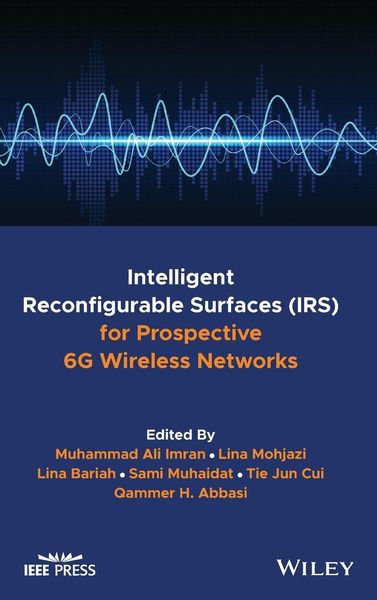
Produktbild: Intelligent Reconfigurable Surfaces (IRS) for Prospective 6G Wireless Networks

Intelligent Reconfigurable Surfaces (IRS) for Prospective 6G Wireless Networks Network

147,99 €

inkl. gesetzl. MwSt., Versandkostenfrei


Beschreibung

Produktdetails

Einband

Gebundene Ausgabe

Erscheinungsdatum

28.11.2022

Herausgeber

Muhammad Ali Imran + weitere

Verlag

John Wiley & Sons

Seitenzahl

304

Maße (L/B/H)

23,5/15,7/2,1 cm

Gewicht

596 g

Auflage

1. Auflage

Sprache

Englisch

ISBN

978-1-119-87525-3

Beschreibung

Produktdetails

Einband

Gebundene Ausgabe

Erscheinungsdatum

28.11.2022

Herausgeber

Verlag

John Wiley & Sons

Seitenzahl

304

Maße (L/B/H)

23,5/15,7/2,1 cm

Gewicht

596 g

Auflage

1. Auflage

Sprache

Englisch

ISBN

978-1-119-87525-3

Herstelleradresse

Libri GmbH
Europaallee 1
36244 Bad Hersfeld
DE

Email: GPSR Kontakt

Noch keine Bewertungen vorhanden

Verfassen Sie die erste Bewertung zu diesem Artikel

Helfen Sie anderen Kundinnen und Kunden durch Ihre Meinung.

Kundinnen und Kunden meinen

Bewertungen (0)

Die Leseprobe wird geladen.
  • Produktbild: Intelligent Reconfigurable Surfaces (IRS) for Prospective 6G Wireless Networks
  • List of Contributors xiii

    1 Introduction 1
    Muhammad Ali Imran, Lina Mohjazi, Lina Bariah, Sami Muhaidat, Tei Jun Cui, and Qammer H. Abbasi

    References 5

    2 IRS in the Near-Field: From Basic Principles to Optimal Design 7
    Konstantinos Dovelos, Stylianos D. Assimonis, Hien Q. Ngo, and Michail Matthaiou

    2.1 Introduction 7

    2.2 Basic Principles 8

    2.2.1 IRS Model 8

    2.2.2 Signal Model of IRS-Aided System 9

    2.3 Near-Field Channel Model 10

    2.3.1 Spherical Wavefront 10

    2.3.2 Path Loss 12

    2.4 Phase Shift Design 13

    2.4.1 Beamfocusing 13

    2.4.2 Conventional Beamforming 14

    2.5 Energy Efficiency 17

    2.5.1 MIMO System 17

    2.5.2 IRS-aided MIMO System 18

    2.6 Optimal IRS Placement 19

    2.7 Open Future Research Directions 20

    2.8 Conclusions 22

    References 22

    3 Feasibility of Intelligent Reflecting Surfaces to Combine Terrestrial and Non-terrestrial Networks 25
    Muhammad A. Jamshed, Qammer H. Abbasi, and Masood Ur-Rehman

    3.1 Introduction 25

    3.2 Intelligent Reflecting Surfaces 27

    3.2.1 Background and Architecture 27

    3.2.2 Intelligent Reflecting Surfaces in Wireless Networks 28

    3.3 Non-terrestrial Networks 29

    3.3.1 Non-terrestrial Networks: 3GPP Vision 30

    3.4 Revamping Non-terrestrial Networks Using Intelligent Reflecting Surfaces 34

    3.4.1 Satellites for Communication: Background 34

    3.4.2 Indoor Connectivity Using Intelligent Reflecting Surfaces 35

    3.5 Conclusion 37

    References 37

    4 Towards the Internet of MetaMaterial Things: Software Enablers for User-Customizable Electromagnetic Wave Propagation 41
    Christos Liaskos, Georgios G. Pyrialakos, Alexandros Pitilakis, Ageliki Tsioliaridou, Michail Christodoulou, Nikolaos Kantartzis, Sotiris Ioannidis, Andreas Pitsillides, and Ian F. Akyildiz

    4.1 Introduction 41

    4.1.1 Key Enabler 1 42

    4.1.2 Key Enabler 2 43

    4.2 Pre-requisites and Related Work 47

    4.2.1 Meta-materials: Principles of Operation, Classification, and Supported Functionalities 49

    4.3 Networked meta-materials and SDN workflows 51

    4.4 Application Programming Interface for Meta-materials 53

    4.4.1 Data Structures of the Meta-material API 55

    4.4.2 API Callbacks and Event Handling 56

    4.5 The Meta-material Middleware 58

    4.5.1 Functionality Optimization Workflow: Meta-material Modelling and State Calibration 60

    4.5.2 The Meta-material Functionality Profiler 64

    4.6 Software Implementation and Evaluation 65

    4.7 Discussion: The Transformational Potential of the IoMMT and Future Directions 73

    4.8 Conclusion 75

    Acknowledgements 76

    References 77

    5 IRS Hardware Architectures 83
    Jun Y. Dai, Qiang Cheng, and Tie Jun Cui

    5.1 Introduction 83

    5.2 Concept, Principle, and Composition of IRS 85

    5.3 Operation Mode of IRS 87

    5.3.1 Prototypes of Wavefront Manipulation Mode 88

    5.3.2 Prototypes of Information Modulation Mode 91

    5.4 Hardware Configuration of IRS 94

    5.5 Conclusions 95

    References 95

    6 Practical Design Considerations for Reconfigurable Intelligent Surfaces 99
    James Rains, Jalil ur Rehman Kazim, Anvar Tukmanov, Lei Zhang, Qammer H. Abbasi, and Muhammad Ali Imran

    6.1 Intelligent Reflecting Surface Architecture 99

    6.1.1 Tunability of Unit-cell Elements 101

    6.1.2 Configuration Networks 105

    6.1.3 IRS Control Layer 108

    6.2 Physical Limitations of IRSs 110

    6.2.1 Bandwidth versus Phase Resolution 110

    6.2.2 Incidence Angle Response 114

    6.2.3 Quantization Effects: How Many Bits? 117

    References 117

    7 Channel Modelling in RIS-Empowered Wireless Communications 123
    Ibrahim Yildirim and Ertugrul Basar

    7.1 Introduction 123

    7.2 A General Perspective on RIS Channel Modelling 125

    7.3 Physical Channel Modelling for RIS-Empowered Systems at mmWave Bands 130

    7.4 Physical Channel Modelling for RIS-Empowered Systems at Sub-6 GHz Bands 135

    7.5 SimRIS Channel Simulator 139

    7.6 Performance Analysis Using SimRIS Channel Simulator 141

    7.7 Summary 145

    Funding Acknowledgment 145

    References 145

    8 Intelligent Reflecting Surfaces (IRS)-Aided Cellular Networks and Deep Learning-Based Design 149
    Taniya Shafique, Amal Feriani, Hina Tabassum, and Ekram Hossain

    8.1 Introduction 149

    8.2 Contributions 150

    8.3 Literature Review 151

    8.3.1 Optimization 151

    8.3.2 Deep Learning 152

    8.4 System Model 154

    8.4.1 Transmission Model 154

    8.4.2 IRS-Assisted Transmission 155

    8.4.2.1 Desired Signal Power 155

    8.4.2.2 Interference Power 156

    8.4.3 Direct Transmission 157

    8.4.3.1 Desired Signal Power 157

    8.4.3.2 Interference Power 157

    8.4.4 SINR and Achievable Rate 157

    8.5 Problem Formulation 158

    8.6 Phase Shifts Optimization 158

    8.6.1 Optimization-based Approach 159

    8.6.2 DRL-based Approach 160

    8.6.2.1 Backgound 160

    8.6.2.2 MDP Formulation 161

    8.6.2.3 Training Procedure 161

    8.6.2.4 Proximal Policy Optimization (PPO) 161

    8.6.2.5 Deep Deterministic Policy Gradient (DDPG) 162

    8.7 Numerical Results 163

    8.7.1 Experimental Setup 163

    8.7.2 Baselines 164

    8.7.3 Results 164

    8.8 Conclusion 167

    References 167

    9 Application and Future Direction of RIS 171
    Jalil R. Kazim, James Rains, Muhammad Ali Imran, and Qammer H. Abbasi

    9.1 Background 171

    9.2 Introduction 172

    9.2.1 Intelligent Reflective Surface 173

    9.2.2 Analysis of RIS 174

    9.2.3 Basic Functions of RIS 176

    9.3 RIS-assisted High-Frequency Communication 177

    9.3.1 RIS-assisted Multi-User Communication 179

    9.4 RIS-assisted RF Sensing and Imaging 179

    9.5 RIS-assisted-UAV Communication 180

    9.6 RIS-assisted Wireless Power Transfer 181

    9.7 RIS-assisted Indoor Localization 182

    9.8 Conclusion 183

    References 184

    10 Distributed Multi-IRS-assisted 6G Wireless Networks: Channel Characterization and Performance Analysis 189
    Tri N. Do, Georges Kaddoum, and Thanh L. Nguyen

    10.1 Introduction 189

    10.2 System Model 192

    10.3 Channel Characterization and Performance Analysis 194

    10.3.1 Gamma Distribution-based Statistical Channel Characterization 196

    10.3.1.1 Gamma Distribution-based Ergodic Capacity Analysis 199

    10.3.1.2 Gamma Distribution-based Outage Probability Analysis 200

    10.3.2 Log-normal Distribution-based Statistical Channel Characterization 201

    10.3.2.1 Log-normal Distribution-based Ergodic Capacity Analysis 201

    10.3.2.2 Log-normal Distribution-based Outage Probability Analysis 203

    10.4 Numerical Results and Discussions 203

    10.5 Conclusions 209

    References 210

    11 RIS-Assisted UAV Communications 213
    Mohammad O. Abualhauja'a, Shuja Ansari, Olaoluwa R. Popoola, Lina Mohjazi, Lina Bariah, Sami Muhaidat, Qammer H. Abbasi, and Muhammad Ali Imran

    11.1 Introduction 213

    11.2 Background 215

    11.3 The Role of UAVs in the Future Mobile Networks and Their Unique Characteristics 216

    11.3.1 UAV Characteristics 216

    11.4 Challenges of UAV Communications 218

    11.4.1 Air-to-Ground (3D) Channel Modelling 218

    11.4.2 Three-dimensional Deployment of UAVs 219

    11.4.3 Optimal Trajectory Planning 219

    11.4.4 Network Planning for Cellular-connected UAV Applications 220

    11.4.5 Interference Caused by Ground BSs 220

    11.5 RIS-assisted UAV Communications: Integration Paradigms and Use Cases 220

    11.5.1 RIS to Support UAV-assisted Communications Air-to-Ground (A2G) Links 222

    11.5.2 RIS to Support Cellular-Connected UAV Ground-to-Air (G2A) Links 223

    11.5.3 RIS-equipped Aerial Platforms RIS to Support Air-to-Air (A2A) Links 224

    11.6 Preliminary Investigations 225

    11.6.1 RIS versus Relay 225

    11.6.1.1 System Model 225

    11.6.1.2 Direct Transmission 226

    11.6.1.3 RIS-supported Transmission 226

    11.6.1.4 Relay-supported Transmission 227

    11.6.1.5 Results and Discussion 227

    11.7 Conclusions 229

    References 229

    12 Optical Wireless Communications Using Intelligent Walls 233
    Anil Yesilkaya, Hanaa Abumarshoud, and Harald Haas

    12.1 Introduction 233

    12.2 Optical IRS: Background and Applications 235

    12.2.1 IRS from the Physics Perspective 235

    12.2.2 IRS Applications in OWC 238

    12.2.2.1 Reflection for Blockage Mitigation 238

    12.2.2.2 Enhanced Optical MIMO 240

    12.2.2.3 Media-Based Modulation 241

    12.2.2.4 Enhanced Optical NOMA 242

    12.2.2.5 Enhanced PLS 243

    12.3 Case Study: High Performance IRS-Aided Indoor LiFi 243

    12.3.1 Channel Modelling 243

    12.3.1.1 Generation of the Indoor Environment 245

    12.3.1.2 Source Characterization 246

    12.3.1.3 IRS and Coating Material Characterization 249

    12.3.1.4 Receiver Characterization 252

    12.3.2 Obtaining the Channel Models 254

    12.3.2.1 MCRT Channel Characterization Results 256

    12.3.2.2 VL Band Results 259

    12.3.2.3 IR Band Results 262

    12.3.3 The Achievable Rates for IRS-aided LiFi 265

    12.4 Challenges and Research Directions 268

    12.4.1 Modelling and Characterization 268

    12.4.2 Inter-symbol Interference (ISI) 268

    12.4.3 Channel Estimation 269

    12.4.4 Real-time Operation 269

    References 269

    13 Conclusion 275
    Muhammad Ali Imran, Lina Mohjazi, Lina Bariah, Sami Muhaidat, Tei Jun Cui, and Qammer H. Abbasi

    Index 279