KI-Beratung Beta

Gutscheinbedingungen

**Gültig bis 18.11.2026 auf englischsprachige Klassiker (klassiker-32728) online auf thalia.at und in der Thalia App. Einzelne Artikel können ausgeschlossen sein. Ausgenommen sind preisgebundene Artikel & eBooks. Pro Einkauf einmal einlösbar. Click & Collect nur bei Onlinevorabzahlung möglich. Keine Barauszahlung. Nicht kombinierbar mit anderen Aktionen und Gutscheinen. Gutschein wird auf max. 500€ Bestellwert angerechnet. Nicht gültig für Geschenkkarten, Versandkosten und Services.

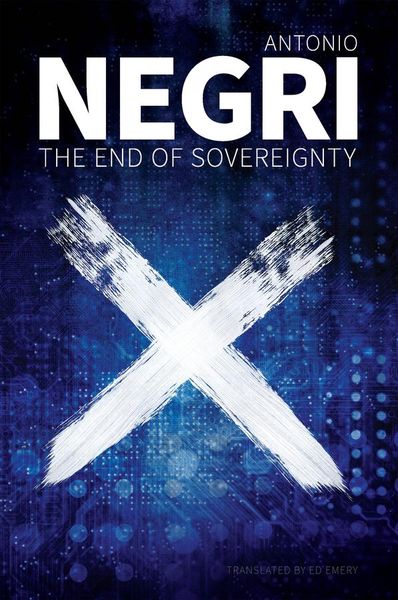
Produktbild: The End of Sovereignty

The End of Sovereignty

29,99 €

inkl. gesetzl. MwSt., zzgl. Versandkosten


  • Kostenlose Lieferung ab 30 € Einkaufswert
  • Versandkostenfrei für Bonuscard-Kund*innen

Beschreibung

This book brings together Antonio Negri's critical writings on the nature and form of the modern state. The central theme that runs through these writings is our need to be done with the sovereign state - that is, with the particular form of political power that the capitalist organization of bourgeois...

Beschreibung

This book brings together Antonio Negri's critical writings on the nature and form of the modern state. The central theme that runs through these writings is our need to be done with the sovereign state - that is, with the particular form of political power that the capitalist organization of bourgeois society has imposed upon us. Negri seeks to show how the sovereign bourgeois state built in the course of modernity has now become a weapon in the hands of a declining ruling class, a class sometimes exhausted in its institutional expressions and sometimes frenetic, zombie-like and parafascist. In arguing that the despotic power of the state should be abolished, Negri distances himself from some other left-wing thinkers who, erroneously in his view, have come to see the state as an unavoidable institution rather than as a place of power that, once conquered, should be transformed and ultimately dissolved, since it represents the central moment in the organization of force against living labour and free citizenship. In Negri's view, the call for the abolition of the state remains vital and active today, as a concrete utopia that is expressed in every thought and act of liberation. The articles brought together in this volume range from Negri's analysis of the first great transformation of the capitalist state in the twentieth century, a phenomenon precipitated by the triumph of Keynesianism, to his more recent work on how the form of sovereignty changed from being a figure of transcendent and local command to being a dispositif of immanent and global control. Like its companion volumes, this new collection of essays by Negri will be a valuable resource for anyone interested in radical politics and in the key social and political struggles of our time.

Produktdetails

Einband

Taschenbuch

Erscheinungsdatum

11.10.2022

Verlag John Wiley & Sons Inc
Seitenzahl

220

Produktdetails

Einband

Taschenbuch

Erscheinungsdatum

11.10.2022

Verlag John Wiley & Sons Inc
Seitenzahl

220

Maße (L/B/H)

23,5/15,2/1,6 cm

Gewicht

270 g

Auflage

1. Auflage

Übersetzt von

Ed Emery

Sprache

Englisch

ISBN

978-1-5095-4430-1

Herstelleradresse

Libri GmbH
Europaallee 1
36244 Bad Hersfeld
DE

Email: gpsr@libri.de

Noch keine Bewertungen vorhanden

Verfassen Sie die erste Bewertung zu diesem Artikel

Helfen Sie anderen Kundinnen und Kunden durch Ihre Meinung.

Kundinnen und Kunden meinen

Bewertungen (0)

Die Leseprobe wird geladen.
  • Produktbild: The End of Sovereignty
  • Introduction
     
    Part I - Once upon a time...
     
    1. John Maynard Keynes and the capitalist theory of the state
     
    2. Is there a Marxist doctrine of the state?
     
    Part II - Having done with sovereignty
     
    3. The end of sovereignty
     
    4. Text by Esposito
     
    5. Negri's reply to Esposito
     
    6. The state of the state
     
    7. On the concept of nation-state
     
    8. Hegemony: Gramsci, Togliatti, Laclau
     
    Part III. The extinction of the state
     
    9. On revolution
     
    10. Lenin: from theory to practice
     
    11. Who are the communists?
     
    12. Who's afraid of Virginia Woolf
     
    Notes