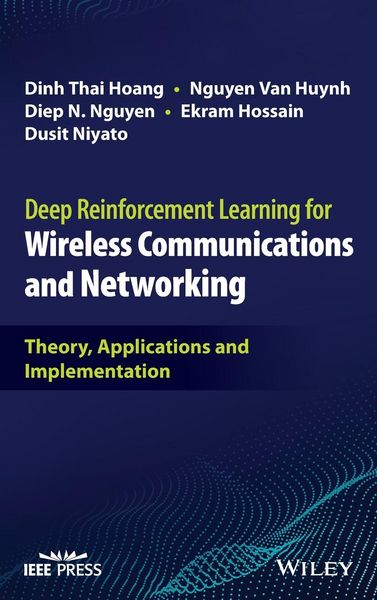
Deep Reinforcement Learning for Wireless Communications and Networking Theory, Applications and Implementation
-
- Englisch ausgewählt
152,99 €
inkl. gesetzl. MwSt.,
Beschreibung
Produktdetails
Einband
Gebundene Ausgabe
Erscheinungsdatum
25.07.2023
Verlag
John Wiley & Sons IncSeitenzahl
288
Maße (L/B/H)
23,5/15,7/2 cm
Gewicht
573 g
Auflage
1. Auflage
Sprache
Englisch
ISBN
978-1-119-87367-9
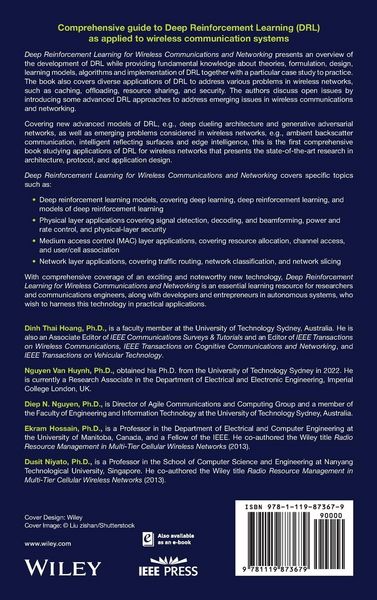
Comprehensive guide to Deep Reinforcement Learning (DRL) as applied to wireless communication systems
Deep Reinforcement Learning for Wireless Communications and Networking presents an overview of the development of DRL while providing fundamental knowledge about theories, formulation, design, learning models, algorithms and implementation of DRL together with a particular case study to practice. The book also covers diverse applications of DRL to address various problems in wireless networks, such as caching, offloading, resource sharing, and security. The authors discuss open issues by introducing some advanced DRL approaches to address emerging issues in wireless communications and networking.
Covering new advanced models of DRL, e.g., deep dueling architecture and generative adversarial networks, as well as emerging problems considered in wireless networks, e.g., ambient backscatter communication, intelligent reflecting surfaces and edge intelligence, this is the first comprehensive book studying applications of DRL for wireless networks that presents the state-of-the-art research in architecture, protocol, and application design.
Deep Reinforcement Learning for Wireless Communications and Networking covers specific topics such as:
* Deep reinforcement learning models, covering deep learning, deep reinforcement learning, and models of deep reinforcement learning
* Physical layer applications covering signal detection, decoding, and beamforming, power and rate control, and physical-layer security
* Medium access control (MAC) layer applications, covering resource allocation, channel access, and user/cell association
* Network layer applications, covering traffic routing, network classification, and network slicing
With comprehensive coverage of an exciting and noteworthy new technology, Deep Reinforcement Learning for Wireless Communications and Networking is an essential learning resource for researchers and communications engineers, along with developers and entrepreneurs in autonomous systems, who wish to harness this technology in practical applications.
Noch keine Bewertungen vorhanden
Verfassen Sie die erste Bewertung zu diesem Artikel
Helfen Sie anderen Kundinnen und Kunden durch Ihre Meinung.
Kurze Frage zu unserer Seite
Vielen Dank für Ihr Feedback
Wir nutzen Ihr Feedback, um unsere Produktseiten zu verbessern. Bitte haben Sie Verständnis, dass wir Ihnen keine Rückmeldung geben können. Falls Sie Kontakt mit uns aufnehmen möchten, können Sie sich aber gerne an unseren Kund*innenservice wenden.
zum Kundenservice