• Produktbild: Metal Oxide-Carbon Hybrid Materials
  • Produktbild: Metal Oxide-Carbon Hybrid Materials

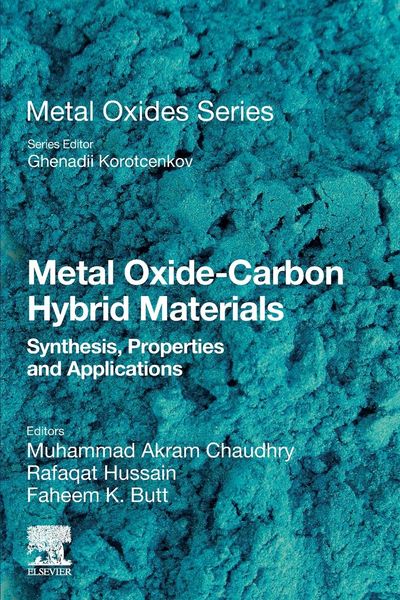
Metal Oxide-Carbon Hybrid Materials Synthesis, Properties and Applications

299,99 €

inkl. gesetzl. MwSt., Versandkostenfrei


Beschreibung

Produktdetails

Einband

Taschenbuch

Erscheinungsdatum

31.03.2022

Abbildungen

220 illustrations (40 in full color), Illustrationen, nicht spezifiziert

Herausgeber

Muhammad Akram Chaudhry + weitere

Verlag

Elsevier

Seitenzahl

588

Maße (L/B/H)

22,9/15,2/3 cm

Gewicht

930 g

Sprache

Englisch

ISBN

978-0-12-822694-0

Beschreibung

Portrait

Dr. Muhammad Akram Chaudhry currently serves as assistant professor of chemistry at the Government Associate College, Raiwind (Lahore, Pakistan). He holds his MSc (chemistry) from the Institute of Chemistry, University of the Punjab, Lahore (Pakistan). He taught at the University of Baluchistan, Quetta for 3 years and attended the University of the Punjab, where he completed his MPhil (chemistry). During his stay there, he worked on the spectrophotometric determination of fluoroquinolone drugs and developed a simple and cheap method for their determination. In 2011, he joined Universiti Teknologi Malaysia, Malaysia, to pursue research work in the field of nanosized ceramic materials and received his doctorate in 2014. His PhD dissertation was on the “Synthesis and Characterization of Ceramic Nanoparticles through Continuous Microwave Flow Synthesis Process.” His current research interest is focused on continuous microwave flow synthesis and the microwave-assisted synthesis of nanostructured materials, including biomaterials and photocatalytic materials. His work also involves probing the properties and applications of nanostructured material in various fields especially in biomedical and electrochemical devices. He is working collaboratively with various research groups and has published more than 35 research articles/book chapters as an author/coauthor in peer-reviewed international SCI-indexed journals with various publishers, such as Elsevier, Springer, IOP, and Wiley, with an h-index of 16 and ~1003 citations.

Prof. Rafaqat Hussain graduated with a BSc (Hons) in chemistry from the University College London, where he also received his MSc in chemistry and a PhD in biochemical engineering. To pursue a career in teaching, he obtained a postgraduate certificate in education (chemistry) from the Goldsmiths College, London. In 2007, he moved to Pakistan to lead an ambitious project to establish the Interdisciplinary Research Centre in Biomedical Materials (IRCBM) at the COMSATS University Islamabad (CUI), Lahore campus. After more than 3 years at the IRCBM, he took up a teaching position at the Department of Chemistry, Universiti Teknologi Malaysia (UTM), where he established a successful materials research group. After more than 5 years teaching and supervising numerous research students at UTM, he returned to CUI to establish the Department of Chemistry at the Islamabad campus. He is actively involved in publishing research articles in leading high-impact journals, an author of over 50 research articles (impact factor >150) and several book chapters, and a winner of many research grants in the field of materials science.

Dr. Faheem K. Butt currently works as an associate professor of physics in the Division of Science and Technology at the University of Education, Lahore. Before joining the University of Education, he was an Alexander von Humboldt Fellow at the Technical University of Munich, Germany. He completed his postdoctoral research fellowship from the Centre for Sustainable Nanomaterials, Universiti Teknologi Malaysia, in 2015. He completed his PhD studies at the Beijing Institute of Technology, China. His interests are in optoelectronics devices, energy storage/conversion in nanomaterials, and theoretical studies of materials using various software. He has published more than 120 research articles/book chapters as an author/coauthor in peer-reviewed international SCI journals with various publishers, including the American Chemical Society, Royal Society of Chemistry, Elsevier, Springer, American Scientific Publishers, and Taylor & Francis, with an h-index of 26 and ~3000 citations. He has also provided his services as a reviewer/editor/editorial board member for international publishers. Dr. Faheem has won several national/international awards. He is also a Higher Education Commission (HEC)-approved supervisor for PhD awardees of HEC scholarships, as well as general PhD scholars.

Produktdetails

Einband

Taschenbuch

Erscheinungsdatum

31.03.2022

Abbildungen

220 illustrations (40 in full color), Illustrationen, nicht spezifiziert

Herausgeber

Verlag

Elsevier

Seitenzahl

588

Maße (L/B/H)

22,9/15,2/3 cm

Gewicht

930 g

Sprache

Englisch

ISBN

978-0-12-822694-0

Herstelleradresse

Libri GmbH
Europaallee 1
36244 Bad Hersfeld
DE

Email: gpsr@libri.de

Kundinnen und Kunden meinen

0 Bewertungen

Informationen zu Bewertungen

Zur Abgabe einer Bewertung ist eine Anmeldung im Konto notwendig. Die Authentizität der Bewertungen wird von uns nicht überprüft. Wir behalten uns vor, Bewertungstexte, die unseren Richtlinien widersprechen, entsprechend zu kürzen oder zu löschen.

Die Bewertungen sind nach Format, Anzahl Sterne und Datum sortiert.

Verfassen Sie die erste Bewertung zu diesem Artikel

Helfen Sie anderen Kund*innen durch Ihre Meinung

Kundinnen und Kunden meinen

0 Bewertungen filtern

Die Leseprobe wird geladen.
  • Produktbild: Metal Oxide-Carbon Hybrid Materials
  • Produktbild: Metal Oxide-Carbon Hybrid Materials
  • Section One: Metal oxide-carbon hybrid materials: Synthesis and properties
    1. Physical and chemical aspects of metal oxideecarbon composites
    2. Metal oxideecarbon composite: synthesis and properties by using conventional enabling technologies
    3. Electrical conductivity of metal oxideecarbon composites
    4. Photoelectrochemical properties for metal oxideecarbon hybrid materials
    5. Functionalized multimetal oxideecarbon nanotube-based nanocomposites and their properties

    Section Two: Metal oxide-carbon composites in energy technologies
    6. Metal oxideecarbon composites for supercapacitor applications
    7. Hierarchical porous carbon-incorporated metal-based nanocomposites for secondary metal-ion batteries
    8. Metal oxideecarbon nanofibers based composites for supercapacitors and batteries
    9. Metal oxideecarbon composite electrode materials for rechargeable batteries
    10. Two-dimensional transition metal carbide (MXene) for enhanced energy storage
    11. Vanadium oxideecarbon composites and their energy storage applications

    Section Three: Metal oxide-carbon composites in biomedical, catalytic, and other applications
    12. Metal oxideecarbon composites and their applications in optoelectronics and electrochemical energy devices
    13. Graphene oxideemetal oxide composites, syntheses, and applications in water purification
    14. Biomedical applications of metal oxideecarbon composites
    15. Antimicrobial studies of metal oxide nanomaterials
    16. Metal oxideecarbon nanotube composites for photodegradation

    Section Four: Metal oxide-carbonebased sensors
    17. Potential carbon nanotubeemetal oxide hybrid nanostructures for gas-sensing applications
    18. Drug-detection performance of carbon nanotubes decorated with metal oxide nanoparticles
    19. Role of functionalized metal oxideecarbon nanocomposites in biomolecule detection
    20. Metal oxide/carbon nanotube hybrid nanomaterials as ultraviolet photodetectors