KI-Beratung Beta

Gutscheinbedingungen

**Gültig am 27.11.2026 auf Spielzeug, Schreibwaren, Filme, Geschenke & Trends, Musik, tolino eReader & Zubehör, Hörbücher und Hörbuch-Downloads, nicht preisgebundene Bücher und Kalender online auf thalia.at und in der Thalia App. Einzelne Artikel können ausgeschlossen sein. Aufgrund der Buchpreisbindung sind deutschsprachige Bücher und eBooks ausgenommen. Zusätzlich ausgenommen sind Abos & Flatrates, Games, Geschenkkarten/-boxen, Shelfies, Software, Zeitschriften sowie einzelne Artikel von tonies®. Pro Einkauf einmal einlösbar. Click & Collect nur bei Onlinevorabzahlung möglich. Keine Barauszahlung. Nicht kombinierbar mit anderen Aktionen und Gutscheinen. Gutschein wird auf max. 500€ Bestellwert angerechnet. Nicht gültig für Versandkosten und Services.

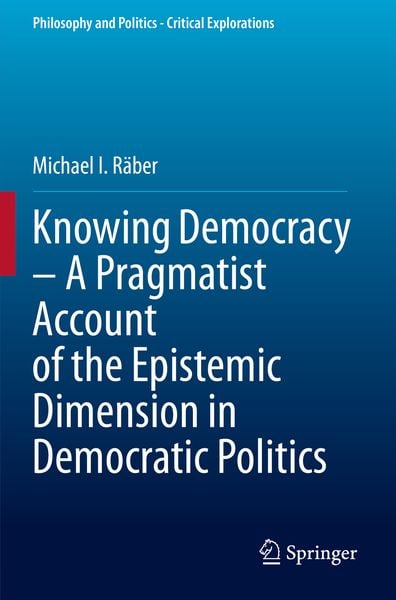
Produktbild: Knowing Democracy – A Pragmatist Account of the Epistemic Dimension in Democratic Politics
Band 14

Knowing Democracy – A Pragmatist Account of the Epistemic Dimension in Democratic Politics

51,99 €

inkl. gesetzl. MwSt., Versandkostenfrei


Beschreibung

How can we justify democracy’s trust in the political judgments of ordinary people? In  Knowing Democracy , Michael Räber situates this question between two dominant alternative paradigms of thinking about the reflective qualities of democratic life: on the one hand, recent epistemic theories of democracy,...

Beschreibung

How can we justify democracy’s trust in the political judgments of ordinary people? In 
Knowing Democracy
, Michael Räber situates this question between two dominant alternative paradigms of thinking about the reflective qualities of democratic life: on the one hand, recent epistemic theories of democracy, which are based on the assumption that political participation promotes truth, and, on the other hand, theories of political judgment that are indebted to Hannah Arendt’s aesthetic conception of political judgment. By foregrounding the concept of political judgment in democracies, the book shows that a democratic theory of political judgments based on John Dewey’s pragmatism can navigate the shortcomings of both these paradigms. While epistemic theories are overly and narrowly rationalistic and Arendtian theories are overly aesthetic, the neo-Deweyan conception of political judgment proposed in this book suggests a third path that combines the rationalist and the aesthetic elements of political conduct in a way that goes beyond a merely epistemic or a merely aesthetic conception of political judgment in democracy. The justification for democracy’s trust in ordinary people’s political judgments, Räber argues, resides in an egalitarian conception of democratic inquiry that blends the epistemic and the aesthetic aspects of the making of political judgments.


By offering a rigorous scholarly analysis of the epistemic and aesthetic foundations of democracy from a pragmatist perspective, 
Knowing Democracy
 contributes to the current debates in political epistemology and aesthetics and politics, both of which ask about the appropriate reflective and experiential circumstances of democratic politics. The book brings together for the first time debates on epistemic democracy, aesthetic judgment and those on pragmatist social epistemology, and establishes an original pragmatist conception of epistemic democracy.

Produktdetails

Einband

Taschenbuch

Erscheinungsdatum

08.10.2021

Abbildungen

XVII, 211 p. 2 illus.

Verlag Springer

Produktdetails

Einband

Taschenbuch

Erscheinungsdatum

08.10.2021

Abbildungen

XVII, 211 p. 2 illus.

Verlag Springer
Seitenzahl

211

Maße (L/B/H)

23,5/15,5/1,3 cm

Gewicht

353 g

Auflage

21001 Auflage 1st edition 2020

Sprache

Englisch

ISBN

978-3-030-53260-4

Herstelleradresse

Springer-Verlag GmbH
Europaplatz 3
69115 Heidelberg
DE

Email: ProductSafety@springernature.com

Noch keine Bewertungen vorhanden

Verfassen Sie die erste Bewertung zu diesem Artikel

Helfen Sie anderen Kundinnen und Kunden durch Ihre Meinung.

Kundinnen und Kunden meinen

Bewertungen (0)

  • Produktbild: Knowing Democracy – A Pragmatist Account of the Epistemic Dimension in Democratic Politics

  • Chapter 1. Introduction: How to Justify Democracy’s Trust in the Political Judgments of Ordinary People.- Part I: A Pragmatist Theory of Democratic Political Judgment.-  Chapter 2. Democracy, Epistemology and Deweyan Pragmatism.- Chapter 3. A Pragmatist Theory of Judgment.- Chapter 4. Political Judgments and Political Inquiry: Arendt and Dewey.- Chapter 5. Judgments, Juries and the Political Sphere.- Chapter 6. Dewey’s Epistemic Argument for Democracy Reconsidered.- Part II: Pragmatist Political Judgment and The Circumstances of Democratic Politics.- Chapter 7. The Epistemic Value of Diversity in Democratic Publics.- Chapter 8. Diversity, Democratic Systems and Epistemic Quality.- Chapter 9. Which Types of Knower Should Democracies Include and Why?.