KI-Beratung Beta

Gutscheinbedingungen

**Gültig bis 30.11.2026 auf Spielzeug, Schreibwaren, Filme, Geschenke & Trends, Musik, tolino eReader & Zubehör, Hörbücher und Hörbuch-Downloads, nicht preisgebundene Bücher und Kalender online auf thalia.at und in der Thalia App. Einzelne Artikel können ausgeschlossen sein. Aufgrund der Buchpreisbindung sind deutschsprachige Bücher und eBooks ausgenommen. Zusätzlich ausgenommen sind Abos & Flatrates, Games, Geschenkkarten/-boxen, Shelfies, Software, Zeitschriften sowie einzelne Artikel von tonies®. Pro Einkauf einmal einlösbar. Nur gültig mit im Onlineshop hinterlegter Bonuscard. Click & Collect nur bei Onlinevorabzahlung möglich. Keine Barauszahlung. Nicht kombinierbar mit anderen Aktionen und Gutscheinen. Gutschein wird auf max. 500€ Bestellwert angerechnet. Nicht gültig für Versandkosten und Services.

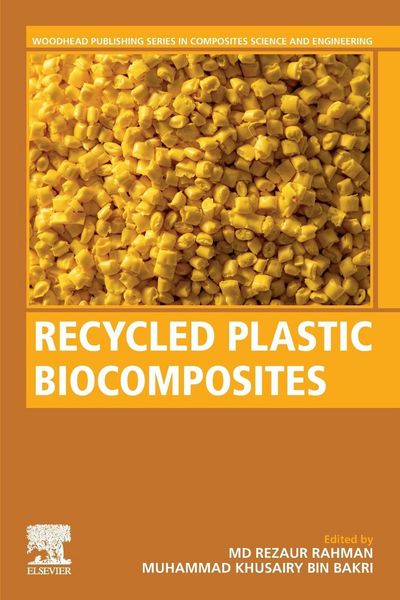
  • Produktbild: Recycled Plastic Biocomposites
  • Produktbild: Recycled Plastic Biocomposites

Recycled Plastic Biocomposites

194,99 €

inkl. gesetzl. MwSt., Versandkostenfrei


Beschreibung

Recycled plastic biocomposites have attracted widespread attention from both researchers and manufacturers due to the significant improvements in their physico-mechanical, thermal, rheological, and barrier properties when compared to conventional materials, as well as their potential regarding commercialization...

Beschreibung

Recycled plastic biocomposites have attracted widespread attention from both researchers and manufacturers due to the significant improvements in their physico-mechanical, thermal, rheological, and barrier properties when compared to conventional materials, as well as their potential regarding commercialization and zero waste. Recycled Plastic Biocomposites presents the latest information on recycled polymers, textiles, pulp and paper, wood plastic, rubber waste plastic, and micro and nano effects of recycled plastic waste resources that have great potential as reinforcement materials in composites because they are non-toxic, inexpensive, biodegradable, cost-effective, and available in large amounts. Recycled plastic biocomposites are now starting to be deployed in a broad range of materials applications due to their advantages over petroleum-based materials. Currently, there are no limits to the possibility of their applications. They also have exceptional sustainable and biodegradable properties when compared to conventional materials such as polymers and composites.

Recycled Plastic Biocomposites reviews the latest research advances on recycled plastic-based biocomposites, including thermoplastic, thermoset, rubber, and foams. In addition, the book covers critical assessments on the economics of recycled plastic, including a cost-performance analysis that discusses its strengths and weaknesses as a reinforcement material. The huge potential applications of recycled plastic in industry are also explored in detail with respect to low cost, recyclable and biodegradable properties, and the way they can be applied to the automotive, construction, and packaging industries. The life cycles of both single and hybrid recycled plastic-based polymer composites and biocomposites are also discussed in detail. From the viewpoint of recycled plastic-based polymer composites, the book covers not only the well-known role of recycled polymers and composites, but also advanced materials produced from micro-, nano-, and pico-scale fillers that achieve better physical, mechanical, morphological, and thermal properties.

This book will be an essential reference resource for academic and industrial researchers, materials scientists, and those working in polymer science and engineering, chemical engineering, manufacturing, and biocomposites.

Portrait

Dr. Md. Rezaur Rahman is an Associate Professor in Chemical Engineering and Energy Sustainability at Universiti Malaysia Sarawak (UNIMAS). He expertise in polymer engineering, advanced materials, membrane technology, nanocomposites, and sustainable environmental solutions. With a distinguished academic career spanning teaching, research, innovation, and leadership, Dr. Rahman has made significant contributions to the advancement of sustainable materials science and environmental engineering. He has an exceptional scholarly record, having authored over 350 peer-reviewed publications indexed in Scopus and Web of Science, along with 10 academic books, numerous book chapters, and conference proceedings. His work focuses on biodegradable polymers, polymer nanocomposites, membrane-based separation processes, waste valorization, and circular economy-driven materials, addressing pressing challenges in sustainability, energy efficiency, and environmental protection. His commitment to interdisciplinary research, translational innovation, and policy-relevant outcomes positions him as a key contributor to sustainable development goals and industry-academia collaboration.

Dr. Hj. Muhammad Khusairy Bin Capt. Hj. Bakri is a Postdoctoral Research Associate at Washington State University (WSU). He specializes in materials and mechanical engineering. He holds a BEng (2014), MEng (2016), and PhD (2018) from Swinburne University of Technology. His research focuses on developing composites making them durable by improving their interfacial interaction and stability of composites through advanced thermal and chemical treatments. His research also emphasizes bio-composites for sustainable and economically viable applications. He also has published over 279 scholarly works, including journal articles, book chapters, newspaper/bulletin, and conference proceedings, focusing on his expertise in wood composites, bio-composites, biomaterials, and wastewater treatment. Previously, Dr. Khusairy worked as a Research Fellow at Universiti Malaysia Sarawak (UNIMAS) from 2019-2021. During that time, he has collaborated with many researchers through international research projects across Malaysia and abroad. He is also certified as a Graduate Engineer and Professional Technologist under the Malaysian Board of Technologists (MBOT). He is a lifelong member of the Association of Professional Technicians and Technologists (APTT) located in Sarawak, Malaysia. Dr. Khusairy has received worldwide recognition, having been nominated and selected as a finalist for the Swinburne Alumni Impact Awards in 2022, and was included in Successful People in Malaysia 2023.

Produktdetails

Einband

Taschenbuch

Erscheinungsdatum

25.01.2022

Abbildungen

170 illustrations (20 in full color)

Herausgeber Md Rezaur Rahman + weitere

Produktdetails

Einband

Taschenbuch

Erscheinungsdatum

25.01.2022

Abbildungen

170 illustrations (20 in full color)

Herausgeber
Verlag Elsevier Science & Technology
Seitenzahl

332

Maße (L/B/H)

22,9/15,2/1,8 cm

Gewicht

447 g

Sprache

Englisch

ISBN

978-0-323-88653-6

EU-Ansprechpartner

Elsevier B.V.
Radarweg 29
1043 NX Amsterdam
NL
productsafety@elsevier.com

Herstelleradresse

Elsevier Science & Technology
London Wall 125
EC2Y 5AS London
GB
tradeorders@elsevier.com

Noch keine Bewertungen vorhanden

Verfassen Sie die erste Bewertung zu diesem Artikel

Helfen Sie anderen Kundinnen und Kunden durch Ihre Meinung.

Kundinnen und Kunden meinen

Bewertungen (0)

Die Leseprobe wird geladen.
  • Produktbild: Recycled Plastic Biocomposites
  • Produktbild: Recycled Plastic Biocomposites
  • 1. Introduction to recycled plastic biocomposites
    2. Food residue to reinforce recycled plastic biocomposites
    3. Development of pulp and paper waste-recycled plastic biocomposites
    4. Recycled polymer and plastic waste and its biocomposites
    5. Recycled plastic and textile waste biocomposites
    6. Recycled wood plastic biocomposites and development of new materials
    7. Recycled rubber waste plastic and its composites
    8. Role of agricultural waste in recycled plastic biocomposites
    9. Micro and nano effects of recycled plastic waste to reinforce and enhance biocomposites
    10. Recycled industrial plastics' fine waste incorporated into biocomposites
    11. Marine-based reinforcing materials for biocomposites
    12. Impact of recycled plastics biocomposites on the economy and socioenvironment
    13. Resources and energy recovery with recycled plastic biocomposites
    14. Education and awareness of waste and recycled plastic biocomposites