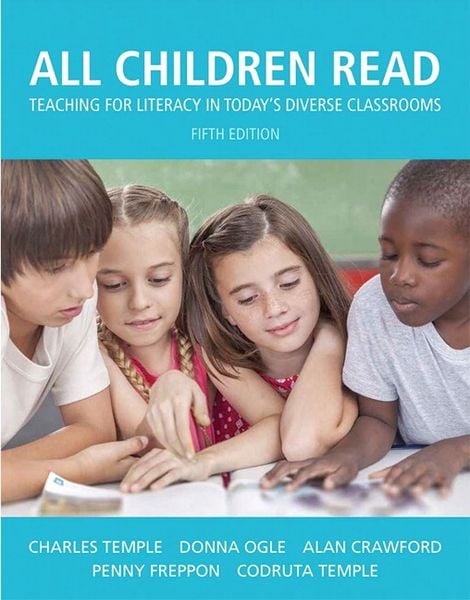
Produktbild: All Children Read: Teaching for Literacy in Today's Diverse Classrooms
- 14%

All Children Read: Teaching for Literacy in Today's Diverse Classrooms

14% sparen

102,99 € UVP 119,99 €

inkl. gesetzl. MwSt., Versandkostenfrei


Beschreibung

Produktdetails

Einband

Taschenbuch

Erscheinungsdatum

27.02.2018

Verlag

Pearson

Seitenzahl

480

Maße (L/B/H)

27,6/21,6/2,6 cm

Gewicht

862 g

Auflage

5

Sprache

Englisch

ISBN

978-0-13-489465-2

Beschreibung

Produktdetails

Einband

Taschenbuch

Erscheinungsdatum

27.02.2018

Verlag

Pearson

Seitenzahl

480

Maße (L/B/H)

27,6/21,6/2,6 cm

Gewicht

862 g

Auflage

5

Sprache

Englisch

ISBN

978-0-13-489465-2

Herstelleradresse

Pearson
St.-Martin-Straße 82
81541 München
DE

Email: salesde@pearson.com

Noch keine Bewertungen vorhanden

Verfassen Sie die erste Bewertung zu diesem Artikel

Helfen Sie anderen Kundinnen und Kunden durch Ihre Meinung.

Kundinnen und Kunden meinen

Bewertungen (0)

  • Produktbild: All Children Read: Teaching for Literacy in Today's Diverse Classrooms
  • Brief Table of Contents

    1. Approaches to Teaching Reading
    2. The Social and Cultural Contexts for Teaching All Children to Read
    3. What Reading Teachers Need to Know About Language
    4. Emergent Literacy
    5. Phonics and Word Knowledge
    6. Helping Readers Build Fluency
    7. The Importance of Vocabulary Development
    8. Reading Comprehension, Part I: Making Sense of Literature
    9. Reading Comprehension, Part II: Understanding and Learning with Informational Texts
    10. Critical Thinking and Critical Literacy
    11. Teaching Children to Spell and Write
    12. Assessing Literacy
    13. Integrating Language and Literacy Instruction Across the Grades
    14. Models and Strategies for Teaching ESL and for Teaching Reading in the Mother Tongue
    Appendix A: Addressing the Common Core Standards Appendix B: Teach It! Instructional Activities References Glossary Name Index Subject Index Detailed Table of Contents
    1. Approaches to Teaching Reading
      • Why Does Literacy Matter?
      • How Well Do Children in the United States Read?
      • Components of Reading Ability
      • Phases of Reading Development
      • The Recent History of Reading Instruction: How WeGot Where We Are
    2. The Social and Cultural Contexts for Teaching All Children to Read
      • The Social Contexts of Literacy
      • Planning for a Literate Classroom
      • Meeting the Literacy Needs of All Children
      • Response to Intervention (RTI)
      • Finding the Books and Materials TheyWant to Read
    3. What Reading Teachers Need to Know About Language
      • Phonology: The Sounds of English
      • Morphology: How English Words Are Built
      • Vocabulary: Words and Their Meanings
      • Syntax: Ordering and Inflecting Classes of Words
      • Text Structure
    4. Emergent Literacy
      • What Is Emergent Literacy?
      • Language-Based Learning and Emergent Literacy
      • Print-Based Learning and Emergent Literacy
      • Comprehensive Strategies to Nurture Emergent Literacy
      • Teaching Specific Skills
      • Environmental Strategies to Support
      • Emergent Literacy
      • Involving Families in Emergent Literacy
    5. Phonics and Word Knowledge
      • What Is Phonics? What Is Word Knowledge?
      • Words as Wholes: The Logographic Phase
      • Letter-by-Letter Reading: The Alphabetic Phase
      • Chunking: The Orthographic Phase
      • Meaningful Word Parts: The Morphological Phase
      • Word Histories and Families: The Derivational Phase
      • Helping Students Read Words in Context
    6. Helping Readers Build Fluency
      • Fluency in Reading
      • Modeling Fluent Oral Reading
      • Supporting Children’s Reading for Fluency
      • Practicing Fluency With and Without the Teacher’s Guidance
      • Embedding Repeated Reading in Performance
    7. The Importance of Vocabulary Development
      • What Is Vocabulary?
      • What Does the Research Say About Vocabulary?
      • Teaching Vocabulary
      • Teaching Strategies for Independent Word Learning
    8. Reading Comprehension, Part 1: Making Sense of Literature
      • How Students Understand Literature
      • Teaching for Comprehension: General Strategies
      • Teaching for Comprehension: Specific Skills
      • Close Reading
      • Assessing Comprehension
    9. Reading Comprehension, Part II: Understanding and Learning with Informational Texts
      • Characteristics of Informational Texts
      • Understanding How Readers Comprehend Informational Texts
      • Teaching Students to Use Features of Informational Texts
      • Teaching with Informational Texts
      • Classrooms That Develop Independent Learners
    10. Critical Thinking and Critical Literacy
      • Critical Thinking and Critical Literacy
      • Looking Critically at Works of Literature
      • Thinking Critically About Texts Other Than Stories
      • Teaching Strategies for Critical Thinking
    11. Teaching Children to Spell and Write
      • Spelling Development and Assessment
      • Teaching Children to Spell
      • A Writing Process in Five Parts
        Writing in Different Genres
      • Assessment of Writing
      • Writing to Learn
    12. Assessing Literacy
      • What Is Assessment and Why Do We Assess?
      • Approaches to Assessment
      • Terms Used in Testing
      • Assessing Emergent Readers
      • Assessing Beginning Readers and Beyond
      • Other Uses of Assessment
    13. Integrating Language and Literacy Instruction Across the Grades
      • Teaching Print Concepts and Phonological Awareness in Context
      • Teaching Phonics in Context
      • Teaching Morphology in Context
      • Teaching Grammar in Context
      • Teaching Text Structure
    14. Models and Strategies for Teaching ESL and for Teaching Reading in the Mother Tongue
      • Options for Teaching the English Language Learner
      • Major Principles of Second-Language Acquisition
      • Instructional Strategies for Second-Language Acquisition
      • Options for Teaching the English Language Learnerto Read
      • Mother Tongue Support in the Bilingual Classroom
    Appendix A: Addressing the Common Core Standards Appendix B: Teach It! Instructional Activities References Glossary Name Index Subject Index