Gutscheinbedingungen

**Gültig bis 25.08.2026 ab einem Mindestbestellwert von 30€ auf Spielzeug, Schreibwaren, Filme, Geschenke & Trends, Musik, tolino eReader & Zubehör, Hörbücher und Hörbuch-Downloads (außer Abo), nicht preisgebundene Bücher und Kalender online auf thalia.at und in der Thalia App. Einzelne Artikel können ausgeschlossen sein. Aufgrund der Buchpreisbindung sind deutschsprachige Bücher und eBooks ausgenommen. Zusätzlich ausgenommen sind preisgebundene Artikel, Abos & Flatrates, eBooks, Games, Geschenkkarten/-boxen, Shelfies, Software, Zeitschriften sowie einzelne Artikel von tonies®. Pro Einkauf einmal einlösbar. Click & Collect nur bei Onlinevorabzahlung möglich. Keine Barauszahlung. Nicht kombinierbar mit anderen Aktionen und Gutscheinen. Gutschein wird auf max. 500€ Bestellwert angerechnet. Nicht gültig für Versandkosten und Services. Preisgebundene Artikel sind vom Mindestbestellwert ausgeschlossen.

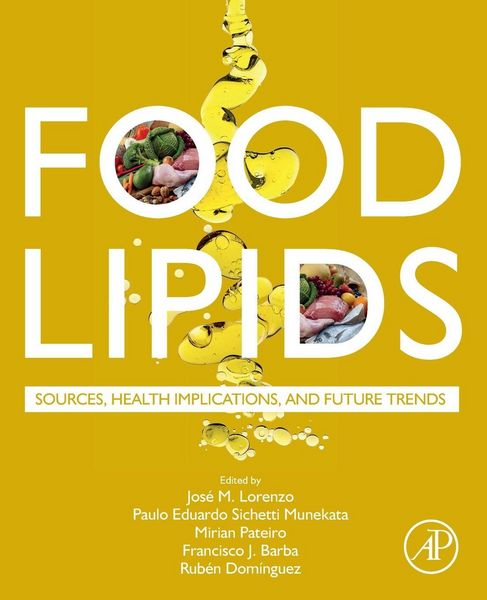
  • Produktbild: Food Lipids
  • Produktbild: Food Lipids
- 13%

Food Lipids Sources, Health Implications, and Future Trends

13% sparen

155,99 € UVP 180,00 €

inkl. gesetzl. MwSt., Versandkostenfrei


Beschreibung

Produktdetails

Einband

Taschenbuch

Erscheinungsdatum

01.03.2022

Herausgeber

Jose M. Lorenzo + weitere

Verlag

Elsevier Science & Technology

Seitenzahl

518

Maße (L/B/H)

23,5/19,1/2,6 cm

Gewicht

882 g

Sprache

Englisch

ISBN

978-0-12-823371-9

Beschreibung

Portrait

José Manuel Lorenzo is Head of Research at the Meat Technology Centre of Galicia, Ourense, Spain. His research focuses on development of new product, processes, and food packaging. He has more than 300 publications and more than 4000 citations. He is an associate editor of the Food Research International, Journal of the Science Food and Agriculture, Food Analytical Methods, and Canadian Journal of Animal Science. Currently, he is directly involved in the: 1) Animal production; 2) Study of natural compounds as food ingredients; 3) Understanding physicochemical, biochemical, sensorial, and microbial changes during the technological processes applied to meat products; and 4) Development of new and healthier meat food products.
Paulo Eduardo Sichetti Munekata is a postdoctoral researcher (Juan de la Cierva - formación scholarship) at the Meat Technology Centre of Galicia (CTC), Ourense, Spain. He has 53 publications and 573 citations. Currently, he is directly involved in projects aiming to: 1) Characterize natural compounds with antioxidant activity; 2) Develop healthier food products (particularly meat products) using natural compounds (specially antioxidants); 3) Study the effect of natural and active ingredients in the technological properties of food products.
Mirian Pateiro Moure is a researcher at the Centro Tecnológico de la Carne de Galicia, Ourense, Spain. Her scientific production includes 164 scientific articles in high impact peer-reviewed journals and 25 book chapters in the food science and biochemistry areas, as well as 89 scientific communications to national and international meetings, congresses, and symposia.

Francisco J. Barba, PhD, is working as a Professor in the Nutrition and Food Science area in the Department of Preventive Medicine and Public Health, Food Science, Toxicology and Forensic Medicine, Faculty of Pharmacy and Food Sciences, University of Valencia, Spain. Dr. Barba earned his PhD in Food Technology and master's degree in Dietetics and Dietotherapy from the University of Valencia. His areas of interest include edible and bioactive packaging, novel and emerging techniques in food and bio-engineering, thermal and non-thermal technologies, bioactive compounds, essential oils, spectroscopy and analytical techniques, phytochemistry of medicinal and aromatic plants, and sustainable processing. He has published more than 441 research papers and review articles, 12 books and 84 book chapters on different aspects of food and nutritional science and food packaging. Dr. Barba is a co-inventor of two patents and the editor-in-chief or editor of several reputed journals such as Food Research International, Innovative Food Science and Emerging Technologies, Journal of Food Composition and Analysis, Applied Food Research, among others.

Rubén Domínguez obtained his Ph.D. degree in Food Science and Technology in the University of Vigo (Spain) in 2012. He is a researcher at the Centro Tecnológico de la Carne de Galicia (CTC), Ourense, Spain. He is the author of 152 scientific articles in high impact peer-reviewed international journals, 27 book chapters, and more than 57 communications to congresses, mostly international. Moreover, he is an associate editor of the journals Antioxidants, Foods, Current Research in Food Science, Meat Technology, Ciência Rural and others. He has been collaborating in several research projects in Food Technology and Meat Science in the last eleven years with major focus on 1) Development of new healthier meat products; 2) Use of agro-food industries by-products as potential sources to obtain valuable and bioactive compounds; 3) Incorporation of bioactive compounds and development of functional foods; 4) Use of active packaging to protect foods against oxidative degradation; 5) Evaluation of carcass, meat and meat products quality from different species; 6) Application of chromatography and mass spectrometry techniques for food analysis.

Produktdetails

Einband

Taschenbuch

Erscheinungsdatum

01.03.2022

Herausgeber

Verlag

Elsevier Science & Technology

Seitenzahl

518

Maße (L/B/H)

23,5/19,1/2,6 cm

Gewicht

882 g

Sprache

Englisch

ISBN

978-0-12-823371-9

Herstelleradresse

Libri GmbH
Europaallee 1
36244 Bad Hersfeld
DE

Email: gpsr@libri.de

Noch keine Bewertungen vorhanden

Verfassen Sie die erste Bewertung zu diesem Artikel

Helfen Sie anderen Kundinnen und Kunden durch Ihre Meinung.

Kundinnen und Kunden meinen

Bewertungen (0)

Die Leseprobe wird geladen.
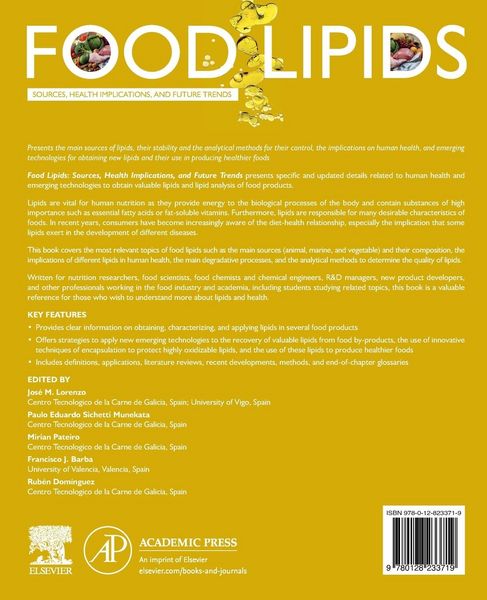
  • Produktbild: Food Lipids
  • Produktbild: Food Lipids
  • 1. Introduction and Classification of Lipids

    Part 1: Lipid Sources and Their Chemical Composition
    2. Animal source. Meat, subcutaneous fat, milk and dairy products
    3. Marine source. Fish, shellfish and algae
    4. Plant source. Vegetable oils

    Part 2: Oxidative Degradation
    5. Lipid oxidation of animal fat
    6. Lipid oxidation of marine oils
    7. Lipid oxidation of vegetable oils

    Part 3: Lipid Analysis in Food
    8. Fat and fatty acids
    9. Cholesterol and cholesterol oxidation products (COPs)
    10. Fat-soluble vitamins (A, E, D, and K)
    11. Lipid-derived oxidation products

    Part 4: Lipids in Human Health
    12. Fatty acids
    13. Importance of n-3 long chain and CLA
    14. Sterols and fat-soluble vitamins
    15. Dietary oxidized lipids

    Part 5: Future Trend
    16. Application of emerging technologies to obtain valuable lipids from food by-products
    17. Encapsulation techniques to increase lipid stability
    18. Replacement of saturated fat by healthy oils to improve nutritional quality of foods