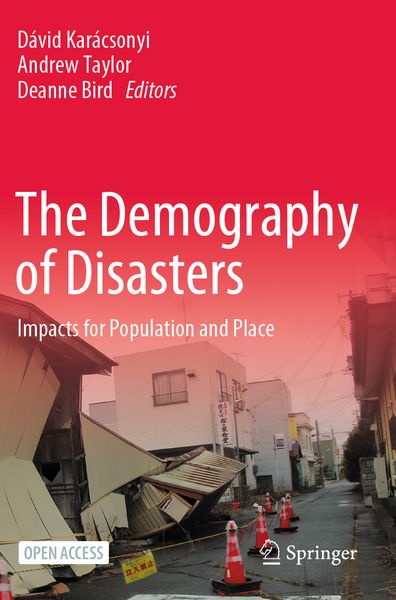
The Demography of Disasters Impacts for Population and Place
-
- Englisch ausgewählt
41,99 €
inkl. gesetzl. MwSt.,
Beschreibung
Produktdetails
Einband
Taschenbuch
Erscheinungsdatum
19.09.2021
Abbildungen
XVII, 268 p. 42 illus., 36 illus. in color.
Herausgeber
Dávid Karácsonyi + weitereVerlag
SpringerSeitenzahl
268
Maße (L/B/H)
23,5/15,5/1,5 cm
Gewicht
493 g
Auflage
1st ed. 2021
Sprache
Englisch
ISBN
978-3-030-49922-8
This open access book provides worldwide examples demonstrating the importance of the interplay between demography and disasters in regions and spatially. It marks an advance in practical and theoretical insights for understanding the role of demography in planning for and mitigating impacts from disasters in developed nations.
Both slow onset (like the of loss polar ice from climate change) and sudden disasters (such as cyclones and man-made disasters) have the capacity to fundamentally change the profiles of populations at local and regional levels. Impacts vary according to the type, rapidity and magnitude of the disaster, but also according to the pre-existing population profile and its relationships to the economy and society. In all cases, the key to understanding impacts and avoiding them in the future is to understand the relationships between disasters and population change.
In most chapters in this book we compare and contrast studies from at least twocases and summarize their practical and theoretical lessons.Noch keine Bewertungen vorhanden
Verfassen Sie die erste Bewertung zu diesem Artikel
Helfen Sie anderen Kundinnen und Kunden durch Ihre Meinung.
Kurze Frage zu unserer Seite
Vielen Dank für Ihr Feedback
Wir nutzen Ihr Feedback, um unsere Produktseiten zu verbessern. Bitte haben Sie Verständnis, dass wir Ihnen keine Rückmeldung geben können. Falls Sie Kontakt mit uns aufnehmen möchten, können Sie sich aber gerne an unseren Kund*innenservice wenden.
zum Kundenservice